

IS the Islamic State (IS), that brutal group of caliphniks whose recruits seem possessed of a philistine’s sense of where Islamic values and Arab culture intersect, about to get beheaded? I certainly hope so.
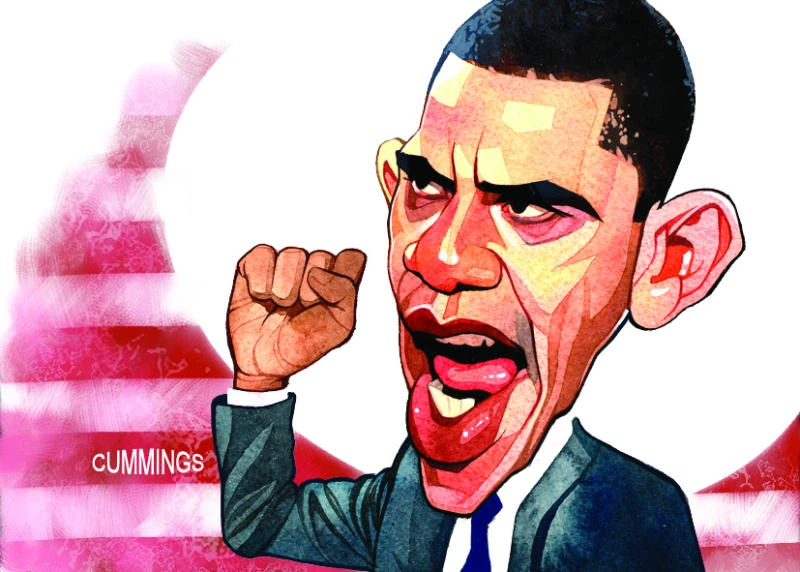
President Obama did not have to try hard in order to convince Americans to back a new, expanded campaign of airstrikes against IS in Iraq and Syria by giving a speech to the nation about the issue last Wednesday, three hours before the 13th anniversary of the 9/11 attacks. Americans appear to overwhelmingly view the terrorist group now rampaging in the Levant as a serious threat to US interests, and support for military action has widened dramatically in just the past few weeks, certainly since the gruesome beheading of two American journalists.
Polls indicate that 71 percent of all Americans support the new campaign, up from a mere 54 percent four weeks ago. Thus, when Obama delivered his speech in which he outlined his thinking about how the US would “start going on the offensive” against the IS, he did so against the backdrop of an increasingly hawkish national mood. Obama’s speech contained no surprises, centered as it was on how his administration would stand against “anyone who threatens America’s core interests.” Most of what he said in it he had already verbalized to the nation earlier in an interview aired last Sunday on “Meet the Press.”
Not soon enough. In its relentless inhumanity, the IS has wreaked enough havoc in the region, displaced enough minorities, made enough orphans and vulgarized enough Islamic tenets that its degradation, shrinkage and ultimate defeat would be a welcome relief to us all. We have all watched its brutalities on TV screens that, in addition to the beheading of those two innocent American journalists, the expulsion of the Yezidis from their ancestral homes, the mass execution of prisoners and the destruction of centuries-old houses of worship.
Obama’s remarks came a day after he conferred with a bipartisan group of congressional leaders at the White House about the administration’s planning. He does not need authorization to launch his military campaign, but he appears to want legislators to bear joint responsibility for its outcome.
So Washington means business. For Obama, a president known for his caution — some would call it skittishness — in foreign policy, especially in Syria over the last three years and more recently in handling Russia’s aggression in Ukraine, to start “going on the offensive” represents a significant shift away from his early posture about how “we have no strategy.”
To be sure, over the last several weeks, he authorized airstrikes against IS in Iraq. Now, however, Obama is going all out — albeit without sending boots on the ground, as he was quick to reassure Americans in his speech.
Truth be told, IS will not be a walk over. It is the most incredible phenomenon to emerge in the Arab world in the wake of the Arab Spring, given its transformation from its modest beginnings as the public face of a coalition of caliphniks, former Ba’athist military officers and various tribal leaders fighting US forces in Iraq to what Defense Secretary Chuck Hagel has called a “fighting force as sophisticated and well-funded as any group that we have seen ... beyond anything we have seen.”
Its recruits may be, as some commentators have averred, alienated individuals, lost souls window-shopping for an ideology to fill the existential vacuum in their lives. Yet there’s more to it than that. Steve Coll, the New Yorker senior contributing editor, put it best in his article in the magazine’s Talk of the Town last week, from which I will quote at length. “It is not yet clear that (IS) will endure as a menace,” he wrote. “Fast moving extremist conquerors sometimes have trouble holding their ground. (IS) has promised to govern as effectively as it intimidates, but its talent lies in extortion and ethnic cleansing, not in sanitation and job creation ... The group’s lightning rise is a symptom, however, of deeper instability. A cause of that instability is failed international policy in Iraq and Syria. If the United States is returning to war in the region, one might wish for a more considered vision than Whack-a Mole against jihadists.”
In effect, to defeat IS, sustained airstrikes will help. Equitable political solutions will help even more.


