


A tweet by Javier Blas, chief energy correspondent of Bloomberg News, brilliantly summed up last week in the oil markets: “After a week of talk (and dinners and cocktail parties) in London at the annual International Petroleum Week, oil prices are back exactly to where they started before Trump’s tweet on OPEC.”
This was indeed the case. Oil rose to $66.97 per barrel at the beginning of week 9, only to tumble and test a new low of $64.54 per barrel after President Trump tweeted: “Oil prices getting too high. OPEC, please relax and take it easy. The world cannot take a price hike — fragile!”
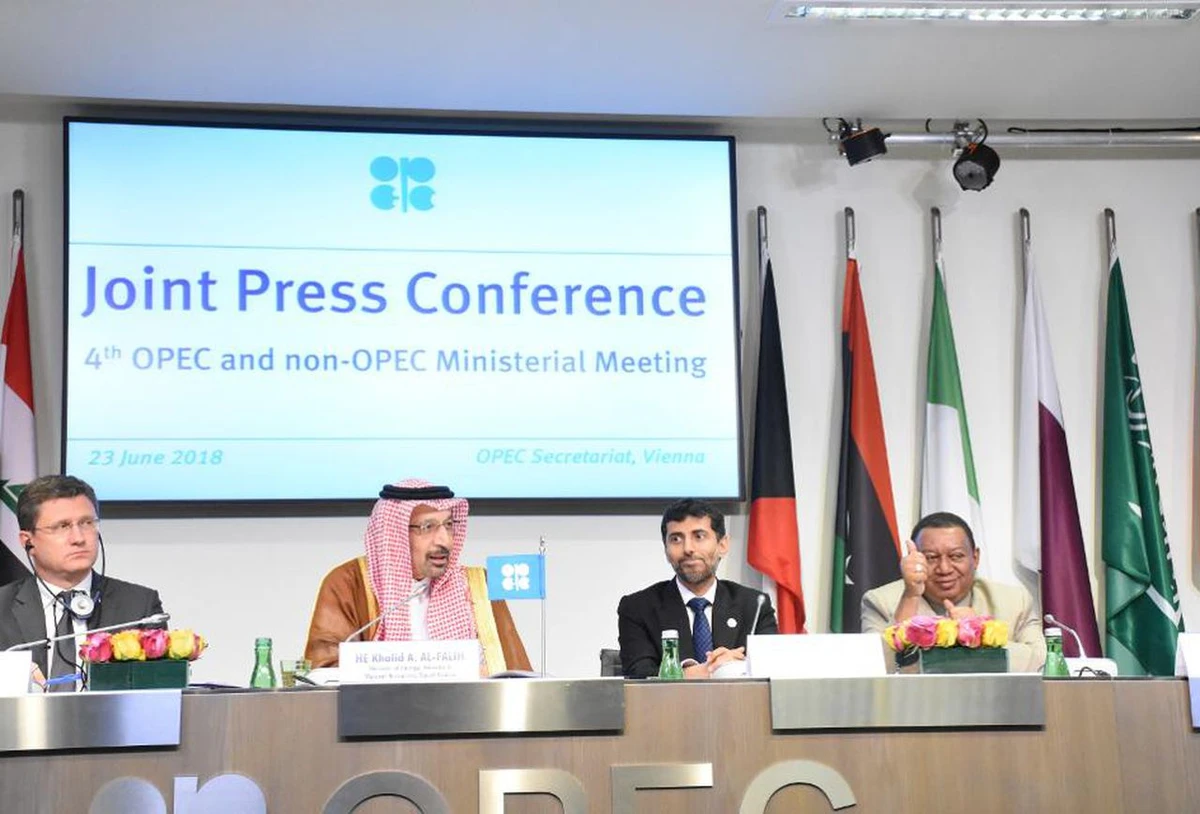
Saudi Energy Minister Khalid Al-Falih did not take this tweet lying down. At the margins of the IEA-IEF-OPEC Symposium on Energy Outlooks, he told CNBC: “The 25 countries (an alliance of OPEC and 10 friendly nations led by Russia and commonly referred to as OPEC+) are taking a very slow and measured approach. Just as the second half of last year proved, we are interested in market stability first and foremost.”
Al-Falih stressed that there were two options when it came to energy policy; one was to move hastily and make mistakes and the other was to move thoughtfully. The latter was the only way forward, as one should not forget that the world will have 9.5 billion energy consumers by 2050. The industry could only meet this demand with well-thought-through policies and adequate investments. Wise words indeed, which suggest that OPEC+ has every intention of moving thoughtfully.
The OPEC and OPEC+ meetings in April and June will determine whether the supply cut of 1.2 million bpd, which had been agreed last December, will be extended beyond June. According to the IEA, OPEC compliance has been stunning at 86 percent. There is headroom for the OPEC+ allies. The background noise and the smart money suggest that the cuts will be rolled over. It will, however, all depend on the supply-demand balance at the time.
OPEC+ has done its best to keep markets adequately supplied.
Cornelia Meyer
At International Petroleum Week, most consultants saw demand growth for 2019 at between 1-1.3 million bpd. According to their monthly oil market analysis, the IEA and OPEC forecast demand growth for 2019 at 1.4 million and 1.24 million bpd respectively. Demand will be driven by global economic growth, which still stands at 3.5 percent for 2019 despite several downgrades by the IMF. The outcome of the US-China trade discussions will be crucial too. The mood music from both Washington and Beijing is positive. A resolution of the conflict would definitely constitute an upward pressure on the oil price, because it would be good news for supply chains and trading of finished goods. Discussions between the EU and the US still loom and a failure to reach an amicable outcome would have bad consequences for the automotive sector, which in turn would result in a downward pressure on oil prices.
On the supply side, a lot will depend on how the situation in Venezuela evolves. Some analysts say that production might fall even further if the domestic situation does not improve and US sanctions prevail. OPEC reported that Venezuela produced 1.1 million bpd in January according to secondary sources. Around April the US administration will decide how many of the waivers to the Iran sanctions will be rolled over, which again will have an impact on the supply situation. Then there are Nigeria and Libya, which are always wild cards.
What is often overlooked is that quality matters when looking at supply. It is true that the US has become the largest producer of petroleum courtesy of the shale oil revolution. The issue there is that shale oil is light. Most refiners are not equipped to accommodate much more light crude and the heavy Venezuelan and Iranian crudes are missed to make up the right mix of feedstock.
All in all, oil markets are in a relatively balanced, good place. OPEC+ has done its best to keep markets adequately supplied. Over the past month or so oil traded relatively flat in the mid-sixties.
A more or less predictable range is precisely what consumers and producers need. The former need to be able to forecast and hedge their costs and the latter need the ability to invest the trillions of dollars needed to substitute for declining fields. OPEC+ plays a vital role in working toward the aim of achieving more predictable trading ranges.
- Cornelia Meyer is a business consultant, macro-economist and energy expert. Twitter: @MeyerResources


