

When the Iraqi city of Ramadi fell to Daesh last May, the White House called it a “setback.” The administration’s many critics called it a disaster, and proof that President Obama’s strategy to defeat the militants was failing.
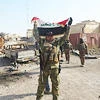
Fast-forward seven months, and Iraqi security forces, backed by coalition air power, recaptured Ramadi this week. But even the administration itself has hesitated to call the victory a vindication, or claim it as evidence that the militants are close to the destruction Obama has promised. Previous significant battles had been won largely by Kurdish forces, known as peshmerga, assisted by US airstrikes, in the northern city of Sinjar in November. This time, although US-trained Sunni fighters are now moving into Ramadi to stabilize the area, the Iraqi Army was largely alone on the ground.
Although the Ramadi victory has engendered at least modest optimism, there are far tougher battles ahead, including a much-delayed offensive to retake Mosul. That densely populated urban center in the north, with triple the population of Ramadi, has served as Daesh’s center of operations in Iraq since the militants overran it 18 months ago. Daesh fighters numbered in the hundreds in Ramadi; there are thousands in Mosul. Reinforcements are expected from neighboring Syria, where efforts to dislodge Daesh have been hampered by an ongoing civil war. More immediately, the Iraqi Army is likely to turn its attention to Fallujah, just past the western outskirts of Baghdad, which Daesh has held for more than two years.
The US military attributes success in Ramadi to intensive Iraqi Army training by US coalition partners over the past year, the kind of slow but steady strategy that the administration says will ultimately prevail over the militants. Skeptics note that the US spent tens of billions of dollars rebuilding, training and equipping Iraqi security forces whose dismantlement it ordered following the 2003 invasion, to apparently little long-term effect. When Daesh forces burst into Ramadi last spring, it was with simultaneous explosions of massive truck bombs that terrified and intimidated the army and sent it running. US forces saw intelligence improvements, and pilots also learned how to better deal with the militants, their tactics and weapons, and to coordinate with the forces on the ground.
Many critics also attribute the army’s collapse last year to what Senate Armed Services Committee Chairman Sen. John McCain, R-Ariz., has called the “vacuum” created when Obama pulled out US forces in 2011. The administration disputes the reasons for the withdrawal, and the ongoing influence the American military might have had. But officials agreed that the withdrawal allowed Shiite Prime Minister Nouri Al-Maliki, who valued sectarian dominance above competence, to complete his own gutting of the army’s Sunni commanders, some of whom joined Daesh. Unity among Iraq’s various military forces will be crucial for future offensives.
In Mosul, both the peshmerga and the Iraqi army — which are barely on speaking terms and fight separately — are expected to participate. Tribal fighters now moving into Ramadi are a separate force from the army, but they will be crucial in operations to clear and hold the Sunni heartland of Al-Anbar province.
The current prime minister, Haider Al-Abadi, also a Shiite, has given much lip service to inclusion but has made little headway in changing Iraq's sectarian equation. “All these things have to move in harmony. You can’t simply focus on the military and ignore political factors,” said a senior administration official, who spoke on the condition of anonymity to discuss internal assessments.
“Our diplomats are working day in and day out” on Iraqi political reconciliation, the official said, “but in some ways it is even more difficult. These are existential questions that the Iraqis are asking themselves.” “If there’s a lesson from the last year or so, it’s that if they’re not united, if they can’t overcome their political differences,” then whatever success they have against Daesh will be lost to the next extremist group taking advantage of their divisions, the official said.
—
THE ASSOCIATED PRESS


