


The road from El-Obeid to En Nahud is an unremarkable ribbon of asphalt across the Kordofan where the Nile Valley gives way to the approaches of Darfur. Over the first two weeks of November, that road became a key stretch of territory in Sudan. Sudanese Armed Forces units and their allied joint force of former Darfur rebel movements seized more than 30 villages and towns across North and West Kordofan, placing them within short distance of En Nahud, West Kordofan’s second city and the Rapid Support Forces’ most important remaining stronghold between the Nile and the western heartland.
One military spokesman declared En Nahud fully encircled, and the RSF’s response has been telling in its desperation — reinforcements rushed in, and detainees transferred out of the city’s prison to Nyala, the paramilitary group’s administrative capital in South Darfur.
En Nahud now matters for three interconnected reasons.
First, its capture would sever the last ground line of communication between the RSF’s Kordofan holdings and Darfur. Second, it would strip the RSF of a gold-mining and gum Arabic hub that has helped finance its war effort, including a trading center from which the UN documented the looting of at least 3,700 tonnes of gum Arabic in 2024. And, third, it would also complete the alienation of the Hamar Arab tribe, whose paramount chief’s headquarters the RSF looted on capturing the city in May last year, driving senior Hamar-linked commanders back to the SAF.
In short, RSF’s compression into a Darfur fortification is now underway, and this war of fluid fronts is becoming a siege with a definable core. More importantly, sieges, unlike insurgencies, can be negotiated.
Going back, SAF’s westward advance began in July with an offensive along the Exports Road linking Khartoum to El-Obeid that broke the RSF siege of North Kordofan’s capital and consolidated SAF control over the central Nile Valley. From there, the SAF turned west, taking Iyal Bakhit; then Umm Sumayma on the road into resource-rich West Kordofan; then Al-Khuwai, a town that sits near major roads connecting central Sudan toward En Nahud and the Darfur region. By mid-November, the SAF and its allies had effectively outpaced the RSF’s ability to reconstitute defensive lines, owing to the latter’s unsustainable battlefield losses and a wave of commander defections that weakened its internal structure.
The string of high-profile defections from the RSF has quietly transformed a tactical setback into a major unraveling.
Hafed Al-Ghwell
This string of high-profile defections quietly transformed a tactical setback into a major unraveling. Since August, the RSF has lost a former governor of Kordofan, Brig. Hamad Osman Mohamed, and Ahmed Hasab Al-Rasoul, commander of the RSF’s First Group in Saraf Omra, North Darfur, accusing the leadership of favoritism and tribal discrimination. Earlier, Maj. Gen. Al-Nour Ahmed Adam left with dozens of combat vehicles and a large contingent of fighters.
Contrary to conventional thinking, RSF functions less as a unitary army than as a franchise of local commanders who control their own men, vehicles, and terrain knowledge. When a commander defects, he takes combat power with him. Thus, SAF’s most effective strategy of breaking the RSF from the inside is by fomenting tribal divisions and incentivizing defections. The loss of En Nahud would demonstrate that the RSF cannot protect the commanders who remain loyal.
Beyond the escalating military pressure, the Kordofan region produces sesame, groundnuts, hibiscus, and gum Arabic, and includes the Heglig and Balila oilfields, which together account for roughly 90 percent of Sudan’s oil production. En Nahud itself sits at the center of the gum Arabic trade and close to gold-mining areas that have helped sustain the RSF’s war economy. Retaking the city would remove a critical node from that revenue network at a moment when the RSF needs liquidity to pay fighters, ensure commander loyalties, and sustain its parallel administration in Nyala.
Moreover, the social terrain is equally unfavorable to the RSF. Its alliances with Kordofan tribal groups have been arrangements of military and political convenience rather than expressions of deep social integration. The RSF’s core support lies among Arab communities in southern and eastern Darfur, around Nyala and El-Daein, and along the Chadian and Libyan borders. Kordofan has never been that kind of stronghold. That is precisely why analysts expect the RSF to withdraw from Kordofan and reposition its forces in Darfur, a shift that would make Darfur the war’s new center sooner than many observers expect.
A Darfur-centered war is a more negotiable war than a multifront insurgency. Volker Perthes, the former UN special representative for Sudan, has argued that as the battlefield stabilizes and both sides recognize the prohibitive cost of further territorial gains, the front lines could gradually freeze, opening a window for a ceasefire and a political settlement.
However, that possibility cuts both ways.
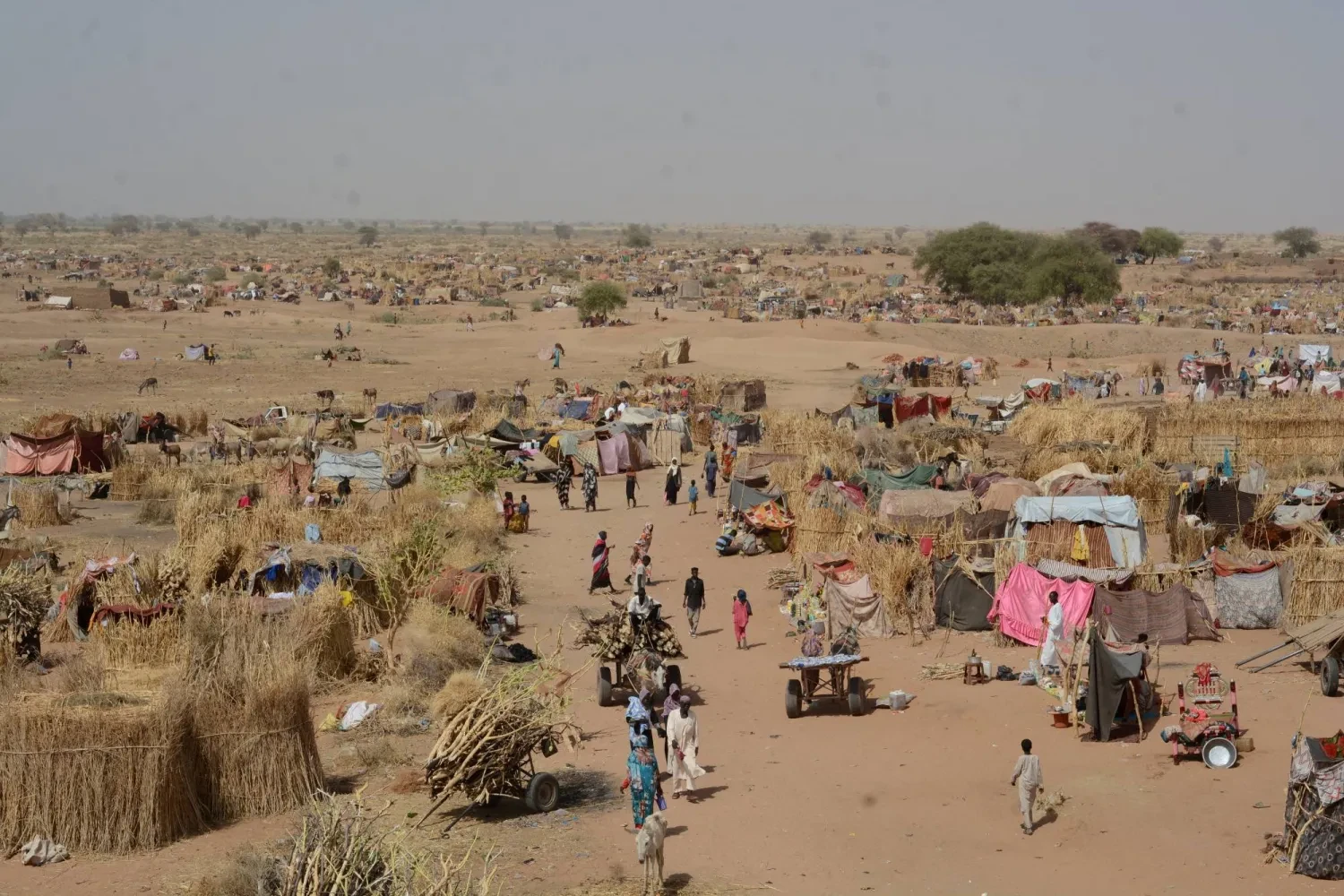
While compactness makes the RSF a more coherent negotiating partner, it also makes the war’s humanitarian consequences more concentrated. Airstrikes have already displaced more than 2,500 people from Abu Galib and Abu Zabad in a single week, and the UN has warned that Kordofan remains the center of the conflict. Civilians are fleeing toward, not away, from Darfur, providing the RSF with a population base it needs to sustain a long occupation.
Additionally, the endgame will not arrive with a single battle. A military victory that leaves hundreds of armed groups and militias in place will not produce a stable peace, and the SAF’s coalition of Juba Peace Agreement factions has its own autonomy concerns that will surface once the common enemy is pushed back.
Nonetheless, the capture of En Nahud would demonstrate that the SAF can translate air superiority and defection-driven attrition into territorial control. It would also force the RSF to choose between bleeding for a region that is not its home and consolidating in one that is, while also giving international mediators a clearer map to work with in order to finally put an end to this devastating war.
Hafed Al-Ghwell is senior fellow and program director at the Stimson Center in Washington and senior fellow at the Center for Conflict and Humanitarian Studies.
X: @HafedAlGhwell


