

The ill-conceived idea to annex parts of the West Bank, as promoted by Israeli Prime Minister Benjamin Netanyahu’s school of disruption, has recently suffered quite a few setbacks and its timetable has been delayed. However, the Israeli government most definitely never intended its plan to be the catalyst for a thawing of relations between Fatah and Hamas, the two rival Palestinian factions.
Since Hamas took over Gaza in 2007 and expelled Fatah from the Strip, the two have become sworn enemies and have failed at every reconciliation attempt. For the most part, this has served the interests of the Israeli right, which has been in power almost continuously since that time, as one of its pretexts for not negotiating peace with the Palestinians and especially for making none of the concessions required to make progress on a fair, just and lasting peace. Notwithstanding the intransigence of both the Fatah and Hamas leaderships to put aside their differences for the sake of desperately needed unity, Israel has threatened to take punitive measures against the Palestinian Authority (PA) should there be a Fatah-Hamas agreement to again govern together the West Bank and Gaza Strip. Conveniently, Israel has portrayed any move in such a direction as a shift of Palestinian positions toward Islamism, and not as a process that might see Hamas becoming increasingly pragmatic and institutionalized.
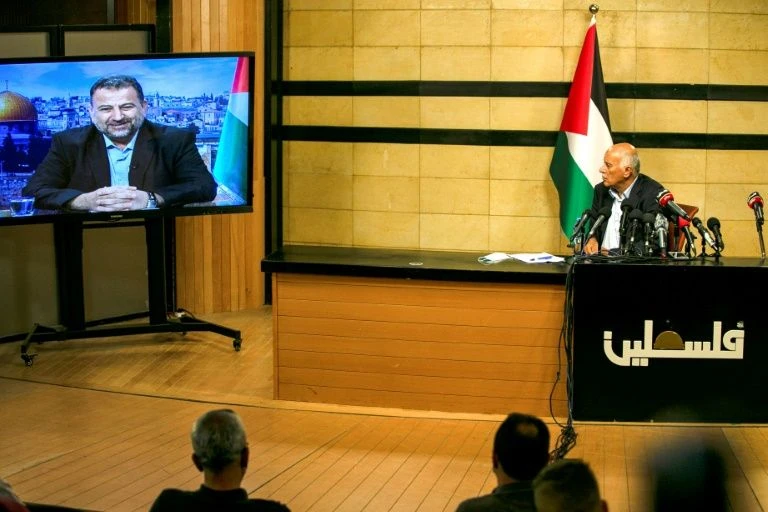
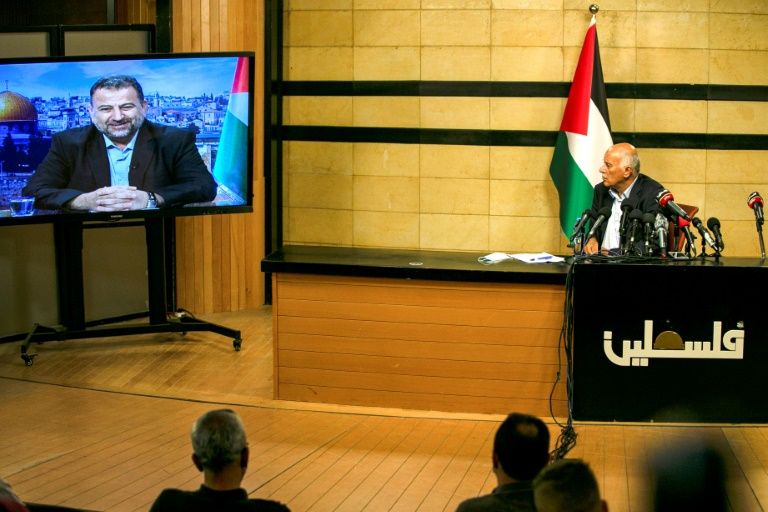
It is not only Israel’s fault that, for more than 13 years, the Palestinians have been divided ideologically and politically, even if it proactively encouraged this and was the main beneficiary, at least in the eyes of those whose intention it is to hold the Occupied Territories in perpetuity. However, it is the threat posed by the newly formed Israeli government to annex up to 30 percent of the West Bank, including the Jordan Valley, that has served as a wake-up call for these two sworn enemies. Senior figures on both sides, even if for now in their “private” capacity, have called for unity in the face of the illegal act of taking the occupation one step further with the blessing of Washington. If annexation takes place unchallenged, it might extinguish the last flicker of hope for a two-state solution, and with it the formation of an independent Palestinian state. In a joint press conference this month, Fatah Secretary-General Jibril Rajoub and Hamas’ deputy chief Saleh Al-Arouri announced that their respective organizations would “unify their efforts” and collaborate “on the ground” to confront the threat of Israeli’s annexation plan.
Over the years, reconciliation attempts between Fatah and Hamas have been hard to come by. A joint document produced back in May 2006 by Palestinian political prisoners in Israeli jails — representing, among others, the Fatah and Hamas movements — demonstrated both their ability to work together and the need for unity in order to fulfill the dream of Palestinian self-determination within the pre-1967 borders through reaching an agreement with Israel. Admittedly, since this letter was handed to the leaders of both movements, relations have deteriorated, leaving a deep and in many cases justifiable suspicion of each one’s intentions toward the other. And, although it is recognized that without a national reconciliation the Palestinian cause is less credible and therefore considerably weakened, and that it plays into the hands of Israel and dismays their supporters in the international community, the two movements haven’t been able to overcome their mutual suspicion or political and ideological differences.
There is also, of course, the issue of not holding elections for the presidency or the legislature since 2006, which severely dents the popular legitimacy of both movements. According to a recent opinion poll conducted by the Palestinian Center for Policy and Survey Research, two-thirds of the Palestinian public have accepted that Israel will annex the Jordan Valley and settlement areas in the West Bank. A majority is also in favor of abandoning the Oslo Accords and severing relations with Israel, including those involving security and civil cooperation. More worrying is that the majority of respondents see a bleak future in the post-annexation era, in which salary payments to the public sector are under threat, as are access to medical treatment and shortage-free water and electricity supplies. They also fear a deteriorating security situation, with armed clashes, chaos and anarchy that might lead to the collapse of the PA.
This is a time of great political uncertainty, not to mention economic instability, and of confronting the coronavirus pandemic in both the West Bank and Gaza. Hence, it is imperative that the different Palestinian factions relearn how to work together and concentrate on addressing the various threats they face, including annexation and its consequences. Since the split between the West Bank and Gaza and the establishment of the two separate and rival political entities, Fatah and Hamas have engaged with Israel and the outside world separately, establishing different channels and forms of communication. While this has occasionally served their interests and kept them in power, it has rarely served those of the Palestinian people as a whole, whether they live under occupation, under siege in Gaza or in exile, and it categorically has not served the long-term aspiration of self-determination free of occupation and a resolution to the refugees’ predicament.
The Israeli threat to annex up to 30 percent of the West Bank has served as a wake-up call for these two sworn enemies.
Yossi Mekelberg
Time will tell whether the annexation threat has been a strong enough incentive for Palestinian society to unite in the face of Israel’s attempt to dictate the borders that separate the two communities. By doing so, in complete disregard of Palestinian interests, Israel will perpetuate the separation between Gaza and the West Bank, as well as the political and social disunity that will allow it to control the entire West Bank and plan further annexations. In the short term, there is also the danger that, in the annexed territory, tens of thousands of Palestinians will be deprived of the same rights the Jewish population enjoys and end up in an apartheid-like condition, with few or no rights at all. What could be a more powerful incentive for the Palestinian political system to unite?
- Yossi Mekelberg is professor of international relations at Regent’s University London, where he is head of the International Relations and Social Sciences Program. He is also an associate fellow of the MENA Program at Chatham House. He is a regular contributor to the international written and electronic media. Twitter: @YMekelberg


