
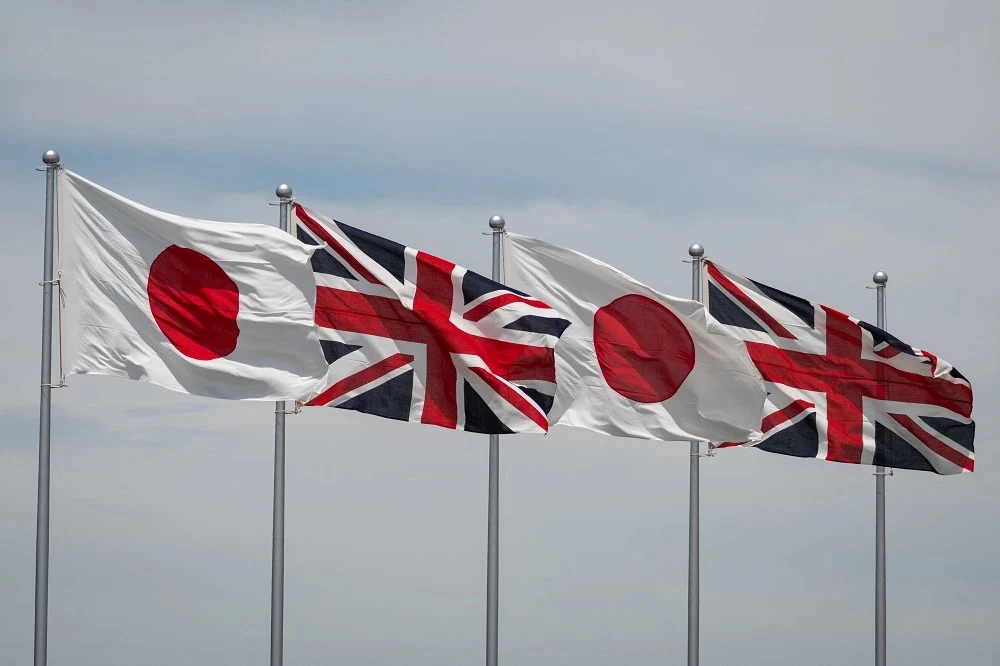

The UK and Japan, two of the world’s most important island nations, have a history of bilateral relations that dates back hundreds of years. While ties have waxed and waned during this long period, there may now be a big opportunity for greater collaboration in Africa and other key emerging markets.
In an increasingly multipolar world of growing geopolitical risks, it is widely recognized in Tokyo and London that they have significant opportunities for cooperation, given their shared goals and interests, including defense and trade.
On the defense front, the two nations in 2023 signed the Reciprocal Access Agreement, which has been billed as the most important security treaty between the two powers since 1902. It allows the UK and Japan to deploy forces in one another’s countries, enabling both militaries to plan and deliver larger-scale, more complex exercises and deployments.
On the trade liberalization agenda, meanwhile, Tokyo and London are helping lead through initiatives like the Comprehensive and Progressive Agreement for Trans-Pacific Partnership. This builds from bilateral platforms such as the 2020 UK-Japan Comprehensive Economic Partnership Agreement.
In the second half of 2026, the growing UK-Japan investment partnership footprint has emerged as a third area of focus. Both parties have pledged to strengthen their investment partnerships, as outlined in the joint statement of the Japan-UK foreign ministers’ strategic dialogue 2026, which includes advancement of so-called third country cooperation.
In the second half of 2026, the growing UK-Japan investment partnership footprint has emerged as a third area of focus
Andrew Hammond
Over the summer, Prime Minister Sanae Takaichi’s trip to London built momentum on this agenda. One of the key announcements during her trip was a new investment memorandum of cooperation for Africa and emerging Asia. This aims to spur UK-Japanese investment into developing African and Asian economies. Signatories include development finance institutions, British International Investment and the Japan International Cooperation Agency. The latter two already have a co-investment and co-financing footprint across emerging markets in Africa and beyond.
This development coincided with significant changes to Tokyo’s wider emerging market policy, including a shift from a focus on development aid toward securing the country’s strategic commercial interests such as energy and critical minerals.
Whereas today’s investment strategy focus for Tokyo and London is Africa and other emerging markets, the history of the bilateral investment partnership goes back far beyond this. A generation ago, in the 1980s and 1990s, for instance, the UK became a key destination for Japanese investment into Europe.
This was spurred by major developments such as the creation of the European single market in 1992. This facilitated a unified economic area allowing the free movement of goods, services, capital and people across EU member states, plus associated countries such as Norway.
The UK is in a strong position to support Japan, along with other Asian and African partners, in mobilizing private finance
Andrew Hammond
A significant number of Japanese firms made high-profile investments across the UK in this era, often designed as a gateway into the continental European market. This strategy is widely seen to have worked well for Tokyo, at least until Brexit, with an estimated 1,000-plus Japanese firms currently having a UK base.
The contemporary bilateral investment agenda, which sees the UK as an investment launchpad for Japan’s interests in Africa and beyond, is likely to secure support from new UK Prime Minister Andy Burnham. He is keen to restart UK growth and one of his former economic advisers, Jim O’Neill, who coined the term “BRIC” in 2001, is encouraging a focus away from industrialized countries to emerging markets.
There is much logic for Tokyo and London to work together to push this forward, building from the extensive collaboration already present at the government-to-government and business-to-business levels in the UK. While Africa and Asia are much further geographically from the UK than continental Europe, many London-based organizations have large networks in parts of both regions, sometimes dating back to the British Empire, whereas Japan has historically had less of a footprint in these regions. This is buttressed by London’s post-Brexit global ambitions, including through participation in trade deals like the Comprehensive and Progressive Agreement for Trans-Pacific Partnership, alongside Tokyo.
The UK is also in a strong position to support Japan, along with other Asian and African partners, in mobilizing private finance. This is not only via leading international development finance institutions but also expertise and innovation from the City of London and wider UK corporate and government entities. UK Export Finance, for instance, works with more than 100 private credit insurers and lenders to help companies access export finance. It has jointly supported projects with Japanese banks, including the Yaounde-Nsimalen motorway in Cameroon.
This collectively amounts to a potentially exciting agenda for London and Tokyo to cultivate in the years ahead. At a time of financial uncertainty and geopolitical turbulence, now is the right time for the two powers to double down on their economic collaboration in Africa and beyond.
Andrew Hammond is an associate at LSE IDEAS at the London School of Economics.


