
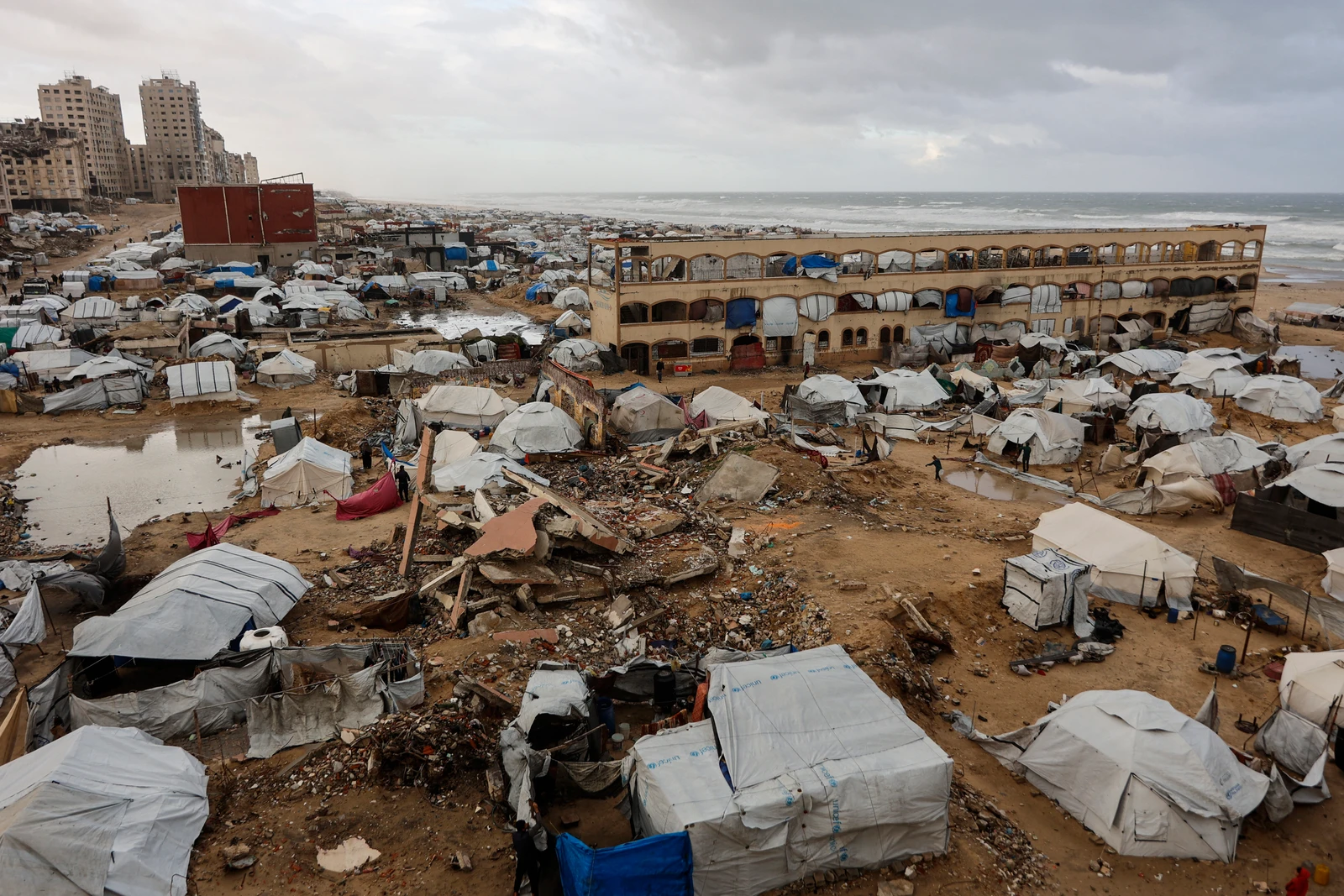

The arrival of winter in Gaza has exposed a humanitarian reality that the ceasefire has failed to change: hundreds of thousands of displaced Palestinians remain trapped in conditions that threaten their lives, with hunger, disease, contaminated water and inadequate shelter compounding the consequences of more than three years of devastating conflict.
Yet this worsening emergency cannot be attributed to the weather, logistical difficulties or funding shortages alone. Israel’s restrictions on humanitarian access, its suspension of vital supply routes and its continued military attacks on populated areas are central to understanding why Gaza’s population remains so vulnerable.
Winter rainfall has turned an already desperate situation into an immediate threat. According to the UN Office for the Coordination of Humanitarian Affairs, heavy rainfall between Nov. 6-9 affected about 46,000 households, or 226,000 people, while damaging more than 40,000 family shelters. Floodwater has inundated tents and makeshift accommodation, leaving families without adequate bedding, clothing or protection from the cold. The destruction of sanitation facilities and damage to health infrastructure have further increased the risks facing displaced communities.
These conditions are not simply the result of a seasonal storm. They reflect the cumulative consequences of the destruction of civilian infrastructure, repeated displacement and the failure to provide adequate materials for shelter, drainage, water and sanitation. Israel’s restrictions on the entry of essential equipment and supplies have obstructed efforts to restore these services. A population forced to live in temporary shelters after losing homes and neighborhoods cannot be expected to withstand another winter through improvised relief measures.
The responsibility for ensuring adequate humanitarian access rests heavily on Israel as the occupying power
Hani Hazaimeh
The responsibility for ensuring adequate humanitarian access rests heavily on Israel as the occupying power. An OCHA report published last week documented a sharp decline in humanitarian supplies entering Gaza. Between Nov. 2-8, 262 UN and partner trucks carrying humanitarian assistance were registered for entry, of which 228 were offloaded on the Israeli side of the Kerem Shalom crossing. This represented a decline of about 42 percent from the previous week. The reduction was largely attributed to Israel’s suspension of the Egyptian humanitarian corridor, which Israeli authorities reportedly justified by citing smuggling concerns. No trucks were offloaded from Egypt between Nov. 3-8.
The consequences are tangible. The World Food Programme has warned that 1.4 million people in Gaza, about two-thirds of the population, continue to face crisis or worse levels of acute food insecurity. In October, it announced that funding shortages had forced it to reduce food assistance by about a third, cutting support from 1.6 million to 1.1 million people and leaving half a million without critical assistance.
These funding constraints are serious but they do not absolve Israel of responsibility for restrictions that impede the entry and distribution of essential supplies. Humanitarian agencies cannot deliver assistance at the scale required when access routes are suspended, critical materials are restricted and the movement of relief operations remains subject to obstacles.
The health consequences are equally alarming. The OCHA has reported that sewage-contaminated stormwater, flooded health facilities, suspended services and shortages of essential medicines are creating serious public health risks. Between Sept. 27-Oct. 31, Gaza recorded 294 probable viral meningitis cases and 119 probable bacterial cases. Of 202 cases individually documented by Nov. 5, 77 percent involved infants under one year old. Such figures illustrate the particular vulnerability of children living in overcrowded shelters with inadequate sanitation and limited access to medical care.
The international response must therefore address the causes of this emergency, not merely its symptoms
Hani Hazaimeh
Meanwhile, the healthcare system is struggling to respond. According to the health authorities in Gaza, about 42 percent of essential medicines were at zero-stock levels in October. Shortages of medical supplies and the limited availability of hospital beds have further weakened the capacity to treat patients. As winter brings increased risks of respiratory infections, waterborne diseases and hypothermia, the consequences of this deterioration will become even more severe, particularly for children, older people, pregnant women and those with chronic illnesses.
Nor can the humanitarian crisis be separated from the continuing military situation. The OCHA report confirmed that Israeli airstrikes, shooting and shelling continue to hit populated areas, causing casualties, including among displaced people. Between Nov. 3-9 alone, Gaza’s Ministry of Health reported 22 Palestinians killed and 90 injured in conflict-related incidents. These figures demonstrate that the ceasefire has not ended the danger to civilians. Continued military attacks, alongside restrictions on humanitarian operations, undermine any prospect of stabilizing conditions or rebuilding the basic services on which civilian survival depends.
The combination of these pressures creates a cycle of vulnerability. Malnutrition weakens the body’s ability to resist infection. Flooding exposes families to contaminated water and sewage. Damaged shelters increase exposure to cold and disease, while shortages of medicines and overstretched hospitals limit treatment. When these conditions converge, illnesses that might otherwise be manageable can become fatal. The burden falls disproportionately on children, older people and patients whose survival depends on regular medical care.
The international response must therefore address the causes of this emergency, not merely its symptoms. Israel must allow the immediate and sustained entry of sufficient food, medicine, fuel, shelter materials, water-treatment supplies and equipment needed to repair sanitation systems. Humanitarian corridors must remain open and predictable and relief agencies must be able to operate without arbitrary restrictions or threats to their personnel and facilities. Continued attacks in populated areas must cease and civilians and humanitarian operations must be protected in accordance with international humanitarian law.
The ceasefire was supposed to create space for humanitarian relief and recovery. Instead, Gaza’s population is confronting another winter in conditions that remain profoundly unsafe.
Israel’s obligations under international humanitarian law do not disappear with a ceasefire, nor can restrictions on essential supplies be justified indefinitely through security arguments. The protection of civilians and the facilitation of humanitarian relief are legal obligations, not political concessions.
For Gaza’s displaced families, winter is not a distant forecast. It is water entering their tents, children sleeping in damp clothes, food becoming harder to obtain and medical treatment remaining out of reach. The measure of the international response will not be the number of statements issued or pledges announced but whether the supplies, protection and access needed to keep people alive are delivered in time.
Hani Hazaimeh is a senior editor based in Amman.
X: @hanihazaimeh


