
The debate over the nuclear deal with Iran may obscure an intriguing new reality: Iran approaching a “Gorbachev Moment.” Of course, the skeptics may be right. It could all be a ruse, with Iran pocketing the benefits and biding its time. But is it just possible that the logic leading Iran to temper its nuclear ambitions is the result of a perfect storm of sanctions wrecking a grossly mismanaged economy, internal political shifts and imperial overstretch?
Some would resist any deal that doesn’t completely dismantle Iran’s nuclear program. But there is also danger that, if the US is viewed as rejecting a reasonable compromise, the global coalition putting the sanctions in place could unravel.
The geopolitical aftershocks of a US-Iran détente could cut different ways, but if viewed by Sunni Arab states and Israel as part of a retreat from the US security guarantor role in the region, this could further inflame a region already in turmoil. In any case, a final accord and US-Iran détente would expose divergent interests of the US and its Arab allies: Washington has little stake in the ongoing Sunni-Shiite conflict, though a less confrontational Iran might ameliorate it.
Let’s be clear – Iran’s nuclear program has far more to do with its geopolitical ambitions than with producing electricity. At the end of the day, only a change in the regime’s basic behavior — both internally and externally could quell concerns about Iran. To date, there is scant evidence of any such change. That said, many moving parts paint a more complex picture.
First, sanctions deepened Iran’s economic disaster, which cut its ability to sell oil and barred its use of the international banking system. The World Bank estimates inflation in the 50 percent range, diminishing the value of oil revenues; the Rial, Iran’s currency, has lost more than two-thirds of its value since 2011. Unemployment is officially 12 percent, but believed to be twice that; youth unemployment may be as high as 40 percent, accelerating a brain drain.
Add to that economic picture: chronic inefficiencies and mismanagement, as religious foundations run by Iran’s Revolutionary Guards, IRGC, control perhaps one-third or more of the economy and oil prices appear to be flattening out. Sanctions have hit the Bazaaris, or merchant class, and the middle class particularly hard.
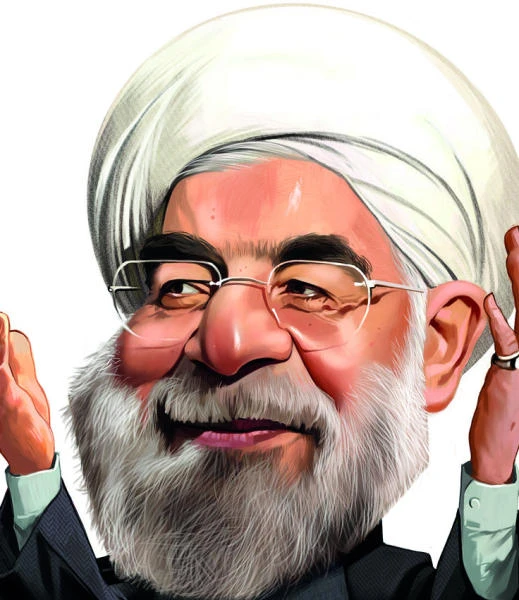
This economic malaise, worsened by populist economic policies of the previous Ahmadinejad government, helps explain the surprise presidency of Rowhani, cleric and former nuclear negotiator. The global coalition that imposed such crippling sanctions is a rare and underappreciated Obama diplomatic achievement.
Add the possibility of imperial overstretch to this picture. Iran is usually portrayed as 10 feet tall, opportunistically pursuing the opening inadvertently provided by the US war and occupation in Iraq, which produced the first Shiite government in the Arab world since 1041. Iran’s missionary Shiism, stretching tentacles into Lebanon via Hezbollah, Gaza via Hamas, and Syria has sowed mischief across the Middle East. But that may be taking a toll in blood and treasure. Support for the Assad regime economically and militarily, with IRGC Qods force troops doing no small share of the fighting, has cost, by some estimates, $8 billion to $9 billion.
Like Mikhail Gorbachev in 1985, Rowhani inherited economic catastrophe and ascended to power with a mandate to fix the economy and improve a tarnished standing in the world. Rowhani’s ascendance also reflects an effort at internal political rebalancing.
Iranian domestic political dynamics may align with efforts to revive the economy and move Iran toward the mainstream, at least enough to persuade potential foreign investors in Iran’s technology-starved oil and gas industry of no undue risks.
Of course, it would be preferable if all Iran’s centrifuges stopped spinning. But diplomacy is the art of the possible. The perfect should not be the enemy of good enough. Just as President Barack Obama and Secretary of State John Kerry must be able to justify the outcome, Rowhani also must demonstrate that Iran did not lose face.
One way to test Iranian intentions may be to enlarge the problem, that is, test whether Teheran is serious about becoming a more normal international actor. The US and Iran have interests that overlap: counter-narcotics cooperation, counterterrorism (recall the recent bombing of the Iranian Embassy in Lebanon) and Afghanistan as US presence winds down.
Expanding the playing field is one way to take measure of Rowhani and test if Teheran can work with the US.
As with the nuclear issue, one must “mistrust but verify.” The deal is a long way from lifting all sanctions, and granting access to international finance and investment in Iran’s energy sector is the big prize. The intriguing question is whether a nuclear deal is the harbinger of change in Iran. And if so, is the model of change China’s “adaptive authoritarianism” or the USSR? After all, Gorbachev’s fate is well known.
— InDepth NewsAnalysis


