
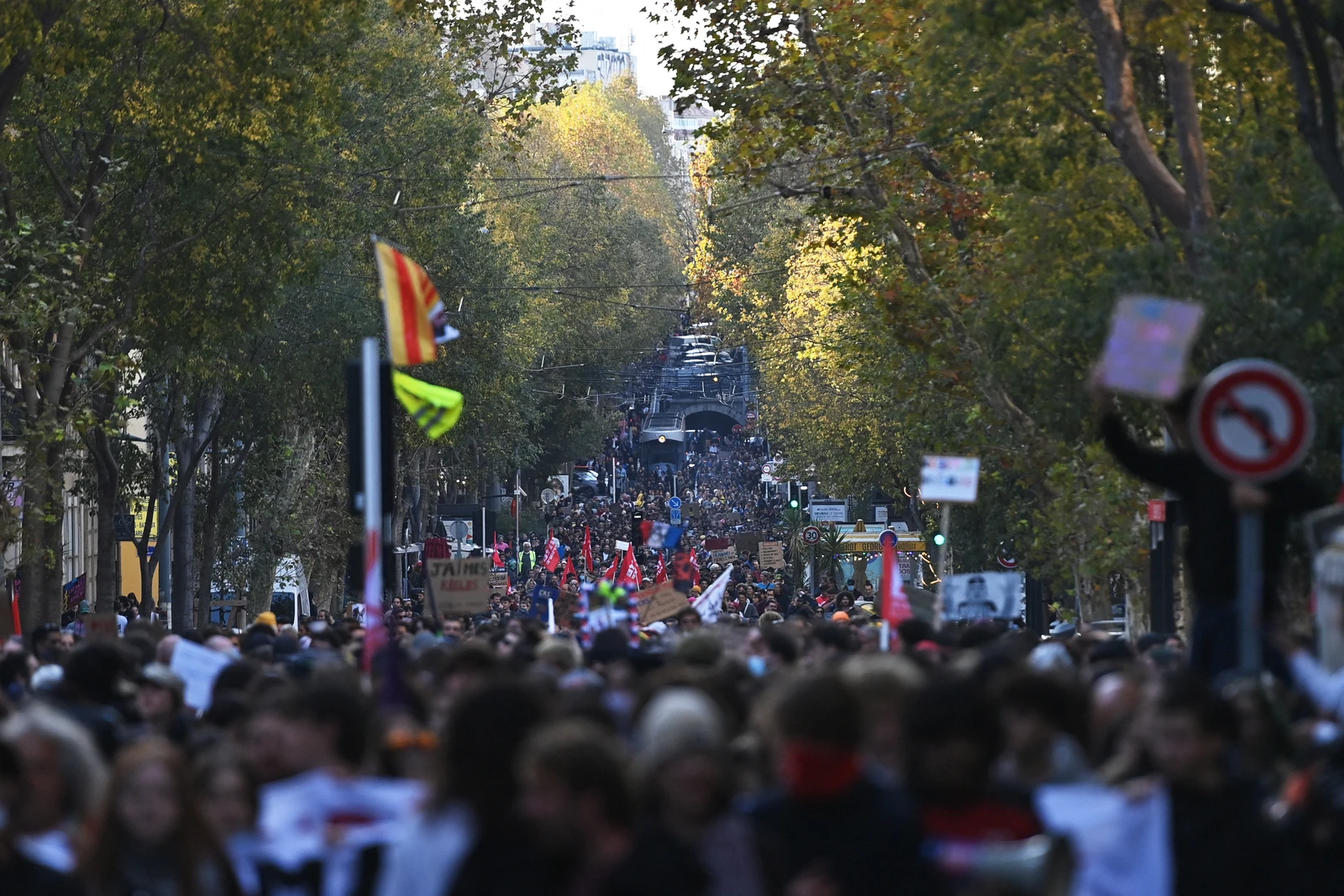

Protests turning violent on the streets of Europe are not a good sight by any measure. It was not good publicity for the students who were demonstrating in Paris in September, nor was it good from the viewpoint of the tourists visiting Europe from all corners of the globe, who were questioning their safety when visiting Rome, Paris or Madrid, as a small group of Alaskans I bumped into recently told me.
Also, the images of violence have gone viral worldwide, surely denting the reputation of Europe, which many people perceive as a haven for happy citizens enjoying liberty and democracy under the umbrella of the welfare state. Over the last few weekends, I have been receiving questions and interview requests from Middle Eastern media outlets inviting me to try and explain what is ailing Europe and to decipher the causes and effects of the violence on justice, the rule of law, order and safety. I have been asked whether the democratic system is about to cave in under the hammer blows of the students and violent anarchists.
Cost-of-living protests across Europe are calling for better pay, better classrooms, better pensions and better opportunities. They prompt the observer to question whether governments are failing their people or the people are becoming more demanding, unrealistic and impatient. Answers are not easy to come by.
Many that demonstrate on the streets are asking the state for jobs, security and affordability in a world in transition
Mohamed Chebaro
Many that demonstrate on the streets are asking the state for jobs, security and affordability in a world in transition, in which conflicts and defense spending are changing what the state can provide. These expressions of dissatisfaction — magnified by social media’s less-than-innocent trends, which even point to foreign meddling at times — are eroding trust in governments. As a result, one wonders if the liberal democratic world is running out of options and ideas. Is it time to review the social contract between the rulers and the ruled, to draw new parameters that could put the entire welfare state model at risk?
The protesters’ demands are simple. For some on the radical left, they want the state to take from the rich and give to the poor. Those from the rising extreme-right are blaming the state’s sickness on the generosity of the welfare state, while blaming immigrants for reduced services and the erosion of the public purse. Some elements are blaming scarcity on the diversion of money to Ukraine, as if supporting Kyiv against the Russian invasion was a luxury. Added to that are the increased prices due to the energy crunch resulting from the US’ war with Iran. Not to mention the effects of the tech transition and the ever greedier corporations hoarding wealth in the hands of the few.
But there are also other considerations. One is the welfare question. Another is foreign interference and the drive to sow chaos and discontent, which are eroding people’s faith in democratic institutions and the social contract of rights and duties.
Across Europe, a rebalancing of the pension and welfare systems is needed to mirror today’s market and society’s needs. In the 20th century, those provisions were introduced to help older people and the poor who were left behind. Now, the pension bill is nearly breaking the budgets in countries like France, Spain, Italy and Germany. More and more of the taxes generated by younger workers are being eaten up by state pension benefits for rapidly aging populations. Governments are using austerity measures, reducing public services and infrastructure spending or allowing debts to spiral, as is the case in France, to fund pension provisions. That is not sustainable.
It looks increasingly like hybrid and shadow warfare, with misled demonstrators playing their part
Mohamed Chebaro
Pensions now account for one in every four euros the French, Spanish and Italian governments spend on all goods and public services. In 2024, the French government spent more on pensions than on education, policing, housing infrastructure and defense combined.
Pensions reform has unfortunately been resisted by all on the left and the right, the young and the old, in countries like France.
But pensions are not the whole story, as falling birth rates, shrinking workforces and rising tax bills mean that young people are today getting a far less generous deal. This is creating greater despair among the youth, which is being capitalized on and turned into anger.
Many fear that the protesters have been doing the work of foreign enemies, as they are unknowingly mobilized by less-than-scrupulous online actors that blame the war in Ukraine and migrants for all evils.
It is not an exaggeration to say that Russia and Iran are waging asymmetric war on Europe to sow chaos, as manifested in cyberattacks, drone incursions, sabotage, paid criminal attacks against critical infrastructure and disinformation and misinformation campaigns. It looks increasingly like hybrid and shadow warfare, with misled demonstrators playing their part.
There are obviously problems in Europe — and they are increasingly difficult for any state and society to grapple with. The widening inequality gap is one, the gaping problem of the welfare state that is eating into Europe’s budgets is another. Then there are the continued vulnerabilities resulting from foreign interference and wars.
All the above could be remedied through reform and the strengthening of the social contract that has guided governments to meet people’s demands and help them prosper, not explode the state with protests. European states have many failings, particularly in times of global adversity. The recent protests are a wakeup call that Europe is under threat and showing signs of sickness on many fronts, but the protesters should hold on to their liberal democratic values as a guarantee and a channel that could reform the system. While liberal democracy might increasingly look like it is on its deathbed due to many adversities, it is not yet.
Mohamed Chebaro is a British-Lebanese journalist with more than 25 years of experience covering war, terrorism, defense, current affairs and diplomacy.


