

Rain is mostly a welcome guest across the Middle East but, when it comes in a short space of time and in large quantities in a place where the infrastructure is not equipped for that, then it turns into a nightmare of flooding and overflowing sewage.
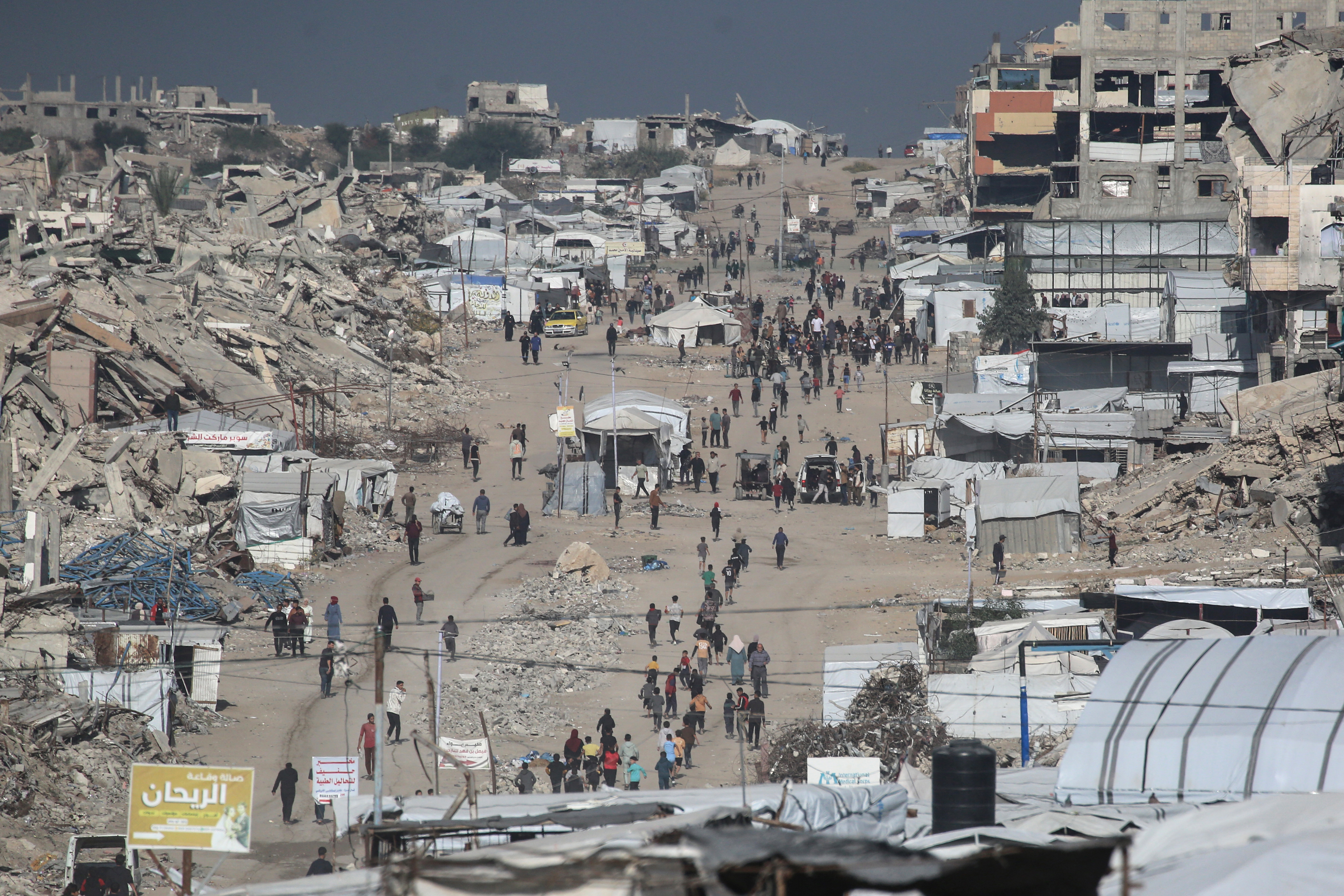
In Gaza, not much of the Strip’s already crippled infrastructure has been left intact after three years of war and constant Israeli bombardment. When the rain began hammering down earlier this month on this stricken, tiny strip of land, which is the home of more than 2 million people, most of them displaced, it had dire consequences for tens of thousands of Gazans. Their makeshift shelters were damaged or destroyed, a collapsed sandbank killed at least five people, and floodwater and sewage destroyed food stocks stored in tents.
More than a year after a so-called ceasefire deal was reached between Israel and Hamas, these are the living conditions in the Gaza Strip: camps of what are referred to as tents, when many are no more than plastic sheets or some other improvised shelter, exposed to the elements and with limited access to clean water, sanitation, food or health services.
When a ceasefire, based on US President Donald Trump’s 20-point peace plan, was agreed in October of last year, there was some hope for progress in ending this horrific tragedy that has befallen Gaza. However, of the entire plan, only the return of the Israeli hostages in exchange for the release of Palestinian prisoners and detainees has been implemented in full. Between improving the lives of Gazan people and moving toward advancing the cause of peace based on a two-state solution, almost nothing has progressed.
All momentum has been lost and all sides seem almost resigned to settle for a reality that is unsustainable
Yossi Mekelberg
From the outset, the fear was that when a ceasefire came into effect, regardless of whether the guns were ever completely silenced, Gaza would be, if not forgotten, then at least pushed down the international list of priorities. And with the war in Iran breaking out a few months later, the consequences of which are still reverberating around the world, along with the ongoing Ukraine war and a heavily congested international and domestic agenda, the focus on Gaza has shifted elsewhere and left the people there to pay the price.
Agreements are only ever the very beginning of resolving a conflict. If they cannot immediately create a momentum that will carry them to full implementation, they become hardly worth the paper they were signed on. When it comes to Gaza, all momentum has been lost and all sides seem almost resigned to settle for a reality that is unsustainable and in which another round of hostilities becomes inevitable.
To begin with, what is called a ceasefire is no more than a reduction — a welcome one but far from satisfactory — in the intensity of Israel’s military operations. The lack of progress on the political-diplomatic level also means that Hamas is rebuilding its military capabilities, about which Israel has legitimate concerns, although it is repeating the same pattern of showing very little consideration for civilian lives in fighting the organization. It is estimated that more than 1,600 people have been killed in daily strikes by Israeli forces in Gaza, most of them civilians. Many others are being injured, while not a single hospital is fully functioning.
It was known by the time the ceasefire deal was agreed that, beyond the first phase of the agreement, there were severe if not insurmountable challenges that would require the full attention of the international community, first and foremost Washington, and swift and decisive action. The time that has elapsed since then without, for instance, Israel allowing the transitional government of technocrats, the National Committee for the Administration of Gaza, to enter the Strip has allowed Hamas to reassert itself. Meanwhile, the Israeli military has extended its control beyond the yellow line that was originally demarcated by the two sides.
The attitude of the Israeli government to the humanitarian situation in Gaza illustrates its political ineptitude and moral decay
Yossi Mekelberg
The International Stabilization Force, which was supposed to form a peace mission, still has not been formed to separate the two sides and Hamas disarmament and Israeli withdrawal do not appear to be happening anytime soon. The result is that the people of Gaza are stuck in the midst of this political-military stalemate.
The toll of the humanitarian crisis is unbearable. Although Israel agreed in the ceasefire deal to allow 600 lorries of humanitarian aid, including food, fuel, medical equipment and medicines, or reconstruction material to enter Gaza every day, for most of this year only half of this number has been allowed in. There is no evidence — so far — of a chronic shortage of food but with many nongovernmental organizations prohibited by Israel from operating in Gaza for some obscure reasons, distribution is negatively affected. Even more badly affected has been the rebuilding of the health and education systems.
According to the Israeli human rights organization Gisha, the near-collapse of the education system is likely to put in jeopardy the education of an entire generation. Over the last three years, it has suffered from unbearable trauma and now its future is badly compromised. The implication of a lost generation missing out on schooling, as many schools have been destroyed and students displaced, could be devastating for their future and is likely to eventually lead to radicalization, which benefits neither Palestinian society nor Israel.
In the absence of an adequate health system in Gaza, especially for those with acute and chronic illnesses, part of the remedy to their predicament would be allowing them to leave for treatment in the West Bank or elsewhere. But with Israel’s blanket refusal to allow Gazan people to leave, for each legal case to have any chance of success it needs to go through the courts. This is despite Israel, as the occupying force, having responsibility for the population’s health and well-being. Consequently, sick people are dying and the long-term implications for public health are dire.
The attitude of the Israeli government to the humanitarian situation in Gaza illustrates its political ineptitude and moral decay. The moral case is clear: Israel keeps punishing the people of Gaza for Hamas’ crimes, for which they cannot and should not be held responsible. From a policy perspective, it only leaves the people who are caught between the rock of living under Hamas’ rule and the hard place of Israeli occupation and constant attacks at the mercy of the former, which controls most of the population. In the hope that a new Israeli government emerges, and very soon, improving the humanitarian situation in Gaza must be high on its agenda.
Yossi Mekelberg is a professor of international relations and an associate fellow of the MENA Program at Chatham House.
X: @YMekelberg


