
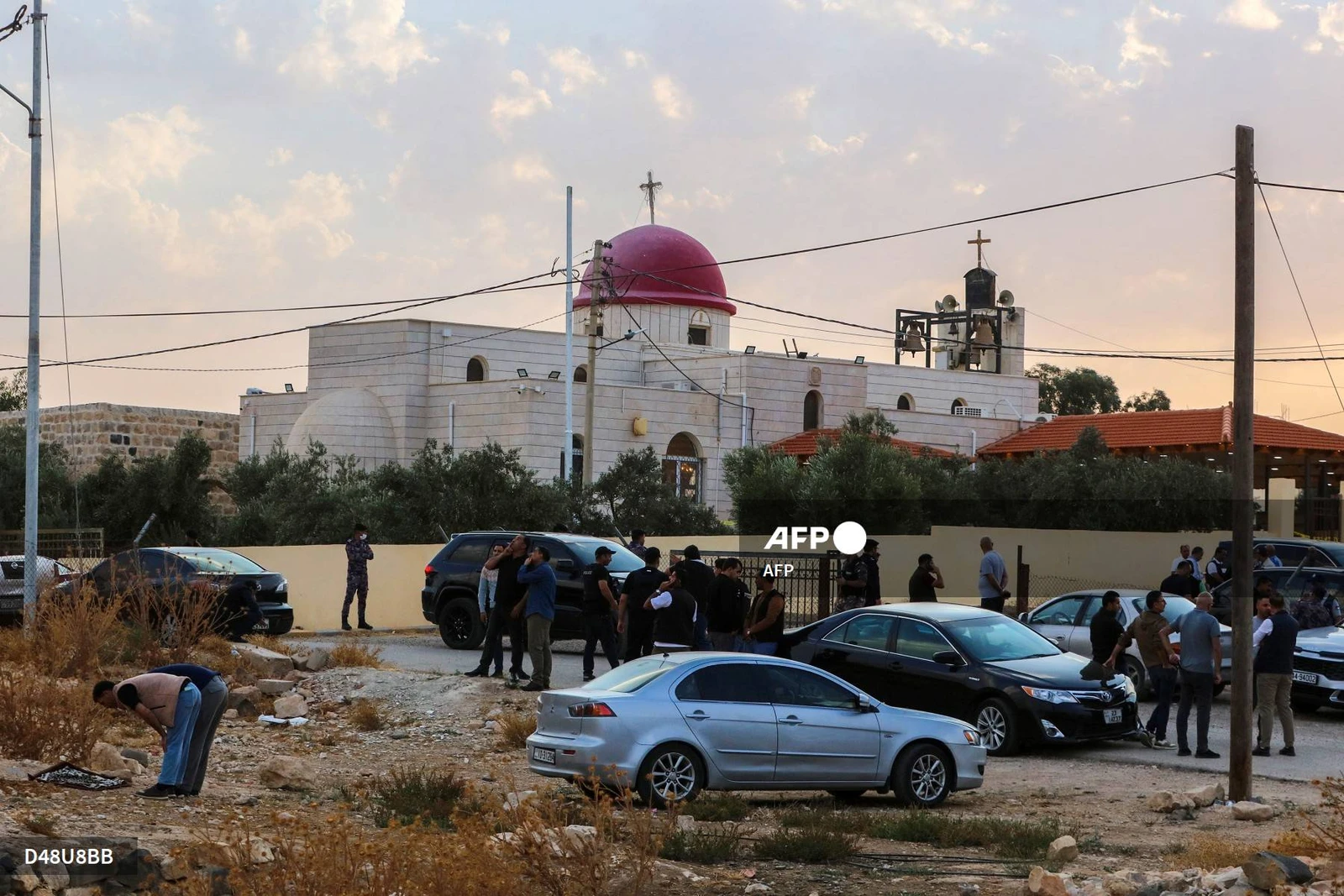

The terrorist attack on a church in Hamoud, Karak, on Oct. 23 was more than an act of violence against a religious community. It was an assault on the foundations of Jordanian society, on the principle of shared citizenship and on generations of Muslim-Christian coexistence that have helped shape the kingdom’s national identity.
When gunmen opened fire on mourners attending a funeral at St. George’s Greek Orthodox Church, killing nine people and injuring dozens, they targeted people gathered to mourn their dead. The choice of a funeral and a place of worship made the crime particularly disturbing. It was an attack on human life, religious sanctity and the basic right of citizens to practice their faith and gather in peace.
But the response from Karak and across Jordan demonstrates something the perpetrators may have underestimated: the bonds between Muslims and Christians are far deeper than religious differences and cannot easily be broken by violence.
Some of the most powerful images following the attack did not come from official statements or political speeches. They came from ordinary Muslim residents who rushed to support their Christian neighbors. Muslim volunteers helped clean the church after the shooting, while others stood alongside the victims’ families and visited the injured in hospital. These were not carefully staged gestures of solidarity. They reflected relationships built through years of living together, sharing neighborhoods, schools, workplaces, celebrations and moments of grief.
The bonds between Muslims and Christians are far deeper than religious differences and cannot easily be broken by violence
Hani Hazaimeh
In an interview with Arab News, Father Chrysanthus of the Greek Orthodox Patriarchate of Jerusalem recalled how Muslim neighbors stood with the Christian community in the aftermath of the attack. His account captured the reality of Jordanian coexistence more effectively than any official declaration: when one community suffers, the pain is shared by the other.
This response was particularly significant in Karak, a governorate whose history offers a strong example of Muslim-Christian partnership. Christians are not newcomers to the region, nor are they a community whose presence can be separated from its history. Their roots in Karak stretch back centuries and their families have been part of its social, tribal and economic life for generations.
Historical accounts document how Muslim and Christian communities in Karak shared social institutions, alliances and traditions. They lived within the same tribal structures, participated in common community affairs and maintained relationships that went beyond religious affiliation. Their history is not simply one of tolerating each other’s presence; it is one of belonging to the same society.
That history matters today because extremist ideologies seek to replace the idea of shared citizenship with divisions based on religion and identity. They attempt to persuade individuals that their neighbors are enemies, that differences justify exclusion and that violence can be legitimized in the name of faith. The tragedy in Hamoud exposed the danger of such thinking but the solidarity that followed also demonstrated its rejection by the wider community.
National unity requires sustained work, particularly in confronting the ideas that make extremist violence possible
Hani Hazaimeh
Jordanian religious leaders were unequivocal in their response. Mufti of Karak Walid Thunaibat stressed that the attack contradicted the teachings of Islam and its prohibition against killing innocent people. Father Alaa Bair, the church’s parish priest, described the attack as an assault on the sanctity of life and national security. Minister of Awqaf, Islamic Affairs and Holy Sites Mohammed Khalayleh likewise described it as a national tragedy affecting all Jordanians, stressing that Muslims and Christians share one homeland and a common destiny.
These statements are important, not merely because they condemn the crime but because they reject the ideological premise behind sectarian violence. No individual or group can claim ownership of religion or use it to justify the murder of fellow citizens.
King Abdullah’s response also reinforced this national position. His visit to the injured and his condemnation of the attack sent a clear message that the safety and dignity of every Jordanian are matters of national responsibility. The subsequent expressions of solidarity by the country’s political, religious and social institutions further demonstrated that the attack would not be allowed to define relations between communities.
However, national unity cannot be protected through statements of condemnation alone. It requires sustained work, particularly in confronting the ideas that make extremist violence possible. Security measures and the prosecution of those responsible are essential — but they must be accompanied by education, public awareness and a broader effort to challenge hate speech, religious intolerance and incitement.
Schools and universities have a particularly important role in this effort. Young Jordanians should learn that Christianity is not an external or recent addition to the history of this land and that Muslim-Christian relations are an integral part of Jordan’s social and national development. Understanding the history of one’s neighbors can help prevent the ignorance and stereotypes that extremist narratives exploit.
Religious institutions also have a responsibility to promote a discourse rooted in moderation, compassion and respect for human dignity. Muslim and Christian leaders should continue working together, not only in response to tragedies but through regular community engagement that brings people closer and strengthens mutual understanding.
The media, too, must recognize its responsibility. It should expose extremist narratives without amplifying them, avoid language that encourages division and give greater visibility to the everyday examples of cooperation that rarely make headlines. The solidarity shown in Hamoud deserves to be documented and shared because it reflects the society that Jordanians want to preserve.
There is also a wider lesson for the region. At a time when Christian communities across parts of the Middle East face displacement, discrimination and violence, Jordan’s experience demonstrates the importance of protecting religious diversity as an essential component of national stability. Christians are not guests in Jordan, nor should their security be treated as a concern belonging only to their community. They are equal partners in the country’s past, present and future.
The real test of Jordan’s response to the Hamoud tragedy will therefore extend beyond bringing those responsible to justice. It will be measured by the country’s ability to ensure that extremist ideas find no fertile ground among future generations and that every citizen feels equally protected, respected and represented.
The attackers may have intended to create fear and division. Instead, the response of Karak’s Muslim and Christian communities offers a reminder of what binds Jordanians together. The Muslim neighbor standing beside a grieving Christian family, the religious leaders speaking with one voice and citizens treating an attack on a church as an attack on their entire country all conveyed the same message.
This is not merely a story about a tragedy suffered by one community. It is a reminder that Jordan’s social fabric belongs to all Jordanians and that defending it is a shared national responsibility.
Hani Hazaimeh is a senior editor based in Amman.
X: @hanihazaimeh


