
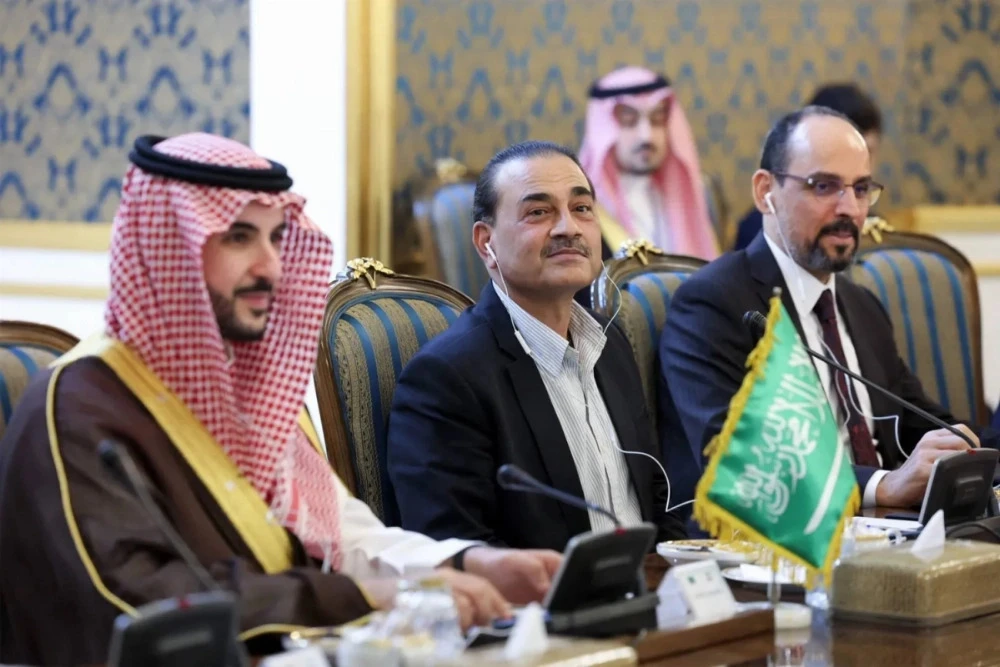

The visit on Monday by a high delegation from the Makkah Joint Defense Agreement countries has added significantly to the gathering momentum for de-escalation and against resumption of the US-Iran war, which had appeared to be all but certain before their visit. The war still remains likely, but the visit made an opening that can be utilized to de-escalate.
During the visit to Tehran, Pakistan’s Chief of Army Staff Field Marshall Asim Munir, Saudi Minister of Defense Prince Khalid bin Salman, and Ibrahim Kalin, director of Turkish National Intelligence, met with Iranian officials including President Masoud Pezeshkian, and Secretary of the Supreme National Security Council Mohsen Rezaei.
This visit marked the first major mediation effort by the newly founded organizations. Prior to the visit, Saudi Arabia said its purpose was to support the ongoing mediation efforts by Qatar and Pakistan. It was “part of the alliance’s efforts for de-escalation of the crisis and the promotion of dialogue and diplomatic solutions.” If the effort succeeds in persuading the two main antagonists (Iran and the US) to pause their military plans, it would in fact demonstrate the “the pivotal role of Makkah Joint Defense Agreement countries in reinforcing regional security and stability, and working with all countries in the region to achieve that goal,” as the Saudi foreign ministry statement hoped.
Since the agreement was signed on Aug. 7, the new organization’s top officials have been meeting regularly to activate its modalities, with emphasis on de-escalation. On Aug. 31, its Political and Strategic Committee (foreign ministers, defense ministers, commanders of the defense forces and chiefs of the general staffs of the three countries) met in Istanbul and announced they would “continue to support efforts aimed at de-escalation and restraint, thereby encouraging the peaceful resolution of crises.”
Iranian officials seem to endorse a role for the Makkah pact countries by speaking about a possible security framework to try to keep things under control
Dr. Abdel Aziz Aluwaisheg
The group met again in Riyadh on Oct. 8 and agreed to “activate collective deterrence measures within the framework of the Alliance in response to the attacks and all those responsible for them,” according to a post on X by Saudi Arabia’s defense minister.
On Oct. 23, just days before the visit to Iran, the three foreign ministers of the Makkah pact countries met in Istanbul and were joined by the foreign ministers of Egypt, France, Germany, Italy and the UK. The impending resumption of the war was high on the agenda. Following the meeting, Turkish Foreign Minister Hakan Fidan said the eight countries were opposed to a resumption of the war and supported diplomacy and dialogue as the way forward. Other foreign ministers such as Italy’s Antonio Tajani echoed this consensus and called for dialogue and “de-escalation to guarantee freedom of navigation.”
The visit to Tehran was meant to convey this message and urge Iran to do its part to avoid the resumption of war. Qatari mediators had presented Tehran with a new draft deal on Sunday, a day before the visit of the three Makkah alliance’s officials to Tehran, and was hoping for a response by the end of the week. The draft includes a tight timeline with specific concrete measures and confidence-building steps. If accepted by the US and Iran, its implementation could start next week. Thus, the visit by the Makkah pact officials, one of whom is a key mediator in the conflict, was meant to give a final and strong push by the three heavyweights for these efforts.
As the three countries are close friends of the US, Washington is likely to give considerable weight to their counsel. Iranian officials have voiced positive, although reserved, statements about the visit describing it as a confidence-building step between four countries and a step in the right direction, while doubling down on Iran’s known positions on the Strait of Hormuz and other issues. In addition, they seem to endorse a role for the Makkah pact countries by speaking about a possible security framework to try to keep things under control.
It is now up to Iran to make this work by agreeing to the compromise proposed by Qatar, which is now being supported by the three Makkah alliance countries. It should not lose this opportunity before war resumes, which remains highly probable following the US election on Tuesday.
For the Makkah alliance, this is the first major mediation effort since the group was announced less than four months ago, but for the rest of the world, their visit to Tehran may have provided a last-ditch chance between war and peace.
Dr. Abdel Aziz Aluwaisheg is the Gulf Cooperation Council assistant secretary-general for political affairs and negotiation. The views expressed here are personal and do not necessarily represent those of the GCC. X: @abuhamad1


