
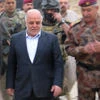
Iraqi forces may face a big battle near Baghdad before they can try to retake the Daesh stronghold of Mosul: Falluja, a long-time bastion of militants sitting at the western gates of the capital.
The government of Prime Minister Haider Al-Abadi and the US-led coalition backing it have been cagey so far in plans for Falluja, which lies between Baghdad and Ramadi, the capital of the western Anbar province that the Iraqi military recaptured this week from the militants.
Falluja was the first Iraqi city to fall to the men of Abu Bakr Al-Baghdadi in January 2014, six month before the group that emerged from Al-Qaeda swept through a third of Iraqi territory and large parts of neighboring Syria.
Abadi, in a speech on Monday declaring victory in Ramadi, said the army would head next to Mosul, the biggest urban center under Daesh control. He said the northern city’s capture would mark the end of the “caliphate” proclaimed from the city’s main mosque in June 2014.
But with many other areas still held by Daesh in western and northern Iraq, the authorities have not made clear what path they intend to take to Mosul, 400 km north of Baghdad.
“The government will need to control Falluja before Mosul,” said Jabbar Al-Yawar, secretary general of the peshmerga, the forces of the Kurdish regional government fighting Daesh in northern Iraq, in an interview to a television channel.
Daily military statements mention air strikes and attacks by the Iraqi army and the international coalition in and around Falluja, a city with a pre-war population of around 300,000 located 70 km west of the capital.
But there has been no indication if and when a battle will be launched to take the city, which Baghdad-based analyst Hisham Al-Hashimi said contains around 1,000 Daesh terrorists.
“There’s a military leadership; there’s planning and a military vision,” Brig. Gen. Yahya Rasool, spokesman for the joint operations command, said on Thursday. “If a battle starts to liberate the center of Falluja, Falluja itself or any other area, we will announce it officially.”
US Army Captain Chance McCraw, a coalition intelligence officer, said the Iraqis were still working on plans for what to do after retaking Ramadi.
“I’m not going to tell you when they’re going to push out there (toward Falluja) but they’re going to push them out of all of Iraq. So if they’re in Iraq, they’re going to get pushed out eventually,” he told reporters in Baghdad on Wednesday.
About 3,000 families remaining in Falluja could be used as human shields, said the analyst Hashimi, who has worked with the Iraqi government.
Around 70,000 families have taken refuge in camps around Baghdad, according to Iraq’s High Commission for Human Rights director Fadel Al-Gharawi.
Falluja, downstream from Ramadi in the Euphrates River valley, is encircled by the Iraqi army’s first quick response force division, the sixth division and the seventeenth division, according to the coalition’s McCraw, though some militants manage to slip past the military’s cordon.
Further south, on the road leading to Karbala, Iran-backed Shiite militiamen are holding ground, Iraqi officials have said.
Known as the “City of Minarets and Mother of Mosques,” Falluja is a focus for Sunni faith and identity in Iraq. It was badly damaged in two offensives by US forces against Al-Qaeda insurgents in 2004.
n REUTERS


