
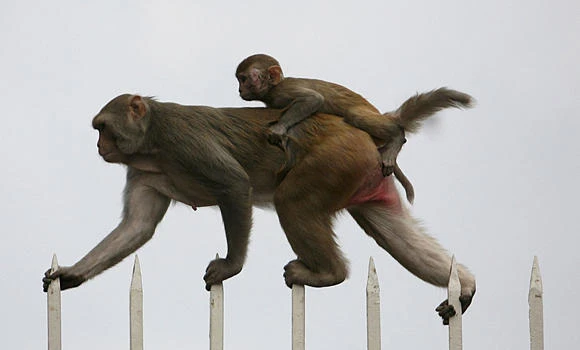

Imagine a game of survival that pits a troop of capuchin monkeys against you and your work colleagues. Both teams would be parachuted into a remote African forest, without any equipment: No matches, knives, shoes, fishhooks, clothes, antibiotics, pots, ropes, or weapons. After one year, the team with the most surviving members would be declared the victor. Which team would you bet on?
You might assume that the humans, given our superior intelligence, are the team to beat. But do you or your colleagues know how to make bows and arrows, nets, water containers and shelters? Do you know which plants are toxic? Can you start a fire without matches? Do you know how to protect yourself from big cats and snakes at night? The answer to most, if not all, of these questions is probably “no,” meaning that your team would likely lose to a bunch of monkeys — probably pretty badly.
We are a cultural species. Our unique psychological capacities allow us to learn from one another over generations. The power of this process arises not from raw individual intelligence, but from the reinterpretation of the serendipitous insights and mistakes that our intelligence produces.
This means that the rate of innovation will depend, at least in part, on the size and interconnectedness of the pool of minds contributing to this process. To understand humans’ social nature, it is crucial to understand how culture has driven our genetic evolution in ways that shape not only our physiology and anatomy, but also our social psychology, motivations, inclinations, and perceptions. From this long process, in which surviving and thriving meant acquiring and adhering to the local social rules, we emerged as potent social learners. The foundation of our ability to form cooperative communities, organizations and societies arises not from innate cooperative tendencies, but from the specifics of the social norms that we learn, internalize, and enforce on others. While our innate motivations do play a role, they are harnessed, extended and suppressed by social norms, which form the institutional skeleton that allows our innate inclinations to operate.
This novel view of human nature and society generates some important insights. First, as a cultural species, humans acquire ideas, beliefs, values and social norms from others in their communities. Second, we gradually internalize the social norms that we acquire through a culture-driven process of self-domestication. These internalized norms become the motivations that guide our actions. This means that people’s preferences, desires and motivations are not fixed, and thus that well-designed programs or policies can change what is automatic, intuitive and obvious.
Third, the most potent social norms harness aspects of our evolved psychology. Social norms for fairness toward foreigners, for example, are much harder to sustain and diffuse than those that demand that mothers care for their children.
Fourth, our ability to innovate depends on the size of our collective brain, which depends on the ability of social norms to encourage people to generate, share, and recombine novel ideas and practices.
Fifth, there is a fundamental link between institutions and psychology. Because different societies have different norms, institutions, languages and technologies, they also have different ways of reasoning, mental heuristics, motivations and emotional reactions. The imposition of imported institutions often creates psychological and social mismatches that tend to lead to poor outcomes.
Finally, humans lack a certain degree of rationality, making us terrible at designing effective institutions and organizations — at least for now. I am hopeful that as we obtain deeper insights into human nature and cultural evolution, this can be improved.
—
©Project Syndicate


