
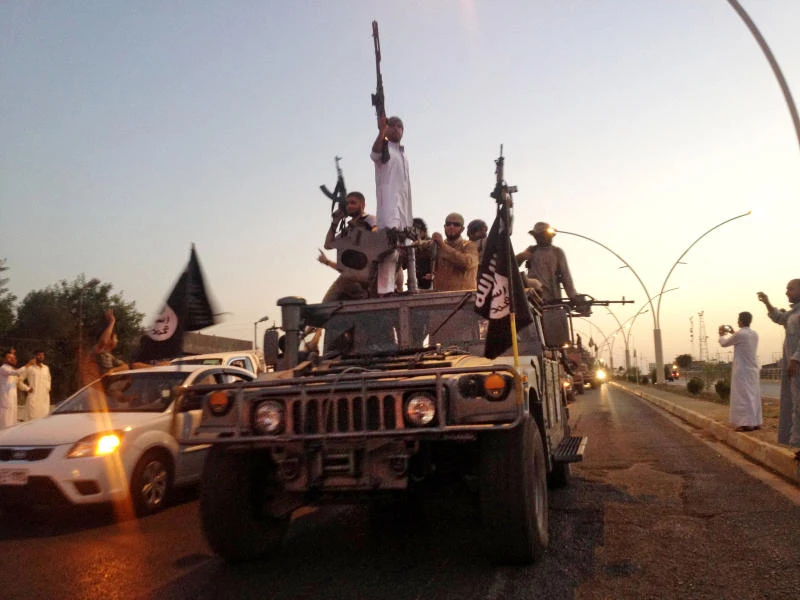

Whenever the self-ascribed Islamic State (IS) advances toward Mosul, particularly near the Iraqi Kurdistan region, the US air force swiftly swings into action and effectively repels the enemy. Strangely though, the US forces don’t take similar action in the case of western Anbar province. Even in much more perilous situations, the US response had been lukewarm to the extent of earning the ire of Anbar residents. The American approach is only raising doubts among them over US motives and giving rise of various conspiracy theories.
Contrary to intelligence traditions, a few weeks ago US officials began issuing statements about plans to liberate Mosul by the next spring. They even went further by describing the operation as being “imminent.”
“Imminent” is the designation given to operations or plans that are carried out within hours or a couple of days maximum. In reality, there is no indication pointing to such a degree of progress being achieved. The number of local volunteers is below the required level and their capabilities are extremely modest. While Iraqi forces are busy on multiple fronts. There are also far more significant targets than Mosul both strategically and in terms of security, such as the Salah Al-Din governorate and the area west of Baghdad, more specifically in the Anbar province. So, why is the US so passionate about Mosul? In principle, and according to the information, liberating Mosul serves neither the project nor the aspirations of the Kurdistan Regional Government President Massoud Barzani, as it will ease the pressures on the Iraqi government at a time when tensions between the two sides, particularly the one relating to article 140 of the constitution about “disputed areas,” remain unresolved.
Moreover, liberating Mosul and southwestern Kirkuk will help resumption of oil export from Kirkuk to Turkey through the national pipeline. Currently, oil is being exported through Kurdish pipelines, which are beyond Baghdad’s control.
This is not to mention the historical sensitivity felt by the people of Mosul as far as the growing Kurdish influence in their governorate is concerned, especially after the Peshmerga forces refused to raise the Iraqi flag during its operations and Barzani’s emphasis that the current borders were drawn by blood, a statement that reveals dangerous intentions that might create friction.
So what explains the US insistence on liberating Mosul? It probably emanates from its commitment not to expose the Kurdistan region to a sudden threat from the IS. This logical line of argument may convince Barzani. But on the part of the central government in Baghdad, it sounds suspicious because the previous protests in Mosul escalated to a degree that some administrative officials from the city harbored intentions to demand the internationalization of their cause. Some even went further by demanding to “internationalize the cause of Sunni Arabs as part of a Muslim Brotherhood project targeting the unity of Iraq.” I have noticed this tune being played by several players, which may threaten Iraq’s unity and lead to a devastating war.
On the other side, resolving the situation in Anbar will strengthen security in Baghdad in particular and the strategic security of Iraq in general, help eliminate pockets of terrorism and secure Iraq’s borders with Jordan, Saudi Arabia and Kuwait. This will also achieve a strategic superiority against IS in Mosul. The people of Mosul have shown no form of armed resistance against IS thus far. No anti-ISIS operation has been recorded within the city of two million people. While the people of Anbar, who have never ceased to fight IS, offering thousands of victims, should be rewarded by giving them precedence in terms of aid.
Although the Nineveh province and its capital Mosul are close to the hearts of Iraqis, its liberation should be carried out by those who believe in the sanctity of the unity and future of Iraq. This requires that those behind the recent failures and defeats not be handed any responsibility for fear they would negatively impact the psychological and administrative situation of the province.
Their return will bring back confusion to the scene and perhaps rekindle the state of rivalry with the center either in coordination with the presidency of the Kurdistan Regional Government or by neighbors. Thus, triumph over IS may bring another problem that may prove more dangerous.
While the danger of IS is obvious and short-lived, fragmentation is more dangerous because it can be endorsed by simple people, those with sectarian agendas or those in charge. Therefore, the central government should be committed to formulating a clear vision.
• The writer is an Iraq police official and security expert.


