
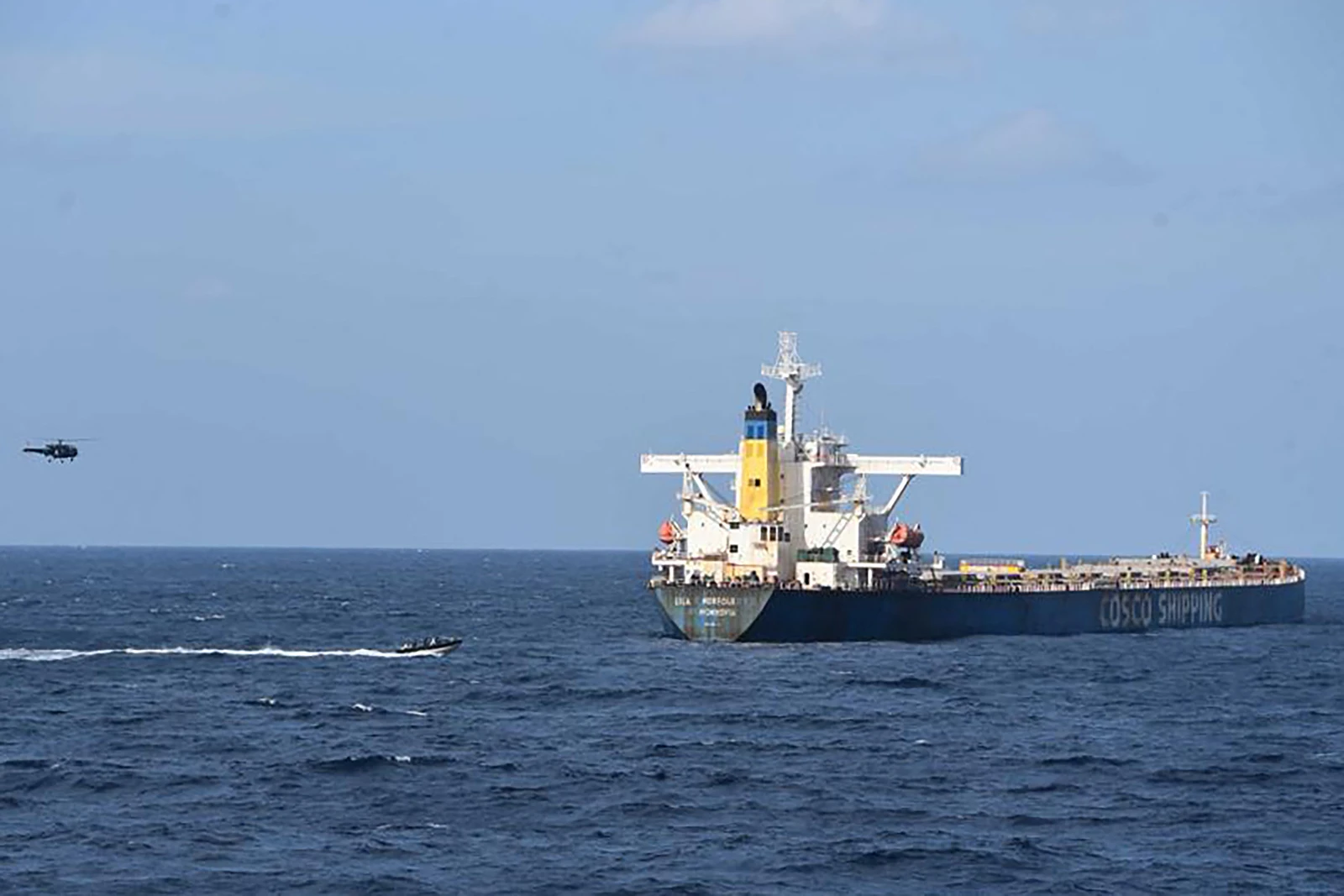

Five vessel seizures in less than five months have turned a supposedly dormant threat into a maritime pattern. MT Honour 25 was captured off Puntland on April 21 with 18,500 barrels of oil aboard. MT Eureka followed on May 2, carrying 20,400 barrels of diesel; its captors initially demanded $10 million. MT Asana disappeared in July. Lutuf was boarded in August amid conflicting reports over whether Turkish commandos intervened or Puntland negotiated its release. Days later, Sibu 1 transmitted a possible distress signal. By early September, five vessels were being held off Somalia.
Chronology matters because geography alone cannot explain it. Somalia’s piracy economy has acquired access to a conflict corridor running from Yemen into the Gulf of Aden, where missiles, drones, shipping disruptions, and ransom markets now interact.
It is reminiscent of a decade and a half ago despite these years’ hijackings operating on a very different mechanism. Maritime authorities recorded two dozen piracy and armed-robbery incidents across the Red Sea and Gulf of Aden during the first three months of the resurgence. A market can revive quickly when the cost structure changes. War pushes commercial traffic onto longer routes. Exposed tankers become more profitable targets, and naval attention migrates toward missiles and drones. A pirate skiff does not need to defeat a warship. It simply needs the warship to be somewhere else.
When factoring in the Houthi connection, the economics become more consequential. UN monitors described contacts between Houthi representatives involving weapons, training, and technical expertise in exchange for maritime disruption and access to ransom revenue. The important transfer, therefore, may be organizational rather than ideological. Navigation equipment, sophisticated weaponry, drone expertise, and Yemen-based training reduce the intelligence and distance constraints that once kept Somali pirate groups closer to shore.
Ransom money completes the circuit. Piracy provides funds outside the formal financial channels targeted by outdated counterterrorism measures. Take for instance, the question of where the ill-begotten earnings go once a vessel disappears. Somalia’s piracy problem has always been partly a cash-conversion problem. Ransoms can move through hawala networks, maritime intermediaries, and informal dealers without passing through the banking channels where governments can freeze, flag or trace suspicious transactions. A successful hijacking therefore creates more than a payoff. It replenishes an underground financial system capable of converting maritime crime into weapons, recruitment, and tactical endurance for actors such as Somalia’s Al-Shabaab.
A fleet can intercept a missile in minutes; dismantling a ransom network may require months of financial investigation across three jurisdictions.
Hafed Al-Ghwell
Al-Shabaab’s territorial recovery gives those transactions a much larger strategic utility. Since last year, the group recaptured several towns across central Somalia and restored a functioning rear area around Jilib. Geography matters because a pirate group operating from Puntland does not need to become an arm of Al-Shabaab for the two economies to intersect. Shared brokers, transport routes, weapons merchants, and facilitators are sufficient. Criminal markets rarely require ideological unity when profit can create practical cooperation.
Moreover, Somalia’s unresolved coastal grievances add another layer. Illegal foreign fishing along Somalia’s roughly 3,300-mile coastline is estimated to cost the country hundreds of millions of dollars each year. For communities that see foreign vessels extracting resources while local enforcement remains weak, piracy can still be framed as an enforcement substitute however criminalized the outcome becomes. Until coastal communities see a credible mechanism for protecting fisheries and distributing legitimate maritime revenues, every crackdown risks removing an income source without removing the grievance that helped produce it.
The Lutuf episode exposes the dangerous, and immediate weakness of command fragmentation. Puntland’s account of the operation, its allegations that fishermen came under bombardment and Mogadishu’s delayed acknowledgment of Turkish involvement produced a dispute over who really controls the counter-piracy response. Foreign military partners can conduct highly sophisticated operations and still create political blowback if the Somali institutions formally responsible for maritime security appear bypassed.
Additionally, Turkey’s expanding security role also makes the problem harder to compartmentalize. Ankara’s defense relationship with Mogadishu includes a long-running training architecture and a substantial military presence, while Puntland has cultivated its own external relationships, including with the UAE. Somalia’s constitutional dispute, therefore, has since acquired a maritime dimension. A foreign military operation against pirates can be interpreted simultaneously as a security action, a federal power struggle, and an affront to Puntland’s authority.
And then there is Djibouti, which faces a similar problem on a different scale. American, Chinese, French, Japanese, and Italian forces sit beside one of the world’s most consequential maritime chokepoints, yet military density does not automatically produce maritime order. Their primary missions revolve around deterrence, force protection, and state-level conflict.
Conventional wisdom suggests that concentrating military power around the Bab Al-Mandab Strait creates formidable capacity for air defense, surveillance, and naval combat. Counter-piracy, however, depends on persistent intelligence collection, rapid boarding authority, local jurisdiction, evidence handling, and trusted coastal partners. Those functions are administratively mundane and politically sensitive. A fleet can intercept a missile in minutes; dismantling a ransom network may require months of financial investigation across three jurisdictions.
Consequently, the solution cannot be another layer of warships alone. Maritime security needs a standing mechanism linking Puntland authorities, the federal government, international naval forces, insurers, and financial-intelligence units. Every hijacking should generate a shared operational picture: vessel ownership, crew nationality, cargo value, suspected financiers, communications traffic, ransom intermediaries, and downstream weapons purchases.
The deeper failure sits in the division of labor. Navies can suppress attacks at sea, but ransom markets are sustained ashore through financiers, brokers, safe houses, fuel suppliers, communications equipment, and political intermediaries. Each actor sees a fragment. Pirates see a target. Insurers see a risk premium. Naval forces see an interception problem. Somali authorities see a jurisdictional dispute. Counterterrorism agencies see illicit finance. The market persists because nobody owns the whole chain.
Ultimately, the Somali resurgence is a warning about what happens when security systems are organized around spectacular threats while opportunistic actors monetize the quieter gaps. Five captive vessels can become 20 if the underlying market remains profitable. A ransom can finance another operation, which creates another risk premium, which diverts another patrol, which opens another window for attack. The cycle feeds itself through economics as much as through violence.
The key contest, then, is over whether maritime insecurity becomes an occasional disruption or a durable business model. The answer will depend on whether Somalia’s coastal governance, federal-political coordination, illicit-finance controls, and international naval priorities can be made to function as one security system rather than several adjacent ones. Until those pieces connect, every warship is an economic opportunity for the next pirate crew.
Hafed Al-Ghwell is senior fellow and program director at the Stimson Center in Washington and senior fellow at the Center for Conflict and Humanitarian Studies.
X: @HafedAlGhwell


