
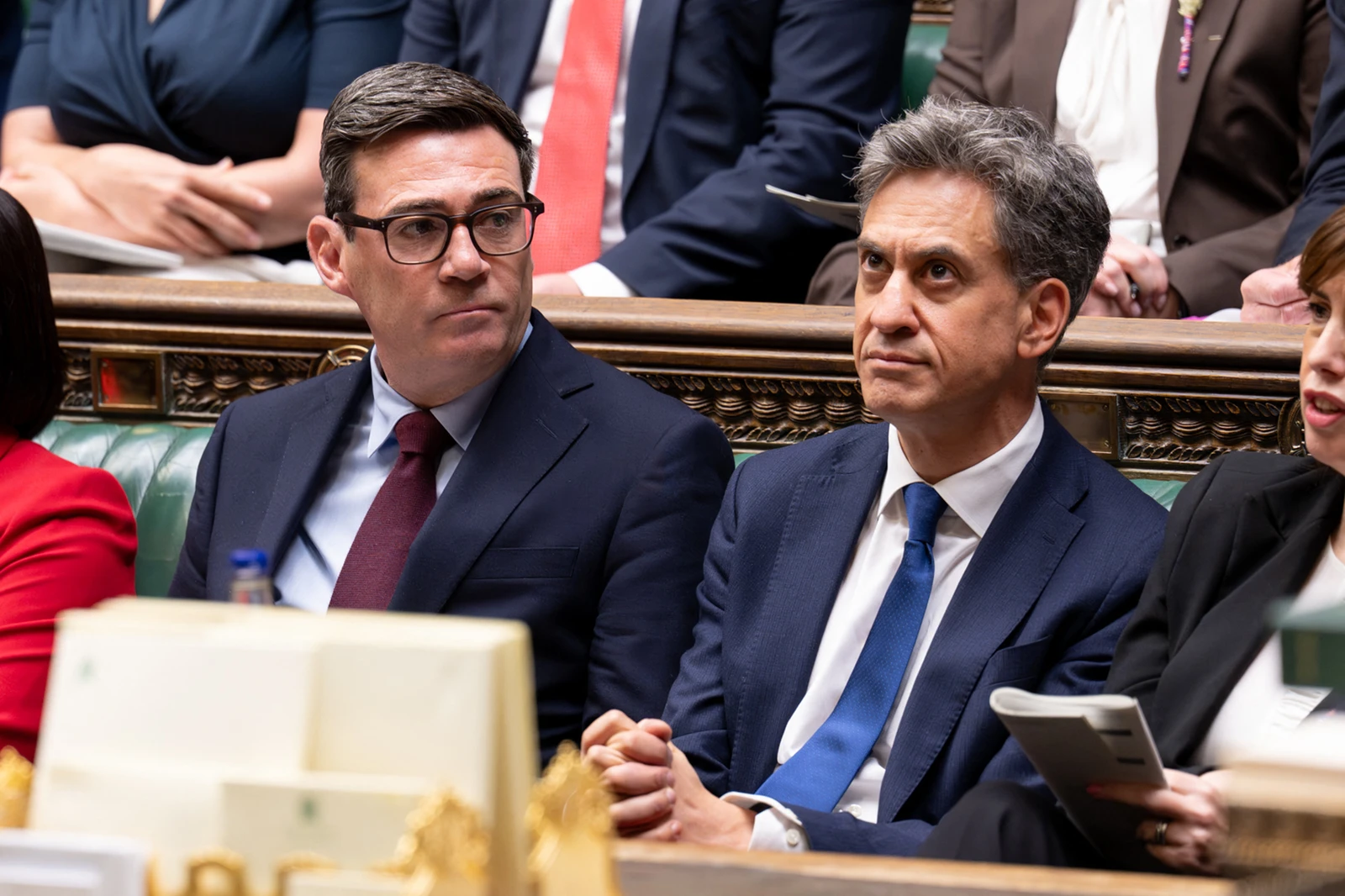

If the Israeli government is looking for anyone to blame for the sanctions against illegal settlements and settlers in the occupied West Bank announced this month by British Foreign Secretary Ed Miliband, it should look no further than the mirror.
Miliband’s speech in the House of Commons was carefully crafted to focus on the issue at hand: Israeli settlements, their illegality, their role as a major obstacle to a peace agreement based on a two-state solution, violence by settlers, and the urgent need for the UK and the wider international community to be more proactive in persuading Israel to reconsider its settlement policies.
If any question should be asked, it is why it took the UK, Canada, and nine other European countries so long to reach the conclusion that diplomatic persuasion would not convince Prime Minister Benjamin Netanyahu and his political partners to change course, either in their approach to settlements or in their treatment of Palestinians, and the prospects for a peace based on a two-state solution.
This is a government that continues to expand settlements, evict and displace Palestinian communities, illegally confiscate land, and allow settler violence against Palestinians to continue largely unchecked and unpunished.
Miliband has described this process as ethnic cleansing. If this is the case, how can he and the British government remain idle when faced with this ugly reality?
The immediate triggers for the governments in the UK, Canada, and their European allies were the rise in settler terrorism and the E1 settlement development plan for the area east of Jerusalem. The former represents, within an already brutal occupation, an apparent loss of any sense of morality; the latter is perceived as potentially the final geographical nail in the coffin of a two-state solution. Both are being pursued in defiance of international law.
For too long, governments that claimed to support Israel have tolerated policies that damage prospects for Israeli-Palestinian peace.
Yossi Mekelberg
To those who seek to portray the sanctions as anti-Israeli or excessively harsh, it is worth looking again at both Miliband’s speech and the specific measures introduced. The claim that they are anti-Jewish is even more baseless; they are specifically directed at Israeli policies that run contrary to British policies and the principles of international law.
The measures are specifically aimed at the settlement project, those who facilitate it, and the increasingly violent settlers who, in the view of critics, the Israeli government has done too little to restrain, an assessment that can hardly be disputed.
The first measure introduced was a ban on the import of goods from illegal settlements in the occupied territories. From a British and European perspective, this is hardly a radical decision; it is, in many respects, low-hanging fruit. These countries regard the occupation as illegal, and therefore the settlements as illegal, and international law prohibits the transfer of an occupying state’s civilian population into occupied territory. Why then should countries who claim to uphold international law trade with entities established in violation of it?
The International Court of Justice reinforced this position with its 2024 advisory opinion, in which it said states should prevent trade or investment relationships that help sustain Israel’s presence in occupied Palestinian territories.
The EU’s top court had already ruled in 2019 that member countries must ensure that products made in Israeli settlements were appropriately labeled as such. That ruling was a hint of what might follow. There was probably an expectation that stronger measures would come much sooner, but it was a warning that Israel chose not to heed.
Instead, it has been reported that almost one in five food shipments entering the EU that are labeled as originating in Israel actually originate from settlements in the occupied West Bank or from the Golan Heights.
Labeling was never likely to be an effective solution on its own; many consumers do not examine labels closely and circumventing the system appears to have been possible, at least in some cases.
Those who describe the import ban as an anti-Israel measure should think again, as this is far from the case. There is no suggestion that the UK intends to stop trading with Israel proper. Bilateral trade is worth about £6.2 billion ($8.3 billion).
Despite growing calls for pressure to be placed on other parts of the Israeli economy — and for voters in the run-up to a crucial general election in Israel next month to recognize that they, too, have a responsibility to act and change a government that is causing immeasurable damage to their country’s credibility, international standing and, arguably, its security — the British government has so far decided against such broader measures.
Whether the decision involves sanctions against additional extremist settlers involved in violence against Palestinians, or the suspension of weapons supplies that enable the occupation and contribute to the killing and devastation in Gaza, the stated objective is to target specific conduct. For now, the message, rightly or wrongly, encourages a distinction to be made between what is being done in the West Bank and Israel proper.
As Miliband correctly pointed out, more settlements have been approved during the four years of the current Israeli government than in the previous 20 years. In addition, Israel has accelerated plans to build in the area known as E1, next to East Jerusalem, issuing tenders for more than 1,200 homes. This would mean further evictions and displacements of Palestinian communities.
But the significance of E1 goes beyond the individual homes themselves: developing the area would isolate East Jerusalem from the rest of the West Bank and sever its northern and southern parts, effectively making the creation of a viable Palestinian state a much more difficult task, if not impossible.
For these reasons, the UK has decided to target not only those living in the settlements, but also those who finance them and who benefit from international economic relations while engaging in activity regarded as illegal and politically damaging.
Israel’s furious reaction to the new British policy, whether the rhetoric or the actions themselves, was hardly unexpected. This is a government that instead of reflecting on its own actions that have led to these sanctions, instinctively lashes out and blames everyone else involved.
This condition worsens as elections loom. The decisions by Israeli Foreign Minister Gideon Sa’ar to order the swift closure of the British Consulate in Jerusalem, evict British officials from an international center in southern Israel that coordinates support for Gaza, order members of the British Support Team based in Ramallah to leave within seven days, and bar a dozen British lawmakers and others he deemed anti-Israeli and antisemitic from entering Israel might impress some of the right-wing parties’ support base, but ultimately it is an act of self-harm.
Expelling people who play a role in Israel’s security and international engagement risks weakening security cooperation while further tarnishing the country’s image as a democracy committed to maintaining constructive relationships with its allies.
Now it is up to the Israeli electorate to respond at the ballot box to what is, after many years of toleration for conduct that should never have been tolerated, a measured response from friends and allies.
For too long, governments that claimed to support Israel have tolerated policies that damage prospects for Israeli-Palestinian peace while failing to adequately confront violence against innocent people.
The question facing Israeli voters now is whether they will continue to support a government whose distorted ideology is compromising their security, associating the country with extremism and driving it further from the international community, or whether they will look for alternative leadership.
Yossi Mekelberg is a professor of international relations and an associate fellow of the MENA Program at Chatham House.
X: @YMekelberg


