
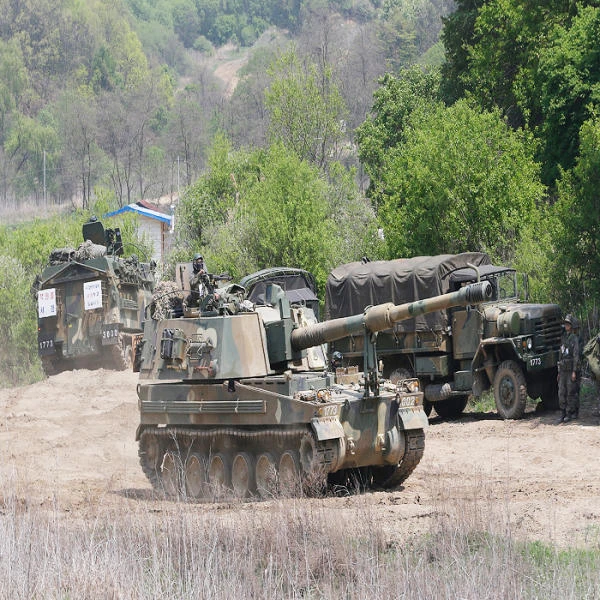

In response to UN sanctions, North Korea carried out its fourth nuclear test in January and a satellite launch that had missile implications in February. Then, when new UN sanctions were imposed and the annual month-long US-ROK military exercises began, the DPRK diverged from its usual practice by openly drawing attention to a number of new weapons it claims to have.
Some US military officers, as well as South Korean specialists, now accept that the North already has the capability to reach the US with a nuclear-tipped missile, while experts who dispute that view nevertheless believe the North will soon have that capability.
What does seem clear is that Kim Jong-un is pressing his weapons specialists to produce a reliable deterrent that will force the issue of direct talks with the US. Meeting with nuclear specialists in early March, he praised their work and, according to the North Korean press, specifically cited “research conducted to tip various type tactical and strategic ballistic missiles with nuclear warheads,” meaning a miniaturized nuclear weapon.
South Korean sources are convinced the North can now put a nuclear warhead on a medium-range (800 miles) Rodong missile capable of reaching all of the ROK and Japan. North Korea has a long history of militant nationalism. Predictably, therefore, Pyongyang treats international sanctions, intended to punish it, as incentives to push ahead with development and production of new weapons for deterrence. It may only be a matter of time before a North Korean missile will be able to reach the US mainland, but Kim Jong-un, like his father and grandfather, is ever mindful of the fact that North Korea is surrounded by the overwhelming strategic power of the US and its South Korean and Japanese partners. The DPRK also faces a US president who once upon a time called for eliminating nuclear weapons but now is presiding over their significant upgrading, in competition with Russia and China.
The best and only chance of dissuading Kim Jong-un from continuing on the path of weapons modernization, which is both dangerous and ruinous in terms of human development, is to put before him a package of alternative incentives — a peace treaty to end the Korean War, security guarantees, sustainable energy options and meaningful economic aid. A joint US-China initiative that, within the context of a revived Six-Party Talks, incorporates such a package would be a welcome development indeed, as much for improving their bilateral relations as for deescalating tensions with the DPRK.
An interim step would have been Washington’s acceptance of a proposal put forth by DPRK foreign minister Ri Su-yong, who told the Associated Press on April 23 that if the US “stops the nuclear war exercises in the Korean peninsula, then we should also cease our nuclear tests.” (President Obama rejected the idea.) I have also put forth the idea of creating a Northeast Asia Security Dialogue Mechanism. Its agenda would ultimately include multilateral denuclearization, but would start with discussion of other security-related topics on which it might be easier to find common ground, the aim being trust building.
Hence, what is often referred to as “the North Korean nuclear issue” is much more than that. The heart of the matter is peace and security in Northeast Asia, which involves a host of interlinked issues: Strategic mistrust between the US and China, territorial disputes, increasing military spending and basing agreements, cross-border environmental problems, and nuclear weapons possessed by four countries today. Decision makers in Washington, though overwhelmed by problems in the Middle East, need to pay attention to the Korean peninsula and think outside the box.
—
TRANSCEND Media Service
Some US military officers, as well as South Korean specialists, now accept that the North already has the capability to reach the US with a nuclear-tipped missile, while experts who dispute that view nevertheless believe the North will soon have that capability.
What does seem clear is that Kim Jong-un is pressing his weapons specialists to produce a reliable deterrent that will force the issue of direct talks with the US. Meeting with nuclear specialists in early March, he praised their work and, according to the North Korean press, specifically cited “research conducted to tip various type tactical and strategic ballistic missiles with nuclear warheads,” meaning a miniaturized nuclear weapon.
South Korean sources are convinced the North can now put a nuclear warhead on a medium-range (800 miles) Rodong missile capable of reaching all of the ROK and Japan. North Korea has a long history of militant nationalism. Predictably, therefore, Pyongyang treats international sanctions, intended to punish it, as incentives to push ahead with development and production of new weapons for deterrence. It may only be a matter of time before a North Korean missile will be able to reach the US mainland, but Kim Jong-un, like his father and grandfather, is ever mindful of the fact that North Korea is surrounded by the overwhelming strategic power of the US and its South Korean and Japanese partners. The DPRK also faces a US president who once upon a time called for eliminating nuclear weapons but now is presiding over their significant upgrading, in competition with Russia and China.
The best and only chance of dissuading Kim Jong-un from continuing on the path of weapons modernization, which is both dangerous and ruinous in terms of human development, is to put before him a package of alternative incentives — a peace treaty to end the Korean War, security guarantees, sustainable energy options and meaningful economic aid. A joint US-China initiative that, within the context of a revived Six-Party Talks, incorporates such a package would be a welcome development indeed, as much for improving their bilateral relations as for deescalating tensions with the DPRK.
An interim step would have been Washington’s acceptance of a proposal put forth by DPRK foreign minister Ri Su-yong, who told the Associated Press on April 23 that if the US “stops the nuclear war exercises in the Korean peninsula, then we should also cease our nuclear tests.” (President Obama rejected the idea.) I have also put forth the idea of creating a Northeast Asia Security Dialogue Mechanism. Its agenda would ultimately include multilateral denuclearization, but would start with discussion of other security-related topics on which it might be easier to find common ground, the aim being trust building.
Hence, what is often referred to as “the North Korean nuclear issue” is much more than that. The heart of the matter is peace and security in Northeast Asia, which involves a host of interlinked issues: Strategic mistrust between the US and China, territorial disputes, increasing military spending and basing agreements, cross-border environmental problems, and nuclear weapons possessed by four countries today. Decision makers in Washington, though overwhelmed by problems in the Middle East, need to pay attention to the Korean peninsula and think outside the box.
—
TRANSCEND Media Service


