


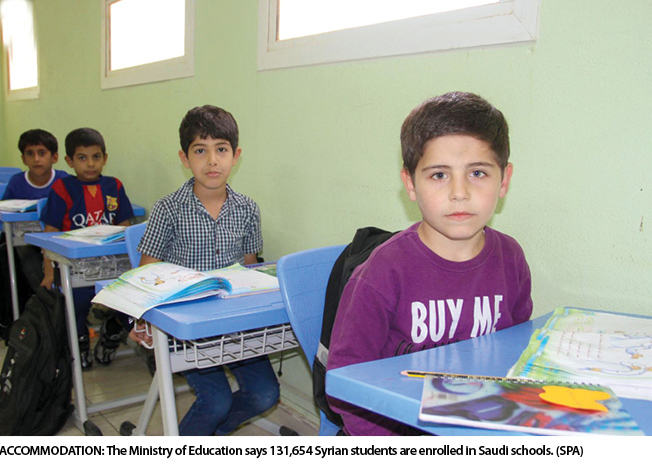
Western critics are stuttering in disbelief that the Saudi government announced it has taken in more than two million Syrians since 2011.
A western acquaintance of mine implied the government was not presenting accurate figures, while another said the numbers are not supported by the United Nations figures.
You are aware of the whining: Why must Europe and the United States allow a large percentage of the four million Syrian refugees to resettle there while the Gulf nations do nothing?
It is perfectly reasonable to this writer that Saudi Arabia has admitted two million Syrians (my column last week underestimated the number by 1.5 million) since the civil war broke out in Syria four years ago. Notice that I say “two million Syrians,” not two million “refugees.” That is because the Syrians are not classified as refugees by Saudi Arabia, but were admitted to the country on visas. The United Nations Commission on Human Rights is counting refugees not visa holders. Further, the Saudi government, as it is often wont to do, doesn’t report its activities regarding refugees to NGOs.
Critics are also fond of pointing out and publishing photos of the permanent tent city at Arafat that can accommodate more than two million people as evidence that Saudi Arabia is capable of handling a large number of refugees. Of course, the tent city is for Haj pilgrims and using it for purposes other than its intended function would mean canceling Haj for perhaps the next decade or so.
Saudi Arabia has a population of around 20 million Saudis and probably over nine million expatriates. By admitting two million Syrians — OK, let’s split the difference with critics and say one million Syrians — the government has implemented a courageous and humane policy to help resolve the crisis.
That means that the number of foreigners is approaching half the total population. Most of those one or two million Syrians are highly educated and skilled workers. They are not only competing against Saudis for high-paying jobs, but also expatriates occupying management positions. It’s a situation that can hardly sustain itself.
Middle Eastern and western media have such a difficult time breaking down the complex issue of the refugee crisis that the standard of reporting has fallen to the most basic and simplistic levels. This failure has led to xenophobic and Islamophobic reporting. The Washington Post, for example, reported on Sept. 15 that one-fifth, or 22 percent, of 1,365 Syrians polled by ORB International, an England-based market research company, said that Daesh was a positive influence in Syria.
The newspaper did not report on the methodology of the poll or explain what Syrians mean by “positive.” In previous media reports, some Syrians have said they view the Daesh occupation as “positive” only because the electricity is on and the water is running.
The perception among some western leaders, Hungary’s Prime Minister Viktor Orbán and British Prime Minister David Cameron among them, is that admitting refugees into their countries will also bring militants. But Daveed Gartenstein-Ross, a security analyst for the Foundation for Defense of Democracies, recently told a US Congressional Homeland Security Committee that Daesh prefers to recruit militants already living in the United States or Canada. Also consider that the nearly 6,000 of the 20,000 Daesh soldiers hold European and British passports. It’s far easier for an extremist holding a western passport to enter a country than militants posing as refugees.
These facts don’t get in the way of the uninformed views of Saudi critics who claim the government is not doing its part to help resolve the crisis. It’s really too much to expect.


