

Around the end of July 2012, the clueless Mitt Romney, then running for president, visited the Israeli entity in Palestine to pledge obeisance to its leaders, as most American presidential candidates are wont to do.
While there, speaking to a group of Jewish donors, he compared the Palestinian economy to that of Israel's, proclaiming grandiosely that Israel's GDP per capita was $21,000 while that of the Palestinians was a paltry $10,000 (actually, the figures are $31,000 for Israel and $3,000 for Palestinians).
Romney's take on that disparity? It showed a "dramatically stark difference in economic vitality," he said. It further showed, he added — evincing not just ignorance of the facts on the ground but a racist mind-set — that "culture makes all the difference." He was, of course, wrong. The disparity in the economic performances of the Zionist entity and that of Palestine had nothing to do with the inherent cultural superiority of Israelis.
It was the occupation, stupid. The Palestinians are an occupied people subject to the rule of the gun who have no control over their land, water resources, borders, infrastructure, state institutions and the rest of it.
That's the be all and all of the Palestinian people's plight, a military occupation with a stranglehold on Palestinian life that had grafted itself on the land close to a half century ago, the oldest in modern history.
The Oslo agreement, signed two decades ago on the White House Lawn with much fanfare, an agreement that the Palestinian President Mahmoud Abbas "repudiated" in his speech at the UN General Assembly recently, has resulted not in an independent Palestinian state "within five years," as expected, but in a doubling of the number of colonists and the expansion of colonies in the West Bank.
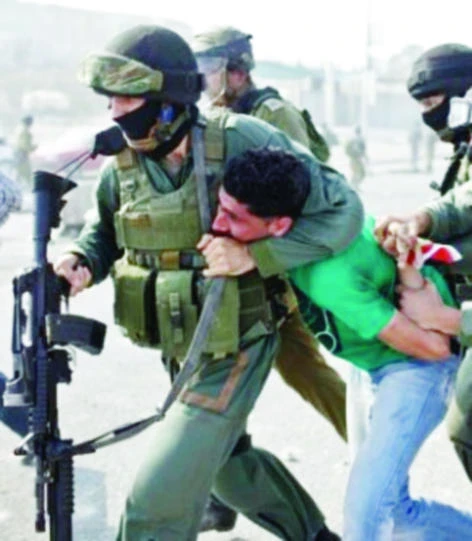
Meanwhile, Israel has equally doubled and expanded its efforts to torment Palestinians wherever it found them. A whole generation of these folks — some now middle-aged — have known nothing but an existence defined by checkpoints, ID papers, night raids, curfews, targeted assassinations, house demolitions, land confiscation, assaults by colonists, detentions, verbal abuse and beatings by well-armed soldiers, and violent death, a mosaic of life that, when its disparate pieces are put together, paint a grim picture of what it feels like to live under the rule of the gun, a condition that amounts to a boot on your neck.
When that happens to a people, there always comes a moment when they, gasping for breath, lash out in what is known in Arabic as intifada, an attempt to "shake off" the oppressive forces pressing hard on one's choked psyche. We do not know yet if the people of Palestine are at that point yet. If they are, it should come as no surprise. An intifida will be mounted even if its cadre of activists knew that it may yield no tangible results for an intifada is, in and by itself, a cleansing, indeed a healing, act.
An occupied people — unlike people who are discriminated against, who have some recourse to justice, either under the law or through political action — are often subject to physical and psychological brutality for displeasing their occupiers, and left with one remedy: Force. That is, revolutionary violence. Under international law, pursuing colonists and doing them harm is not unlawful. It is certainly not terrorism. An occupied territory is considered a battle zone. Enemy civilians roaming around a battle zone are likely to be killed. If you are a civilian, don't bring yourself or your women and children to a battle zone and then complain when you are shot at. All colonists are fair game in the West Bank.
What is galling about Israel is the fact that its occupation, backed by solid and consistent diplomatic support from the US, has deprived its victims of all safeguards provided by sundry international laws governing military occupation, including the Geneva Conventions of 1949 whose Article 49 states that "the occupying power shall not transfer parts of its civilian population into the territory it occupies." No colonies, no colonists.
What is equally galling is that the Palestinian National Authority (PNA), in a well-meaning effort to "keep the peace" in the territories, has allowed its security forces, often with the aid of Israeli intelligence, to pursue Palestinians engaged in resistance, even just dissent. In effect, it has agreed to act, so to speak, as a subcontractor to the occupiers, a situation whose end result, after all these years, was that the PNA has lost, according to various polls, the support of two thirds of its constituency.
In an interview a year before he died in 2013 at age 69, Eyad El-Sarraj, the noted psychiatrist who served as a consultant to the Palestinian delegation at the Camp David 2000 Summit and was a recipient of the prestigious Physicians for Human Rights Award, told Padraig O'Malley, author of the recently published The Two-State Delusion, about his distrust of the Palestinian security forces.
"How can we work with these people who have provided information to the Israelis that lead to the incarceration of Palestinians?" Sarraj asked rhetorically. "Palestinians who are arresting fellow Palestinians on behalf of the Israelis? How can we ever trust these people?" (The quote is from O'Malley book.)
If another intifada is coming, whose intention is to "shake off" the grime of the occupation from one's national soul, well, I say bring it on. When you've got nothing, you've nothing to lose.


