
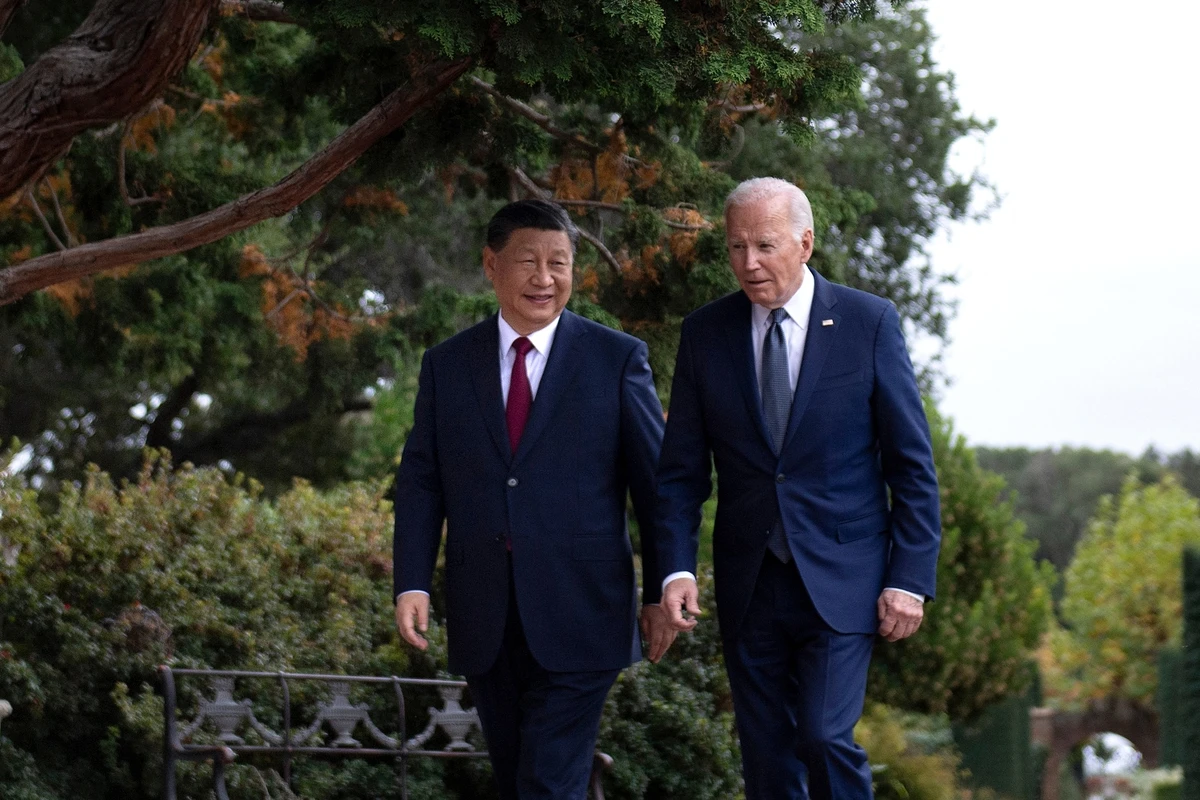

The list of US business executives attending last week’s dinner with Chinese President Xi Jinping could not have been more impressive. It included Tim Cook of Apple, Stephen Schwarzman of the Blackstone Group, Bridgewater Associates founder Ray Dalio, Robert Goldstein of BlackRock and Joseph Bae of KKR, to name just a few. These are companies that have revenues that exceed the gross domestic product of entire regions. They have global impacts and influence.
Despite the daily dose of news stating that US-China relations are deteriorating, this gathering tells a different story. The sheer economic power of these businessmen raises the question: Can the US and China really divorce? Are they not too interconnected to go through a full decoupling? Has Henry Kissinger not succeeded in making war impossible?
The US-China marriage will always be associated with Kissinger. In 1971, he became the first high-ranking US official to visit China. As national security adviser, his secret meetings paved the way for then-US President Richard Nixon to visit the following year. What followed perhaps became key to the collapse of the Soviet Union and economic prosperity for China and the West. It allowed the emergence of China as an economic and political superpower.
The US and China have been great trade partners ever since. US goods and services trade with China totaled an estimated $758.4 billion in 2022. Exports were $195.5 billion, while imports were $562.9 billion. The US goods and services trade deficit with China was $367.4 billion in 2022. This does not include financial instruments and, here too, there are great links.
Tougher global economic conditions, along with increasing regional conflicts, have strained the relationship
Khaled Abou Zahr
Nevertheless, there have been many worsening signs geopolitically in recent years. Tougher global economic conditions, along with increasing regional conflicts, have strained the relationship. The discussions of decoupling following the COVID-19 pandemic arose from the realization of just how reliant on China Western economies had become. The past year has seen mutual economic trade-related restrictions and sanctions, which have been interpreted as warning signs of an inevitable broader confrontation.
Indeed, US President Joe Biden signed an executive order in the summer aimed at restricting American investments into Chinese semiconductor, quantum computing and artificial intelligence companies over national security concerns. And Commerce Secretary Gina Raimondo, who attended last week’s dinner, has stated that US companies have complained to her that China has become “uninvestible,” pointing to fines, raids and other actions that have made it risky to do business in the world’s second-largest economy. However, the overwhelming sentiment when reading news of last week’s meeting is that US executives are still eager to do business in China and that no such complaints will make a difference.
So, President Xi’s visit to San Francisco for a China-US summit and the 30th Asia-Pacific Economic Cooperation forum leaders’ meeting at Biden’s invitation had the objective, according to the US president, of restoring normal communications with Beijing, including military-to-military contacts.
On this occasion, San Francisco, which has become known for its homelessness problem, was cleaned up by California Gov. Gavin Newsom, who, along with Treasury Secretary Janet Yellen, greeted the Chinese leader as he exited his plane. This welcoming committee says a lot. First, Newsom is rumored by several media outlets to be preparing his candidacy for the Democratic primaries. Then, Yellen was present while China’s stash of US treasuries dropped to $821.8 billion, the lowest since May 2009.
The overwhelming sentiment of last week’s meeting is that US executives are still eager to do business in China
Khaled Abou Zahr
There were many signals within this visit. One thing that was made clear — as emphasized by the presence of the business titans at the meeting — was that the two sides have too many interdependencies and shared interests to ignore. This does not mean that there will not be efforts to rebalance the supply chain toward countries other than China. But none of these executives want to be forced to replace all their suppliers from China and, despite current challenges, be kept out of the domestic Chinese market.
Raytheon head Gregory Hayes declared in June that, while it is possible to reduce the risks associated with China, complete separation is not a viable option. He added that, if Raytheon — a leading US aerospace and defense company — had to pull out of China, it would take many years to reestablish that capability either domestically or in other friendly countries.
If a company like Raytheon cannot decouple from China, why and how would any other business do so? And, in case of war with China, how is this viable? Hayes’ declaration indicates that the industrial capacity of China has a clear advantage over the US and the entire West. This conveys the same message as the strong executive presence in honor of Xi, which clearly emphasizes the importance of avoiding confrontation between the US and China and having stable bilateral relations.
In July, when Kissinger visited China, Xi extended a warm welcome to the former US secretary of state. During his visit, Kissinger met with China’s top diplomat, Wang Yi, and Defense Minister Li Shangfu. Kissinger foresaw during his first visit that China’s growth story and strong trade links with the US would make war impossible. We are now witnessing these ties and the wealth created on both sides acting as real deterrents to an escalation. Perhaps his visit in 2023 will serve as a renewed agreement that acknowledges China’s new dimension.
- Khaled Abou Zahr is the founder of SpaceQuest Ventures, a space-focused investment platform. He is chief executive of EurabiaMedia and editor of Al-Watan Al-Arabi.


