
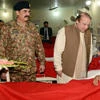

Ask one question to any Pakistani these days: Who is the de facto ruler of the country today? The answer will invariably be, Army chief Gen. Raheel Sharif. The masses have reached this conclusion due to a number of factors. However, some maybe imaginary but the opinion is based on realism.
Over a period of just a year or so, the army chief has become the moving spirit behind the government of Pakistan’s decisions that have helped prevent many disasters.
In reality Prime Minister Nawaz Sharif and his PML(N) party is in power. The prime minister also chairs important meetings on law and order, security, defense, or lately has been touring grocery marts to find out the reason behind the soaring prices of eatables.
What, however, is worth watching is the almost omnipresence of the army chief and his intelligence commander— ISI chief Lt. Gen. Rizwan Akhtar. The premier often reportedly consults them in unannounced meetings or even where TV cameras show them together in intense dialogue. The question, automatically come to one’s mind as to why such a situation has developed in a country with an elected government?
Pakistan does carry the label of being a democratic state, but is it really? The answer is in the negative. The army chief has, for the last 13 months, been holding vital negotiations in United States, China, Afghanistan, meeting not just military leaders but also political leaderships.
In Washington he was honored with the Legend award and asked to extend his stay for a week and in London he was given guard of honor, rarely seen before for any army chief. These ceremonies are reserved for heads of states. The US Secretary of State, John Kerry, even held an official banquet in his honor, while no such dinner was served for the Pakistani premier during his visit to the United Nations last September.
The army chief spent two weeks in the United States sorting out problems about US military aid to Islamabad and the US attitude toward Kashmir and India. In England and China, the welcome accorded to him was impressive and the statements from Prime Minister David Cameron and the Chinese leadership during clearly spelt out support for Pakistan.
Some insiders report that arguments advanced by the military chief during his stay in the US perhaps brought about a change in White House thinking. US President Obama’s telephone call to Pakistani premier, prior to his India’s visit and the second such call from Obama to Sharif about a week ago, is said to be the outcome of the efforts of the army chief.
Obama understood the military’s viewpoint that border skirmishes along the line of control need to be halted lest it develops into an uncontrollable inferno.
Soon after Obama’s phone call to Pakistani premier, Indian PM Narendra Modi called Sharif to resume the negotiation process, which Islamabad and Delhi had halted for unexplained reasons.
Die-hard democracy lovers may not agree with such an illustration but facts speak for themselves. Foreign policy is now being solely controlled by the military and now handling of the internal situation too is rapidly being transferred from civilian to military’s hands.
In the last six months or so, not a single sensitive security subject has been discussed without the presence of the army chief or the ISI boss. Earlier this week, when Sharif visited Karachi and discussed the killings in Karachi or the repeated strike calls from secular or religious parties for targeted killings, he admonished the Sindh chief minister. When the Sindh police chief complained about lack of resources and logistics to deal with target killers, the army chief instantly snubbed him.
“Ask us and we will meet your requirements” was the crisp answer from Gen. Sharif. That was not all, the four-star general requested the prime minister for an exclusive meeting with military commanders. The army chief later was quoted as saying that he would not spare a single terrorist.
It would not be an exaggeration to say that army chief’s public image has boosted over time, which indeed is a threat to the civilian government.
It would be difficult to predict any change in the short term but one thing is evident from these developments that things have started to change in the country.


