
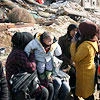

In terms of scale, surely the most resonant news story this month was not the terrorist attacks in Paris, which are a dreadful outrage, nor was it the Palestinians’ diplomatic Intifada against Israel, which has rendered Washington an irrelevant player in Mideast peace efforts, but the story of the unspeakable suffering of Syrians who have taken refugee in the surrounding countries, where a brutal winter has set in, with temperatures dropping to the mid-teens.
Reporters on the scene have filed numerous reports about the catastrophic conditions — there’s no other way to describe them —these refugees have had to endure. Here is a long paragraph from one, filed by the Washington Post’s Liz Sly, that appeared in Jan. 7 edition, describing the travails of one refugee woman and her family in Zahle, a mountain retreat in northeastern Lebanon.
“As the driving rain turned to icy sleet and a blustering wind rocked their family tent,” wrote Sly, “Umm Khalil and her four children shivered, with fear as much as from the cold. A major storm was descending on Lebanon, and along with hundreds of thousands of Syrian refugees bracing for the onslaught, she worried the family would lose the few possessions they had left. Or perhaps worse. Two Syrian babies died of exposure in Lebanon’s last storm, in November. Such is the ferocity of this one — which is expected to bring snow and gale force winds to the areas where most of the refugees live — that aid agencies as well as refugees worry that people’s lives could be at risk.”
There are fewer people in the world today who will suffer more during this season of misery than the millions displaced by the war in Syria, who are facing their fourth winter in exile, without adequate shelter from the biting cold weather descending on the region. We are talking, hyperbole aside, about a mega crisis that involves, literally, millions of people. We are talking about the astounding total, according to the United Nations, of 10.8 million Syrians who have fled the war in the last four years, with 3.2 million of them having taken refuge in Lebanon, Jordan and Turkey, and 7.6 million displaced within their own homeland.
Other reporters have written about how the majority of these folks huddle in flimsy tents, made from sheets of white plastic and only straw mats as flooring, with just blankets to shield them against the icy wind and the torrential rain.
One reporter from the British newspaper, The Guardian, quoted an elderly woman as bemoaning: “All we have is blankets and God’s mercy.”
How dreadful is that suffering? How does one quantify its magnitude? Let’s extrapolate here. This columnist lives in Washington, a city known, shall we say, for its mild winters. I leave my centrally-heated home, I bundle up with a thick woolen hat, a turtle-neck sweater, a heavy coat, gloves, a scarf and boots. I had just had a good breakfast and two cups of tea. I’m ready to brave the cold. But am I? It is so nasty out there you can’t feel your fingers. Raindrops freeze on your beard within seconds. You sprint two blocks to the subway, which is centrally heated, and then connect with a bus, which is equally centrally heated. You curse the elements and, after you run your errands, you run back home where you adjust the thermostat to your liking. Yet you complain about the cold.
Now having extrapolated, I begin to imagine what a refugee Syrian family, without access — not in any mockingly remote way — to any of my decadent privileges, must be feeling at this moment in any of the refugee camps in any of the surrounding countries. And I wince at the horror of it all. I wince at the evil of the Syrian regime that has destroyed the lives of so many people over the last four years. And then I wince some more at how that regime has armed itself with the assurance of impunity, immunity granted to it, albeit indirectly, by the international community.


