
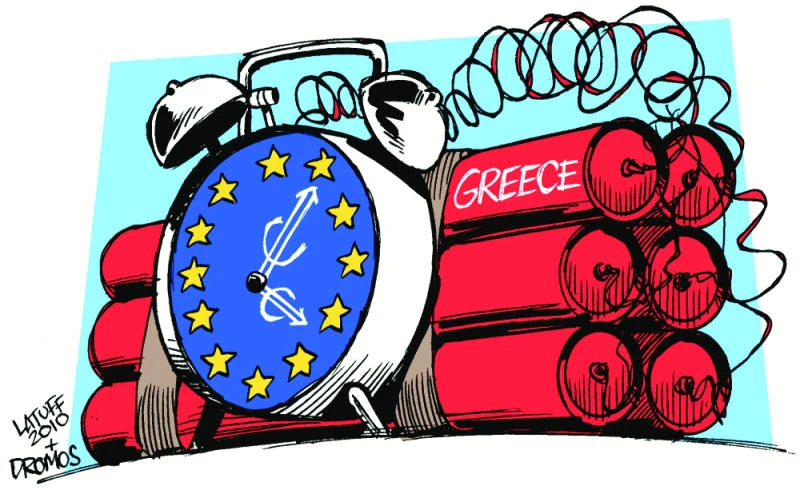

Much is at stake in Greece’s upcoming election. Indeed, the outcome could determine whether the country remains in the euro zone, with far-reaching implications for the rest of the monetary union.
Syriza, a radical left-wing party whose popularity has skyrocketed amid the country’s economic crisis, is the favorite to win, though it is unlikely to gain enough parliamentary seats to govern alone. Instead, it will probably lead a coalition government, though with which other parties remains unclear.
Fundamental to Syriza’s platform is its economic program, designed to counteract the impact of the excessively strict austerity that Greeks have endured for the last four and a half years, in exchange for bailouts from the “troika” of the European Central Bank, the International Monetary Fund, and the European Commission. Pensions have been reduced by 40 percent, on average, while the middle class is suffering under the weight of crippling new property taxes.
As a result, Greece has fallen into a deep and prolonged recession, with output down 25 percent from pre-crisis levels. Worse, unemployment stands at nearly 26 percent – and more than 50 percent among young people. Yet most unemployment benefits are now being eliminated after 12 months, with the long-term unemployed often losing access to the state health care system. Add to this a 30 percent increase in prices for prescription drugs, and it is easy to see why Greek society is unraveling.
That is why Syriza has promised to launch a massive new spending program — including free electricity and food coupons for the poor and an increase in state pensions to pre-crisis levels — that would cost about 6.5 percent of GDP. Tax hikes for high-income earners and large property owners would help to finance these expenditures, while increases in the minimum wage would round out income redistribution efforts.
Syriza has also promised to repeal labor-market liberalization and suspend privatization. Finally, it plans to renegotiate Greece’s debt with lenders, in the hope of writing off the bulk of its liabilities.
Syriza’s economic program neglects the important fact that fiscal consolidation and structural measures not only form part of Greece’s commitments; they also serve the country’s long-term interest. Given this, they cannot — and should not — be abolished. Instead, the problems in their design and implementation should be addressed, in order to improve their effectiveness within current economic circumstances.
Such an approach would strengthen Syriza’s position in debt-relief negotiations. Nonetheless, official statements suggest that the troika would not be inclined to accept Syriza’s negotiating framework, intending instead to complete the talks that it had launched with the outgoing center-right government, the goal being to securing further budget cuts and initiate new labor-market and pension reforms. In short, the troika will insist that Greece honors its prior commitments.
If negotiations stall, financial and liquidity stress, resulting from Greece’ inability to borrow at current interest rates — ten-year bond yields have reached 9.5 percent — will weaken the fiscal position and banking system further. This could lead to a collapse in confidence, triggering financial upheaval and, in turn, forcing the country to seek a third bailout — one that would require Greece to leave the euro zone and introduce a new, devalued currency.
In that case, Greece’s geopolitical position would be weakened, its economy would sink further into recession, and social tensions would rise. Moreover, instability would become chronic, because the euro zone would no longer offer a backstop for fiscal and financial laxity.
A Greek exit may serve as a warning to countries like Spain, Italy, and France, where strong anti-Europe or anti-establishment parties are on the rise. But it would do nothing to address the real problem: The increasing economic divergence among euro zone countries. So long as performance gaps continue to widen, voters will continue to challenge European integration. Only further unification, underpinned by growth-oriented policies in the struggling countries, can reverse this trend.
Such an outcome is still possible — but only if the relevant actors recognize the risks associated with a Greek exit from the euro zone. A Syriza-led government must moderate its approach and promise that it will continue to pursue reform and limit spending in exchange for a substantial reduction to its debt burden — a reduction that the troika must be willing to grant.
—
The writer is Greece’s former Minister of Economy and Finance. ©Project Syndicate


