
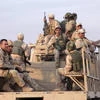

The joint operation by the US and Kurdish Peshmerga forces to free 20 Iraqis captured by Daesh terrorists in Iraq has stirred a controversy, given that it is the first ground operation carried out by the Americans in Iraq since the decision to withdraw all US forces from the country.
It was an operation that carried some risk. According to reports, the US lost one soldier during the raid to free the hostages. The operation was noteworthy because it was the first the US had carried out in coordination with any foreign force on Iraqi territory since the end of the Nouri Al-Maliki era, during which the US had decided against having any permanent military presence in the country.
There has certainly been coordination between the Americans and the Kurds before. But this happened in Kobani, in Syria, where Kurdish forces reached out to the Americans after they were surrounded by Daesh forces. The US then hit the extremist group’s targets in the area with airstrikes, while the Kurdish forces on the ground assaulted Daesh positions with a ferocity that inflicted heavy losses on the extremists and drove them out of the area.
By contrast, Iraqi forces fighting Daesh have not held their ground at all. We saw this most recently in the Iraqi city of Ramadi, which the extremist group captured in May using tactics combining suicide bomb attacks and booby-trapped vehicles. In Syria, meanwhile, the picture remains murky, especially after Obama’s recent announcement that Washington would be reevaluating its support for the moderate Syrian opposition after many of them were captured by Daesh and ended up handing over their US-made weapons to the extremist group. Then came the Russian military intervention in Syria, which reveals a much more pragmatic strategy for working with forces on the ground fighting Daesh.
However, we must bear in mind that the Russian plan sees Assad’s army as its main partner against Daesh and the most likely candidate for defeating the group in Syria. This is, of course, a problem for those opposition groups, which not only support the Syrian revolution against the Assad regime but are also fighting Daesh on the ground. They view the Assad regime as the problem and not the solution and want revolutionary forces to establish themselves on the ground in Syria and also drive out Daesh from the country.
Until now, though, the Kurds have been the only fighting force against Daesh that has proven its worth, whether in Iraq or in Syria.
But the Kurds also have political aims — and they have not been coy about them — to gain international backing for the establishment of their own autonomous state in the region. This has indeed been a sticking point for efforts seeking both to find a resolution to the Syrian conflict and drive Daesh out of Iraq.
It is a serious political problem, because anyone who would support such aims would put themselves at odds with Turkey, Iran and other domestic factions. When it finally comes time for all to sit at the negotiating table and find political solutions to these crises, there would need to be a clear vision for solving this Kurdish dilemma.
As things stand, there isn’t one, and this makes it extremely difficult to find any solutions to the current problems. We can put it like this: Turkey considers Kurdish calls for autonomy more dangerous to its national security than the threat of Daesh.


