
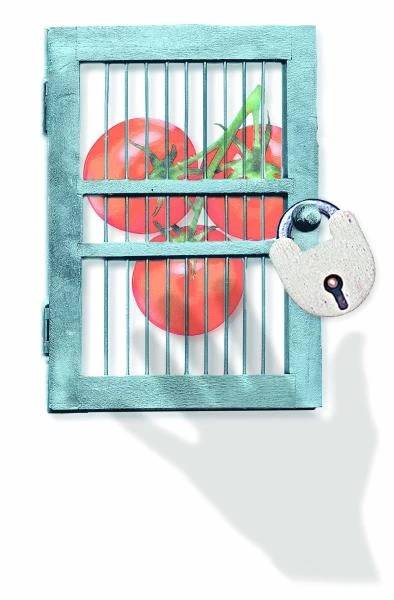

As the New Year begins, I feel compelled to reflect on how fictions and abstract constructions are ruling us; the nature of being and existence is being redefined in such fundamental ways that life itself is threatened. When corporations that were designed as legal constructs claim “personhood,” then real people, who stand in line at polling booths, eke out livelihoods and raise families lose their rights.
This has happened recently in Vermont and Maui. Residents of Maui County, Hawaii voted on Nov. 4 to ban the growing of genetically modified crops on the islands of Maui, Lanai, and Molokai until scientific studies are conducted on their safety and benefits. Monsanto and Dow Chemical’s unit Mycogen Seeds have sued the county in federal court to stop the law passed by the people. And Vermont, which passed a GMO labeling law through a legal, democratic process, is being sued by a conglomerate of corporations on the false premise of corporate personhood, and the influence of money as corporate “free speech.”
This is at the heart of new free trade treaties based on “investor rights.” Denying citizens the right to know violates the fundamental principles of food democracy. Dow and Monsanto sued Maui, thus subverting the democratic process that rests on the will of people, not on the power of corporations. This corporate jurisprudence needs to be reversed if human rights and the rights of Mother Earth are to be protected.
Corporate fictions that have already had disastrous impacts on the biodiversity of the planet, nations and on farmers whose time immemorial rights to save and exchange seeds are being criminalized under patent law and new seed laws.
When biotechnology corporations claim to have “invented” the seed and courts and governments uphold this fiction, thousands of years of agricultural history gets erased.
Seeds are not automobiles or circuit boards; life cannot be manufactured. It is not an invention. A worker on an assembly line does not engineer it, piece-by-piece. Living organisms are self-organized complexity. Chilean scientists Maturana and Varela differentiated between two kinds of systems autopoietic and allopoietic. Autopoietic systems are self-organized and make themselves. Allopoietic systems are put together externally. A seed is an autopoietic system constantly self-organizing, evolving and adapting to changing contexts. To claim that by adding one gene a corporation creates the seed and all future generations of that seed are an ontological flaw, a scientific outrage and an ethical violation.
India’s laws have a clear articulation that biological and living systems are not inventions. Article 3(d) of India’s patent laws states clearly that the discovery of a new property or a new use of a known substance is not an invention.
When corporations claim ownership of a seed that contains a gene from a Bt-bacteria, it is, in fact, a new use of a known substance. When they introduce the gene into a plant by “shooting” the gene through a gene gun into the cell of a plant, the reproduction of the cells and the life cycle of the plant is a biological process. The biotech industry is not assembling the organism, nor are they assembling future generations of seeds.
While the Indian law recognizes that seeds make themselves, including future generations of transgenic seed, which have a gene introduced from an unrelated organism, the American laws treat the transgenic seed as a “machine” invented by corporations. This position of seeds as machines and corporations as inventors was elaborated in the US Supreme Court case of Bowman vs. Monsanto. Bowman had bought mixed soybean seeds from a grain elevator and planted them. Monsanto claimed that the seed being planted to get a crop was not the natural reproduction of a seed sprouting into a plant, which then produced the next generation of seed. The US Supreme Court upheld Monsanto’s claim that the reproduction of the plants in Bowman’s fields was a “replication of a machine” invented and patented by Monsanto.
From the very beginning, Monsanto’s push for GMO seeds has been for claiming creation and ownership of seed.
India’s Protection of Plant Varieties and Farmers’ Rights Act, 2001, has a clause on farmers’ rights, which states, “a farmer shall be deemed to be entitled to save, use, sow, re-sow, exchange, share or sell his farm produce including seed of a variety protected under this act in the same manner as he was entitled before the coming into force of this act.”
The US would like to force India to adopt a false science and laws that dictate that seeds have been created by Monsanto and are therefore Monsanto’s property.
US President Barack Obama will be the chief guest at the India’s Republic Day celebrations on Jan. 26. It is time to start a planetary dialogue and a civilizational exchange based on us all being part of the Earth family; and based on our inalienable right to Swaraj, including “bija swaraj (seed democracy).
We hope Obama’s visit will enhance and deepen the common freedoms of the people of India and the US, and not just the freedoms of corporations, which are undermining the freedoms of citizens in both countries and across the world.
—
Transcend Media Service


