
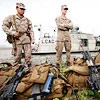

A military agreement with the Philippines and easing an arms embargo against Vietnam show the Obama administration wants deeper security ties with Asia, even as turmoil in the Mideast has undermined its hope of making Asia the heart of its foreign policy.
The “pivot” was intended to be President Barack Obama’s signature push in foreign affairs. As the US disentangled from wars in Iraq and Afghanistan, it would devote more military and diplomatic attention to the Asia-Pacific and American economic interests there.
The world hasn’t turned out as planned. Washington is grappling with the chaotic fallout of the Arab spring, a growing rivalry with Russia and the alarming rise of the Islamic State group that is prompting the US to launch airstrikes in Iraq and Syria.
Against this chaotic backdrop, the growing tensions in the South and East China Seas and US efforts to counter the rise of an increasingly assertive China appear peripheral concerns. The pivot gets few people excited in Washington these days.
Obama didn’t even mention it in a sweeping foreign policy speech in May, and negotiations on a trans-Pacific trade pact — the main economic prong in the pivot — have been mired by differences between the US and Japan over agriculture and auto market access and by opposition to the pact among many of Obama's fellow Democrats.
But the administration is still chipping away at its grand plan for a rebalance to Asia that began within months of Obama taking office in 2009, when the US signed a cooperation treaty with the 10-nation Association of Southeast Asian Nations.
The US has since ended its decades-long isolation of Myanmar, also known as Burma, in response to democratic reforms there.
Like the Philippines, Vietnam has been engaged in standoffs with China over disputed reefs and islands. Tensions spiked between May and July after China deployed a deep-sea oil rig near the Paracel Islands. The vessels of the two sides rammed each other near the rig, and there were deadly anti-China riots in several industrial parks in Vietnam.
On Thursday, the State Department announced it would allow sales, on a case-by-case basis, of lethal equipment to help the maritime security of Vietnam — easing a ban that has been in place since communists took power at the end of the Vietnam War in 1975.
The US won’t be rushing to Vietnam’s defense, nor does it want to be directly involved in negotiating the territorial disputes themselves, that also involve Brunei, Malaysia and Taiwan. But Washington says it has an interest in the maintenance of peace and stability and equipping nations to defend themselves and deter aggression.
Hanoi welcomed the step, saying it would promote the US-Vietnam partnership.
Republican Sen. John McCain, who is an arch critic of the Obama administration’s foreign policy but supports the rebalance and pushed for the easing of the Vietnam ban, said it would strengthen defense cooperation to the benefit of both countries.
But McCain foreign policy adviser Chris Brose said the US still has to convince Asia that the rhetoric of the pivot can become reality.
“The question is not whether America is doing something. Clearly America is,” Brose told a Washington think tank.


