
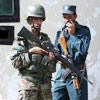

Washington will have to stand by Afghanistan for years, training and funding its army until Kabul can sign a peace deal with the Taleban, or it will follow Iraq in sliding into chaos, experts warn.
“Iraq shows the big security and political price you can pay down the road for over-reliance on a local ally to maintain security without a US presence,” warned Stephen Biddle, senior fellow at the Council on Foreign Relations.
The biggest challenge for the United States will be the complex and painstaking task of building and institutionalizing a national Afghan army in a country that is plagued by competing warlords and has known decades of foreign occupation and civil strife.
On Tuesday, the day-old Afghan government put an end to months of delay by its predecessor and signed a bilateral security deal (BSA) with the United States governing the presence of American forces beyond the end of this year.
A similar deal was inked with NATO, allowing 12,500 foreign troops, including 9,800 Americans, to stay behind in 2015 after the alliance’s combat mission ends.
By January 2017 there will be no American forces left, more than a decade after the US jumped into the ongoing Afghanistan conflict in 2001 to oust Taleban militants, blamed for sheltering the Al-Qaeda militants who masterminded the 9/11 attacks.
But experts warn that pulling out all US troops will only leave another vacuum, as it did in Iraq, where US-trained and funded forces crumbled this year in face of a lightning onslaught by Islamic State militants.
“If we stay on the 2017 zero option time line Afghanistan will be another Iraq,” said former CIA veteran Bruce Riedel, now an expert with the Brookings Institution.
Setting “an arbitrary deadline” for a complete withdrawal “has undermined the mission recklessly,” Riedel insisted. “The whole region believes we are cutting and running by 2017 which is creating its own momentum.”
Obama abruptly pulled all American troops out of Iraq in late 2011 when the US and Iraqi governments failed to reach a deal governing their future presence. Many — Republicans as well as some more impartial observers — have since chided the administration for leaving, saying it created a security vacuum in a fragile country riven by sectarian politics.
Indeed, at the weekend Obama admitted the United States had underestimated the threat posed by the Islamic State militants, while overestimating how effective Iraqi security forces would be against them.
But US ambassador James Cunningham on Wednesday insisted the world should have faith in the Afghan forces.
“Unlike what happened in Iraq, the Afghan security forces have stood, even as they have been taking very significant casualties over the summer,” Cunningham told reporters.
“They have stood and they have fought and, where they had setbacks, they have re-grouped and they have come back and re-established themselves, and I don’t see reason for that to change in the coming years and indeed they can only get better.”
NATO’s new mission — dubbed Resolute Support — will focus on supporting Afghan forces as they take on the Taleban, in parallel with US counter-terrorism operations.
The Taleban described the signing of the BSA as “embarrassing and regrettable.”


