

Our estrangement from the Middle East derives from trends that are much deeper than the manifest deficiencies of executive and congressional leadership in Washington. Americans and our partners in the Middle East have developed contradictory interests and priorities. Where shared values existed at all, they have increasingly diverged. There have been massive changes in geo-economics, energy markets, power balances, demographics, religious ideologies, and attitudes toward America (not just the US government). Many of these changes were catalyzed by historic American policy blunders.
Blunder number one was the failure to translate our military triumph over Saddam’s Iraq in 1991 into a peace with Baghdad. No effort was ever made to reconcile Iraq to the terms of its defeat. The victors instead sought to impose elaborate but previously undiscussed terms by UN fiat in the form of the UN Security Council Resolution 687 — “the mother of all resolutions.” The military basis for a renewed balance of power in the Gulf was there to be exploited. The diplomatic vision was not. The George H. W. Bush administration ended without addressing the question of how to replace war with peace in the Gulf. Wars don’t end until the militarily humiliated accept the political consequences of their defeat. Saddam gave lip service to UNSCR 687 but took it no more seriously than Netanyahu and his predecessors have taken the various Security Council resolutions that direct Israel to permit Palestinians to return to the homes from which it drove them or to withdraw from the Palestinian lands it has seized and settled.
Like Israel’s wars with the Arabs, America’s war with Iraq went into remission but never ended. In due course, it resumed. The US needs to get into the habit of developing and implementing war termination strategies.
Blunder number two was the sudden abandonment in 1993 of the strategy of maintaining peace in the Arabian Gulf through a balance of power. With no prior notice or explanation, the Clinton administration replaced this longstanding approach with “dual containment” of both Iraq and Iran. For decades, offshore balancing had permitted the US to sustain stability without stationing forces other than a very small naval contingent in the Gulf. When the regional balance of power was undone by the Iran-Iraq War, Washington intervened to restore it, emphasizing that once Kuwait had been liberated and Iraq cut back down to size, US forces would depart.
The new policy of “dual containment” created a requirement for the permanent deployment of a large US air and ground force in Saudi Arabia, Kuwait, and Qatar as well as an expanded naval presence in Bahrain and the UAE. The political and socioeconomic irritants this requirement produced led directly to the founding of Al-Qaeda and the 9/11 attacks on New York and Washington. “Dual containment” was plausible as a defense of Israel against its two most potent regional adversaries, Iran and Iraq. But it made no sense at all in terms of stabilizing the Gulf.
By writing off Iraq as a balancer of Iran, dual containment also paved the way for the 2003 American experiment with regime removal in Baghdad. This rash action on the part of the US led to the de facto realignment of Iraq with Iran, the destabilization and partition of Iraq, the destabilization and partition of Syria, the avalanche of refugees now threatening to unhinge the EU, and the rise of Daesh. With Iraq having fallen into the Iranian sphere of influence, there is no apparent way to return to offshore balancing. The US needs to find an alternative to the permanent garrisoning of the Gulf.
Blunder number three was the unthinking transformation in December 2001 of what had been a punitive expedition in Afghanistan into a long-term pacification campaign that soon became a NATO operation. The objectives of the NATO campaign have never been clear but appear to center on guaranteeing that there will be no Islamist government in Kabul. The engagement of European as well as American forces in this vague mission has had the unintended effect of turning the so-called “global war on terrorism” into what appears to many Muslims to be a western global crusade against Islam and its followers. Afghanistan remains decidedly unpacified and is becoming more, not less Islamist. The US needs to find ways to restore conspicuous cooperation with the world’s Muslims.
Blunder number four was the aid to Iran implicit in the unprovoked invasion of Iraq on March 20, 2003. This rearranged the region to the severe strategic disadvantage of traditional US strategic partners like Israel and Saudi Arabia by helping to create an Iranian sphere of influence that includes much of Iraq, Syria, and Lebanon. It showed the US to be militarily mighty but geopolitically naive and strategically incompetent. The US needs to deal with the reality and the challenges to others in the region of the Iranian sphere of influence it helped create.
Blunder number five has been basing US policies toward the Middle East on deductive reasoning grounded in ideological fantasies and politically convenient narratives rather than on inductive reasoning and reality-based analysis. America’s misadventures cannot be excused as “intelligence errors.” They are the result of the ideological politicization of policymaking.
I could go on but I won’t. I’m sure I’ve made my point. Dealing with the Middle East as we prefer to imagine it rather than as it is doesn’t work. The US needs to return to fact-based analysis and realism in its foreign policy.
—
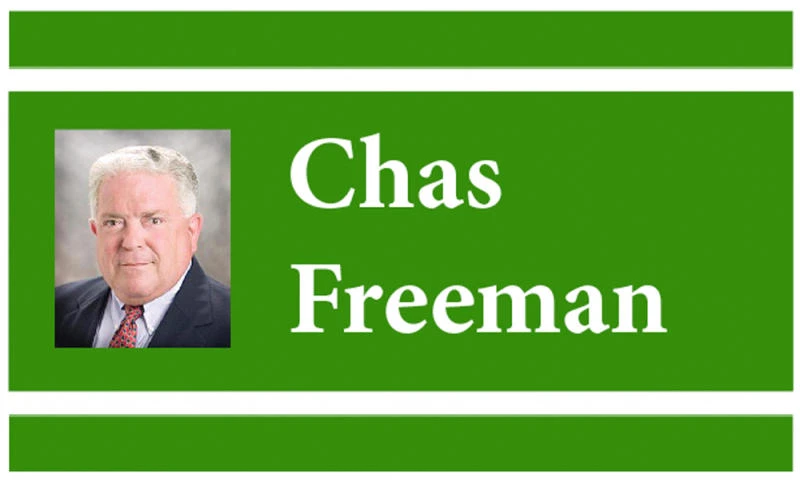
Ambassador Chas W. Freeman, Jr. (USFS, Ret.) is Senior Fellow, Watson Institute for International & Public Affairs, Brown University. Transcend Media Service
Blunder number one was the failure to translate our military triumph over Saddam’s Iraq in 1991 into a peace with Baghdad. No effort was ever made to reconcile Iraq to the terms of its defeat. The victors instead sought to impose elaborate but previously undiscussed terms by UN fiat in the form of the UN Security Council Resolution 687 — “the mother of all resolutions.” The military basis for a renewed balance of power in the Gulf was there to be exploited. The diplomatic vision was not. The George H. W. Bush administration ended without addressing the question of how to replace war with peace in the Gulf. Wars don’t end until the militarily humiliated accept the political consequences of their defeat. Saddam gave lip service to UNSCR 687 but took it no more seriously than Netanyahu and his predecessors have taken the various Security Council resolutions that direct Israel to permit Palestinians to return to the homes from which it drove them or to withdraw from the Palestinian lands it has seized and settled.
Like Israel’s wars with the Arabs, America’s war with Iraq went into remission but never ended. In due course, it resumed. The US needs to get into the habit of developing and implementing war termination strategies.
Blunder number two was the sudden abandonment in 1993 of the strategy of maintaining peace in the Arabian Gulf through a balance of power. With no prior notice or explanation, the Clinton administration replaced this longstanding approach with “dual containment” of both Iraq and Iran. For decades, offshore balancing had permitted the US to sustain stability without stationing forces other than a very small naval contingent in the Gulf. When the regional balance of power was undone by the Iran-Iraq War, Washington intervened to restore it, emphasizing that once Kuwait had been liberated and Iraq cut back down to size, US forces would depart.
The new policy of “dual containment” created a requirement for the permanent deployment of a large US air and ground force in Saudi Arabia, Kuwait, and Qatar as well as an expanded naval presence in Bahrain and the UAE. The political and socioeconomic irritants this requirement produced led directly to the founding of Al-Qaeda and the 9/11 attacks on New York and Washington. “Dual containment” was plausible as a defense of Israel against its two most potent regional adversaries, Iran and Iraq. But it made no sense at all in terms of stabilizing the Gulf.
By writing off Iraq as a balancer of Iran, dual containment also paved the way for the 2003 American experiment with regime removal in Baghdad. This rash action on the part of the US led to the de facto realignment of Iraq with Iran, the destabilization and partition of Iraq, the destabilization and partition of Syria, the avalanche of refugees now threatening to unhinge the EU, and the rise of Daesh. With Iraq having fallen into the Iranian sphere of influence, there is no apparent way to return to offshore balancing. The US needs to find an alternative to the permanent garrisoning of the Gulf.
Blunder number three was the unthinking transformation in December 2001 of what had been a punitive expedition in Afghanistan into a long-term pacification campaign that soon became a NATO operation. The objectives of the NATO campaign have never been clear but appear to center on guaranteeing that there will be no Islamist government in Kabul. The engagement of European as well as American forces in this vague mission has had the unintended effect of turning the so-called “global war on terrorism” into what appears to many Muslims to be a western global crusade against Islam and its followers. Afghanistan remains decidedly unpacified and is becoming more, not less Islamist. The US needs to find ways to restore conspicuous cooperation with the world’s Muslims.
Blunder number four was the aid to Iran implicit in the unprovoked invasion of Iraq on March 20, 2003. This rearranged the region to the severe strategic disadvantage of traditional US strategic partners like Israel and Saudi Arabia by helping to create an Iranian sphere of influence that includes much of Iraq, Syria, and Lebanon. It showed the US to be militarily mighty but geopolitically naive and strategically incompetent. The US needs to deal with the reality and the challenges to others in the region of the Iranian sphere of influence it helped create.
Blunder number five has been basing US policies toward the Middle East on deductive reasoning grounded in ideological fantasies and politically convenient narratives rather than on inductive reasoning and reality-based analysis. America’s misadventures cannot be excused as “intelligence errors.” They are the result of the ideological politicization of policymaking.
I could go on but I won’t. I’m sure I’ve made my point. Dealing with the Middle East as we prefer to imagine it rather than as it is doesn’t work. The US needs to return to fact-based analysis and realism in its foreign policy.
—
Ambassador Chas W. Freeman, Jr. (USFS, Ret.) is Senior Fellow, Watson Institute for International & Public Affairs, Brown University. Transcend Media Service


