Tunisian protesters storm chemicals complex over health fears

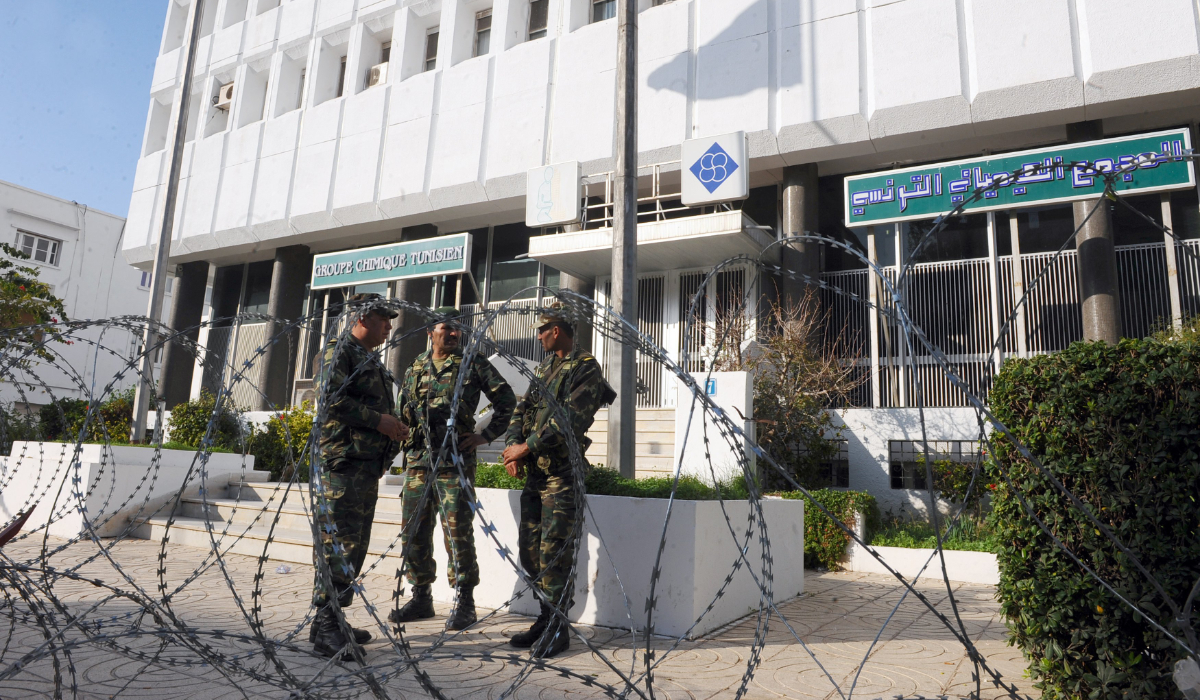
Tunisian soldiers stand guard in front of the headquarters of the Tunisian Chemical Group in Tunis on November 30, 2011. (AFP)
Short Url
Updated 11 October 2025
Follow

Tunisian protesters storm chemicals complex over health fears

Tunisian soldiers stand guard in front of the headquarters of the Tunisian Chemical Group in Tunis on November 30, 2011. (AFP)
  • “Gabes has turned into a city of death, people are struggling to breathe, many residents suffer from cancer or bone fragility due to the severe pollution,” Khaireddine Dbaya, one of the protesters, told Reuters

TUNIS: Residents entered the state-run Tunisian Chemical Group’s (CGT) phosphate complex in the southern city of Gabes on Saturday, demanding its closure to prevent environmental pollution and respiratory illnesses, witnesses said. The protest highlights the pressure on President Kais Saied’s government, already strained by a deep economic and financial crisis, to balance public health demands with the production of phosphate, Tunisia’s most valuable natural resource.
Demonstrators were walking inside the facility and chanting slogans calling for its closure and dismantling, witnesses said and videos on social media showed.

HIGHLIGHTS

• Protesters demand closure of Gabes phosphate complex over pollution

• President Saied blames old policies for Gabes’ environmental crisis, orders solutions

• Government plans to boost production of phosphate , a key export for Tunisia

Army soldiers and military vehicles were seen stationed inside the complex, though no clashes were reported.
“Gabes has turned into a city of death, people are struggling to breathe, many residents suffer from cancer or bone fragility due to the severe pollution,” Khaireddine Dbaya, one of the protesters, told Reuters.

GABES SUFFERING ENVIRONMENTAL CRISIS
CGT did not respond to Reuters’ attempts to seek comment on the situation in Gabes.
President Saied said last week that Gabes was suffering an “environmental assassination” due to what he called criminal old policy choices, blaming them for widespread illness and the destruction of local ecosystems.
He urged swift action and the adoption of youth-proposed solutions to address an ongoing environmental crisis. In 2017, authorities pledged to dismantle the Gabes complex and replace it with a facility that meets international standards, acknowledging that its emissions posed a danger to local residents. However, the plan has yet to be implemented.
Tons of industrial waste are discharged into Gabes’s Chatt Essalam sea daily. Environmental groups warn that marine life has been severely affected with local fishermen reporting a dramatic decline in fish stocks over the past decade, hitting a vital source of income for many in the region.
The latest wave of protests was triggered this week after dozens of schoolchildren suffered breathing difficulties caused by toxic fumes from the nearby plant.
Videos showed panicked parents and emergency crews assisting students struggling to breathe, further fueling public outrage and calls for the plant’s closure.
The government aims to revive the phosphate industry by increasing production fivefold to 14 million tons by 2030 to capitalize on rising global demand. 


Turkiye preparing law to let PKK fighters return under peace plan

Updated 6 sec ago
Follow

Turkiye preparing law to let PKK fighters return under peace plan

Turkiye preparing law to let PKK fighters return under peace plan
The proposed law would protect those returning home but stop short of offering a general amnesty
Some militant leaders could be sent to third countries under the plans

ISTANBUL: Turkiye is preparing a law to let thousands of Kurdistan Workers Party (PKK) fighters and civilians return home from hideouts in northern Iraq under negotiations to end generations of war.
A senior Middle East official and a Kurdish political party source in Turkiye said the proposed law would protect those returning home but stop short of offering a general amnesty for crimes committed by former militants. Some militant leaders could be sent to third countries under the plans.
Bringing PKK guerrillas and their families home from their bases in mountainous northern Iraq is seen as one of the final hurdles in a peace process launched a year ago to end a war that has killed 40,000 people.
While officials have spoken publicly about reconciliation efforts in general terms, the sources disclosed details that have not previously been reported, including proposals for returns to take place in separate waves of civilians and fighters, and for commanders to be sent to third countries.
The Middle East official, describing the sensitive negotiations on condition of anonymity, said legislation to allow the returns could come before the Turkish parliament as soon as this month.

PLAN COULD INCLUDE SEPARATE WAVES OF RETURNS
Turkiye’s intelligence agency MIT, which has led talks with the PKK, did not immediately comment on the proposal. The PKK did not immediately comment.
Since Kurdish militants launched their insurgency in 1984 — originally with the aim of creating an independent Kurdish state — the conflict has exerted a huge economic and social burden on Turkiye and neighboring countries.
Ending it would boost NATO member Turkiye’s political and economic stability, and ease tensions in Iraq where the PKK is based, and Syria where Kurdish fighters have been allied with US forces.
In a major breakthrough, the PKK announced a decision in May to disarm and disband after a call to end its armed struggle from its jailed leader Abdullah Ocalan.
In July the group symbolically burned weapons, and last month it announced it was withdrawing fighters from Turkiye as part of the disarmament process. It called on Ankara to take steps to let its members participate in “democratic politics.”
But the terms of reconciliation have been sensitive, with Turkiye wary of offering a wide amnesty for what it considers past crimes of a terrorist organization.
Numan Kurtulmus, who heads a reconciliation commission set up by Turkiye in August, said last week that any legal steps would come only after Turkiye verifies that the PKK has completed its dissolution process.
“Once Turkiye’s security and intelligence units have verified and confirmed that the organization has truly laid down its arms and completed its dissolution process, the country will enter a new phase of legal regulations aimed at building a terror-free Turkiye,” he said.
According to the senior Middle East official, the proposal now being discussed would see roughly 1,000 civilians and non-combatants return first, followed by about 8,000 fighters after individual screening.
Beyond that, the official said Turkiye had so far rejected taking back around 1,000 senior and mid-level PKK figures, and wants them relocated to a third country, possibly in Europe.
Talks were ongoing on that issue, with some parties involved in the negotiations concerned that excluding PKK top brass from repatriation could eventually fuel a renewed insurgency, the official said.
Legislation to enable returns could come before the Turkish parliament as early as the end of November, the official added.
Tayip Temel, deputy co-chair of the pro-Kurdish DEM Party — which though an opposition party has worked closely with the government on the peace process — said the ongoing negotiations focused on a formula personally emphasized by Ocalan.
“Work is underway on a special law for the PKK to enable the democratic and social reintegration of its members,” Temel told Reuters.
“The law will cover everyone returning from the PKK, whether civilian or militant. There is no plan for a phased return. The formula being worked on is comprehensive and applies to all.”
He confirmed that Turkiye had raised the idea of some PKK figures being sent to third countries, but said this would have to be discussed with the potential hosts.

DIFFERENT PROCEDURES FOR DIFFERENT GROUPS
Another source at DEM, parliament’s third-biggest party, said the commission drafting the proposal was working on a single, PKK-specific law that would avoid the language of a general amnesty.
“Different procedures will apply to different groups of returnees,” the source said, adding that some returning PKK members will likely face investigations and trials. “Otherwise it will be hard to reach common ground among parties in the commission.”
Once the parliamentary commission completes its work, it is expected to recommend the special PKK law to parliament, paving the way for potential legislation.
Human Rights Watch urged lawmakers to use the peace process to reform laws that have long been used to charge and incarcerate non-violent Kurdish activists.
The commission “has a unique opportunity to help shape a post-conflict society and should make bold recommendations to repeal abusive laws used to silence and marginalize people,” said Hugh Williamson, Europe and Central Asia director at HRW.