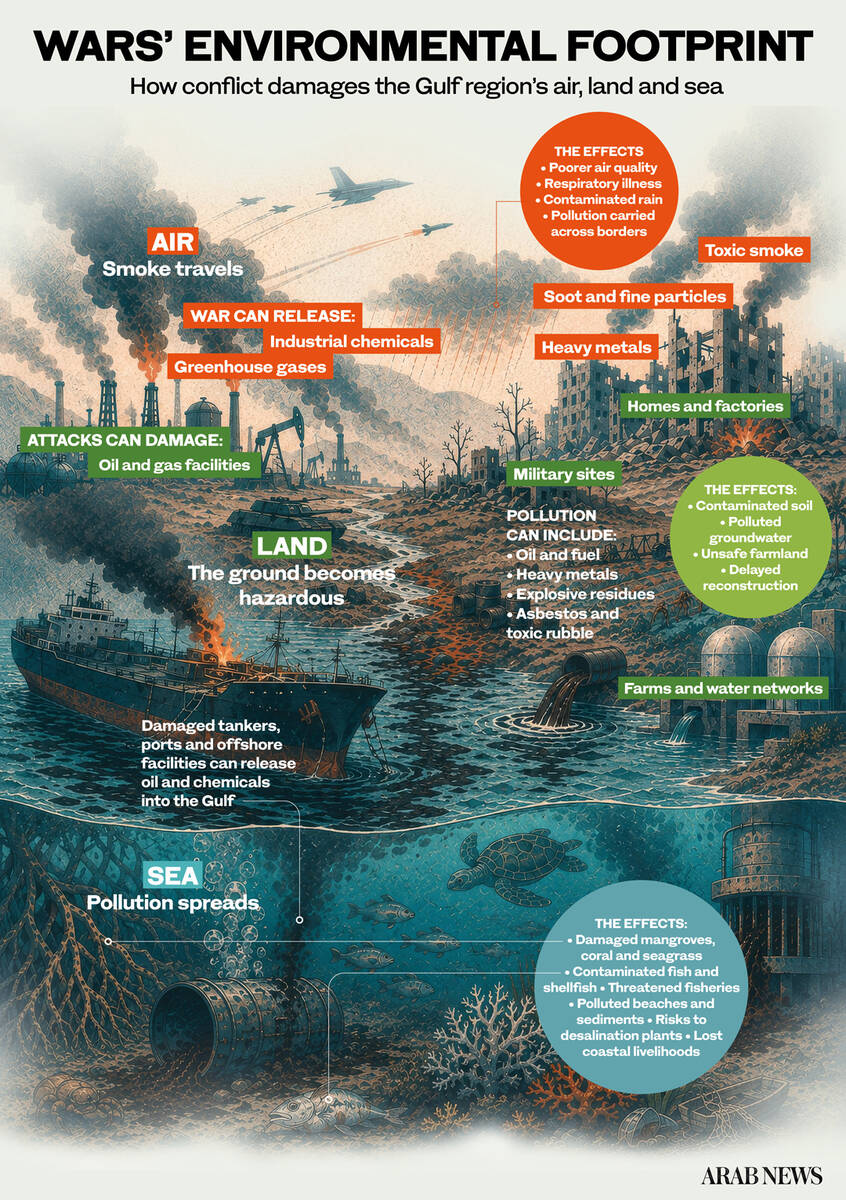
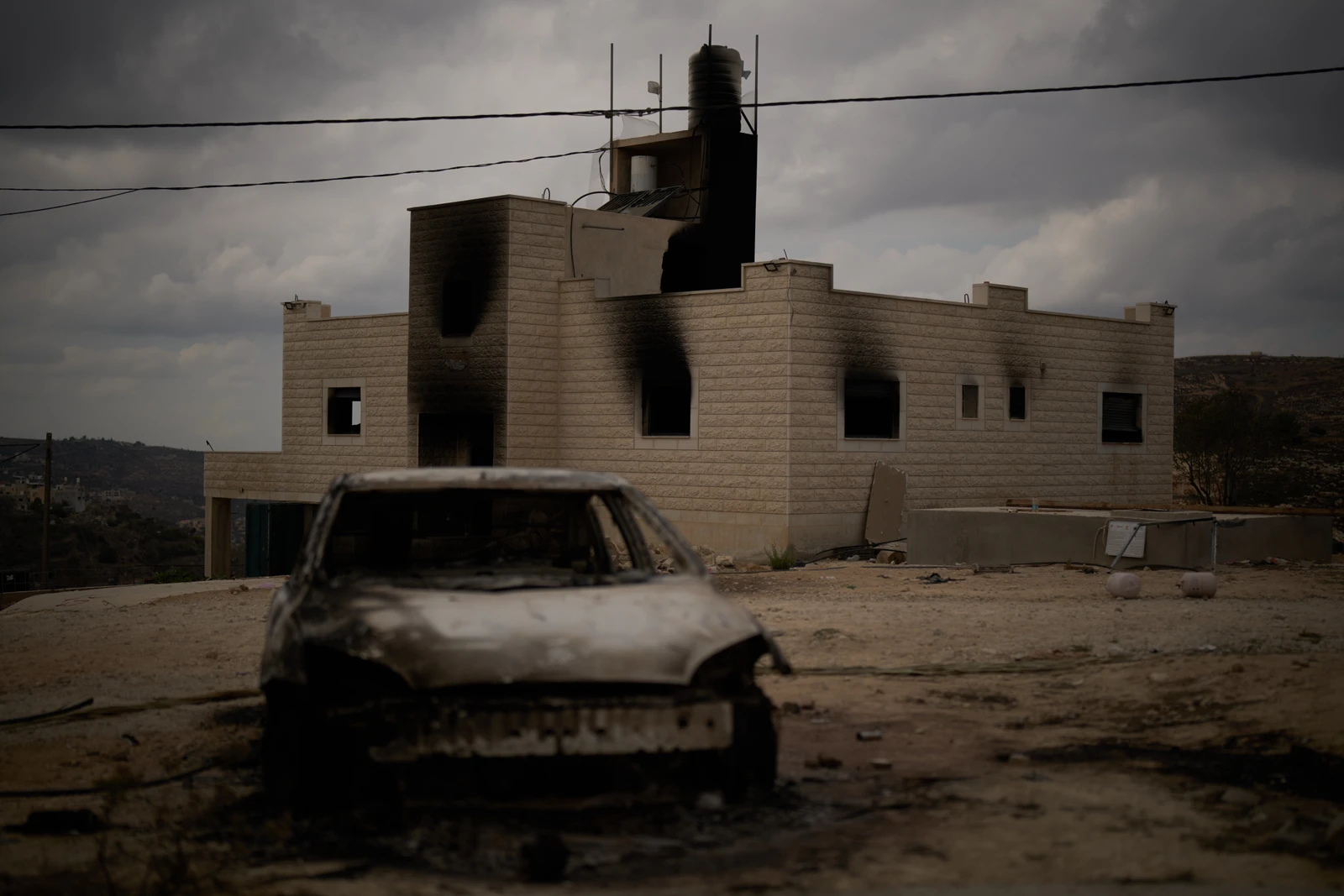
- A tanker spill off Oman is the latest sign of environmental damage ranging from polluted seas to tons of carbon emissions
- Researchers say threat from unexploded ordnance, sunken vessels and damaged infrastructure can persist for decades
LONDON: In a war that has seen tankers in the Gulf and the Red Sea repeatedly targeted, it was clear that a massive oil spill was an environmental disaster just waiting to happen — and that disaster is now unfolding.
On June 30, the Caroline Bezengi, a tanker carrying more than 800,000 barrels of oil, ran aground on an island 50 km off the coast of southern Oman.
The ship, under sanctions by the UK and the EU as a consequence of the Russian invasion of Ukraine, loaded its cargo at Russia’s Black Sea port of Novorossiysk in April, and had transited the Suez Canal on May 30.
On June 8, having just exited the eastern end of the Maritime Security Transit Corridor in the Gulf of Aden, and while still in waters off Yemen, it suffered an explosion.
It seems that the tanker sailed out of one war only to fall victim to another.
The Houthis have fired on shipping in the Red Sea, but so far no state or organization has claimed responsibility for the attack on the Caroline Bezengi.
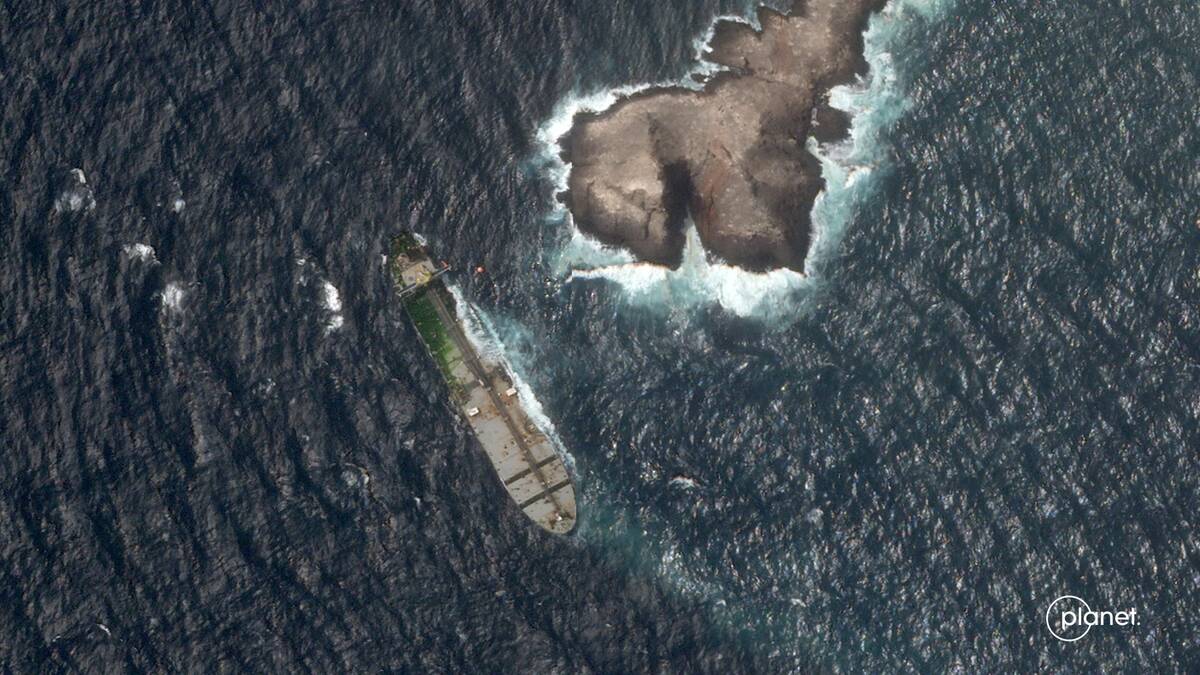
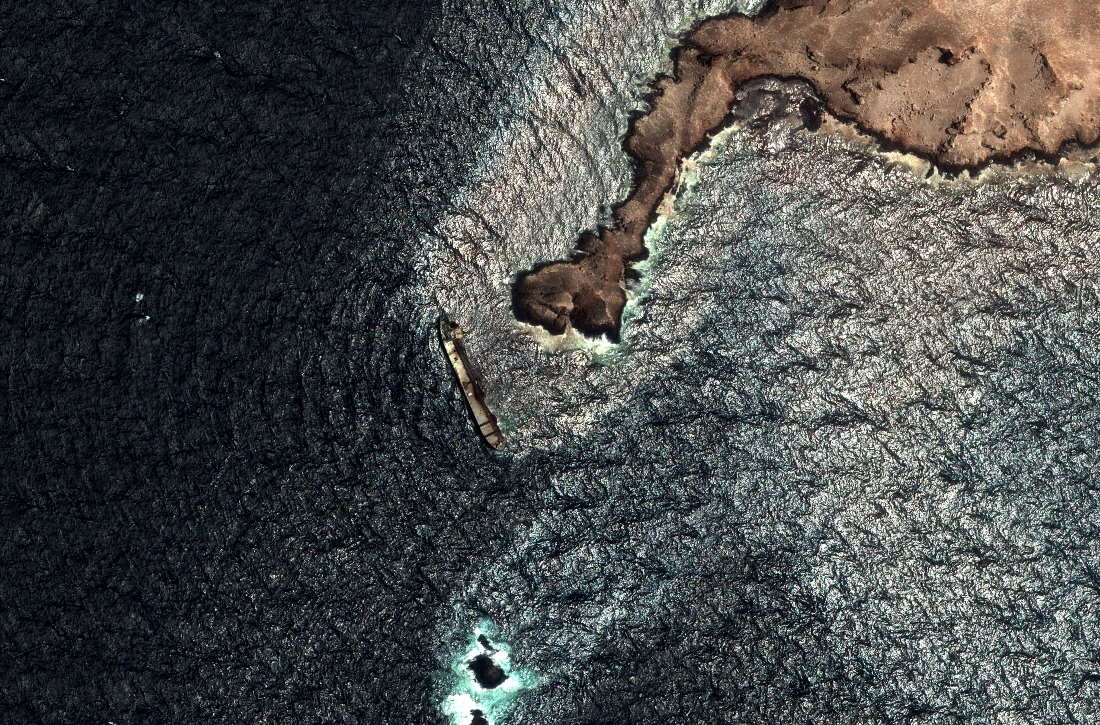
After four days the crew of the ship were rescued and the tanker was driven by heavy seas onto rocks off Al-Qibliyah, one of the Hallaniyat Islands.
Here, in the heart of an Omani nature reserve that is home to diverse wildlife including Socotra cormorants and humpback whales, it is now leaking vast amounts of oil, which has already begun to wash up on the beaches of the mainland, in an area known as the Turtle Coast.
On Thursday, Oman’s National Committee for Emergency Management said it was “monitoring the repercussions of the fuel tanker grounding incident.”
As devastating as such incidents are, oil spills are only the most visible of the multiple environmental consequences of warfare, as a recent analysis shows.
Researchers at Queen Mary University of London, Lancaster University and the Climate and Community Institute found that in the first 14 days alone the current Iran war generated more than 5 million tons of carbon dioxide — equivalent to the entire carbon output of Iceland for a whole year.
Put another way, the study estimates that the emissions generated by the war between Feb. 28 and March 14 March “are equivalent to the annual output of around 1.1 million petrol cars, with associated climate damages exceeding $1.3 billion.”
The research looked at direct and indirect emissions, including those caused by military operations, destruction of infrastructure and damage to fuel and oil facilities.
“Emissions from armed conflict remain largely invisible in global climate policy,” said Benjamin Neimark, a human geographer and political ecologist at Queen Mary University’s School of Business and Management.
“They are rarely counted, rarely reported and rarely discussed. But without proper accounting, we are underestimating the true drivers of climate change and missing a critical part of the picture.”
In a previous piece of research, published in the journal One Earth in March, the researchers estimated that by January 2025 Israel’s war in Gaza had generated more than 30 million tonnes of carbon emissions — comparable to the total emissions of Jordan for 2024.
Both pieces of research revealed that the bulk of the environmental impact of conflict, in terms of carbon pollution, at least, is largely unseen.
For example, although TV news coverage of the Iran war has featured endless dramatic footage of munitions striking targets, the intensive use of missiles and drones in the first two weeks of the conflict accounted for little more than 1 percent of the 5 million tonnes of carbon dioxide equivalent generated.
By far the largest share of carbon cost — almost half of the total — was attributed to the “embodied carbon emissions” from the destruction of airports, military structures, homes and commercial buildings.
The destruction of oil facilities in Iran and around the Gulf accounted for 1.8 million tonnes, fuel expended by aircraft in combat and support operations cost 529,000 tonnes and the loss of “embodied carbon” in destroyed ships and aircraft added up to 172,000 tonnes.
In other words, the environmental costs of war are not limited to obvious consequences, such as the oil spill now threatening Omani waters, are not necessarily obvious at the time, and may have long-term consequences.
And, occasionally, those consequences may be very long-term indeed, as an incident that took place in the Arabian Gulf in the wake of the Second Gulf War demonstrated.
Through the early months of 2011, a team of British maritime security experts had been painstakingly clearing the way for a new pipeline that would reconnect Iraq’s war-battered mainland oil industry to its deep-water tanker terminals, some 50 km offshore.
On May 7, sonar scans had identified a series of six large, seemingly unnatural deposits arranged in a rough line over several hundred meters on the seabed — right in the path of the advancing pipeline.
Divers had managed to free a barnacle-encrusted metal object from one of the rock-like piles and, when it was brought it to the surface and examined it on the deck of the survey ship, it became clear that they had recovered an exploded artillery shell of some kind.
The team of ex-military divers had already found plenty of explosives on this job, relics of Iraq’s wars including large numbers of anti-personnel mines, mortar rounds, artillery shells and even rocket parts.
But this, as a quick call to the NATO-funded Explosive Ordnance Disposal Technical Information Cell in the UK determined, was different.
What they had found was a British-made white phosphorous shell from the First World War — and there were 4,000 more of the things, encased in coral on the seabed, where they had lain undisturbed for almost 100 years.
The conclusion was that the shells, surplus to requirements after the end of the war in Mesopotamia in 1918, had been simply dumped in the Arabian Gulf. Stacked on wooden pallets, the shells had been pushed off the stern of a slowly moving warship.
Removing them now, after almost a century underwater, could have been disastrous — above 30 degrees centigrade, white phosphorous ignites spontaneously in air.
The single recovered shell was quickly returned to the seabed, and the decision was made to simply route the pipeline around the six heaps.
They lie there to this day, pollution that continues to pose an environmental threat long after the last of the men who created it have died.
Since Feb. 28, the unexploded shells, along with the deadly detritus of the 1980s Iran-Iraq war, the Gulf War of 1990-91 and the Iraq War of 2003-2011, will have been joined by countless failed or intercepted rockets fired across the Gulf, to say nothing of the sunken ships and downed aircraft that now litter the seabed.
This unseen environmental toll, a potentially long-term threat to marine wildlife and sensitive coastal environments along the shores of the Arabian Gulf, is part of a large follow-up program of research by the authors of the “snapshot” study of the first two weeks of the war, on which work is now under way.
For now, though, the immediate focus is on the potentially catastrophic consequences of the Oman oil spill.

Incidents such as the wrecking of the Caroline Bezengi impact the insurance premiums paid by shipping companies, which have already rocketed on account of the war and the twin blockades of the Strait of Hormuz and the Bab Al-Mandab strait at the southern end of the Red Sea.
Clearing up such spills is a costly business, as the Insurance Journal has been reporting this week — and the Omani government says the slick already covers an area of almost 400 sq. km, about half the size of New York City.
Satellite monitoring by environmental conservation non-profit SkyTruth appears to suggest that little was done to alleviate the threat from the stricken ship for at least two months after it grounded.
But on Thursday, Ambrey, a UK-based maritime risk-management company, confirmed it had been contracted to coordinate the salvage of the ship and to tackle its spill.
“Ambrey is working diligently with all relevant stakeholders, including within the Sultanate of Oman, and has contracted the support of a leading international oil spill response company,” said the firm in a statement.
Ambrey, it added, “has been mobilized as part of a significant international response including salvage vessels, aircraft and an experienced team of specialist personnel with over 100 tons of equipment.”
Salvage vessels were en route and “specialist personnel have already boarded the vessel with the support of the Royal Air Force of Oman to assess conditions onboard and commence cargo and vessel stabilisation.”
Ed Wollaston, director of Global Response at Ambrey, said they were working in “an extremely challenging situation, compounded by adverse weather conditions associated with the Khareef monsoon. However … we are working around the clock to mitigate the environmental impact.”
Tony Gutierrez, professor of environmental microbiology and biotechnology at Edinburgh’s Heriot-Watt University, told the Insurance Journal that tackling the spill would mean spraying large amounts of disinfectant by aircraft, and using booms and pumps to collect the oil to prevent it reaching the shore or sinking to the seabed.
“If this oil is kept offshore, the impact will be much less than if the oil reaches shallower waters and the actual coastline,” he said.
If that were allowed to happen, he added, “you could find oil still there years later.”
That was what happened after the disastrous oil spill from the tanker Exxon Valdez, which ran aground in Alaska in March 1989, spilling more than 260,000 barrels of oil.
“Ten years down the line, there still were remnants of oil,” he said.
With the oil from the Caroline Bezengi already washing up on Oman’s mainland shoreline, it remains to be seen just how successful the clean-up operation that is now under way will be.
What is certain is that the environmental consequences of the Iran war are likely to be felt, in myriad ways, long after the guns have fallen silent.