



ISLAMABAD: Before Sara Shakeel covered dinner tables, desert landscapes and imagined planets in crystals, her canvas was a screen, where experimental Instagram collages made in Pakistan began attracting an audience far beyond the country.
Nearly a decade later, the Pakistani multidisciplinary artist has built an international career around an instantly recognizable visual language, using crystals, glass and light to transform ordinary objects and images and, increasingly, entire physical spaces.
Her work has moved from viral Instagram collages to major installations in London, Saudi Arabia, Hong Kong and beyond. In 2019, she created the crystal-embedded cover art for American musician Chance the Rapper’s debut studio album, “The Big Day,” and contributed to an immersive pop-up exhibition accompanying its release in Chicago.
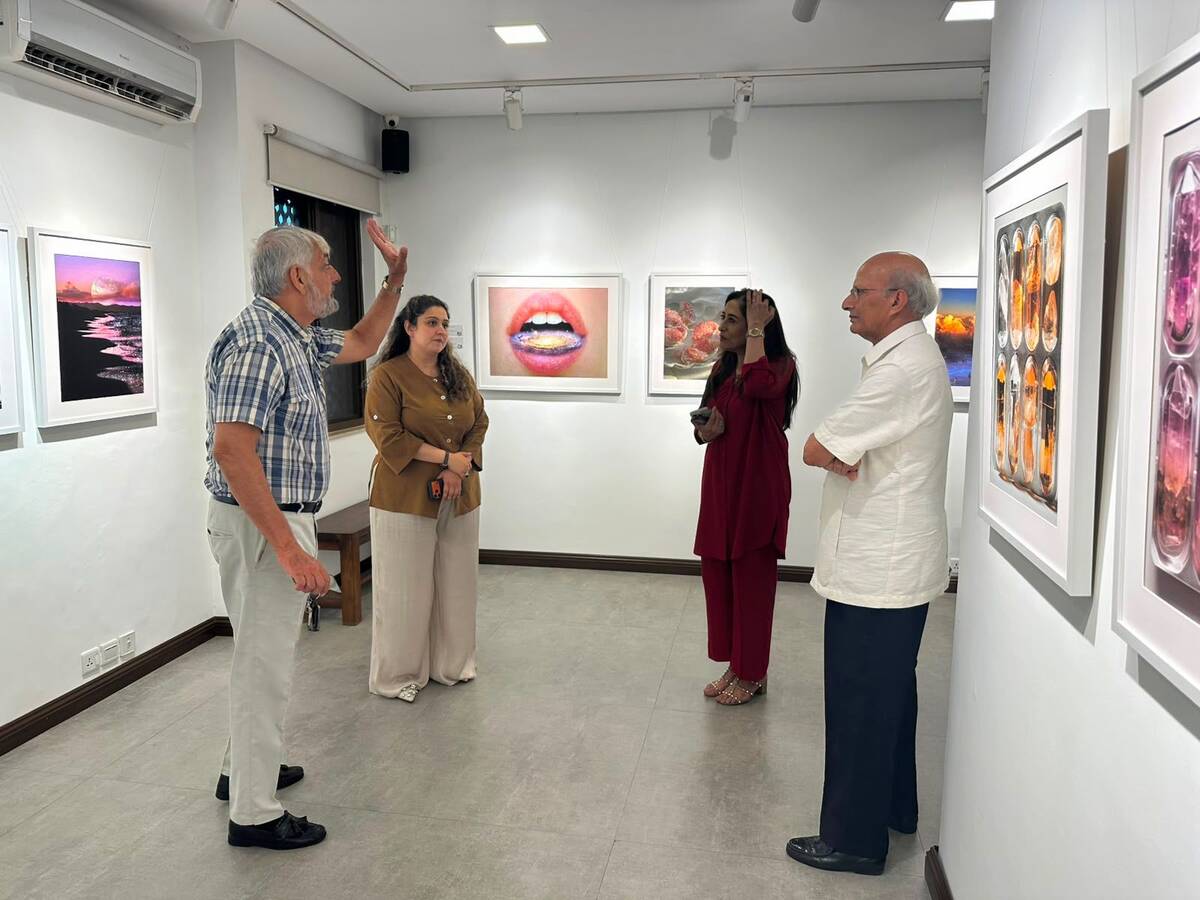
Pakistani multidisciplinary artist Sara Shakeel (second left) having a chat with visitors at an exhibition at Tanzara Gallery in Islamabad, Pakistan, on August 17, 2026. (AN photo)
Her first major physical installation, “The Great Supper,” transformed a dining table, chairs, food and tableware into a crystal-covered meditation on family meals for London’s NOW Gallery. More recently, a 521-square-meter project in Hong Kong during Art Basel Week drew on ancient civilizations’ interpretations of the cosmos and the work of Pakistani artisans. Her physical practice has also expanded through large-scale commissions in Saudi Arabia, including installations for Hia Hub and the Saudi Cup.
Now Shakeel’s journey has brought her back to Islamabad, where her exhibition, “All Roads Lead to Home” traces a practice that began with making digital images for herself.
But Shakeel did not set out to build a career in art. She was studying dentistry in Pakistan and left during her final year, at a point when she said she was looking less for professional recognition than for a sense of peace.
“I never became an artist to be famous. Never. I genuinely did it because it made me happy. It still does,” Shakeel told Arab News during an interview this week at the exhibition at Tanzara Gallery in the historic Saidpur Village.
She began making digital collages and posting them on Instagram, using the process as an escape.
“I used to post a lot of collages on Instagram, every day because, for me, creating collages was extremely therapeutic,” she said. “It released a sense of happiness within me.”
Within months, Shakeel said, the images were being shared around the world, including by celebrities such as Miley Cyrus and Sarah Jessica Parker.
FROM DIGITAL TO PHYSICAL
At the center of the artist’s work was an aesthetic that became her signature: digitally placing crystals and glitter over photographs of bodies, landscapes and mundane objects, sometimes in unexpected places such as stretch marks or rolls of toilet paper. Her glitter stretch-mark images, which recast marks often treated as imperfections as something to be embellished, became among her most widely recognized early works.
Shakeel describes the technique as “digital crystals” and says she began developing it in 2016.
But what had existed largely on screens was soon asked to become physical.
London’s NOW Gallery selected Shakeel for its Young Artist program and challenged the digital artist to create something tangible. Her answer was “The Great Supper,” first exhibited there in 2019: a dining table and everything surrounding it covered in crystals. Contemporary accounts of the exhibition described it as her first sculpture and first solo installation.
“They approached me, and they were like, ‘Sara, we know that you’re a digital artist, but we want to know if you have anything physical that you can create,’” Shakeel said.
“And I came up with this concept of creating a dinner table, which is called The Great Supper, entirely made out of crystals.”
Beneath the spectacle was an intimate memory of Pakistan: the family dinner table.
“In our families back in the days, we used to sit on tables, have conversations with parents and family,” Shakeel said.
“For me, my memory was that if I had to ask my dad to go out for a trip, I had to sit on the dinner table and, you know, say, ‘Papa, I have to ask you something.’”
The installation explored the erosion of that ritual as families increasingly retreated to their phones and separate rooms, an idea Shakeel also discussed when the work originally opened in London.
BUILDING WORLDS
As Shakeel moved from digital collage into physical space, the scale of the worlds she was creating expanded.
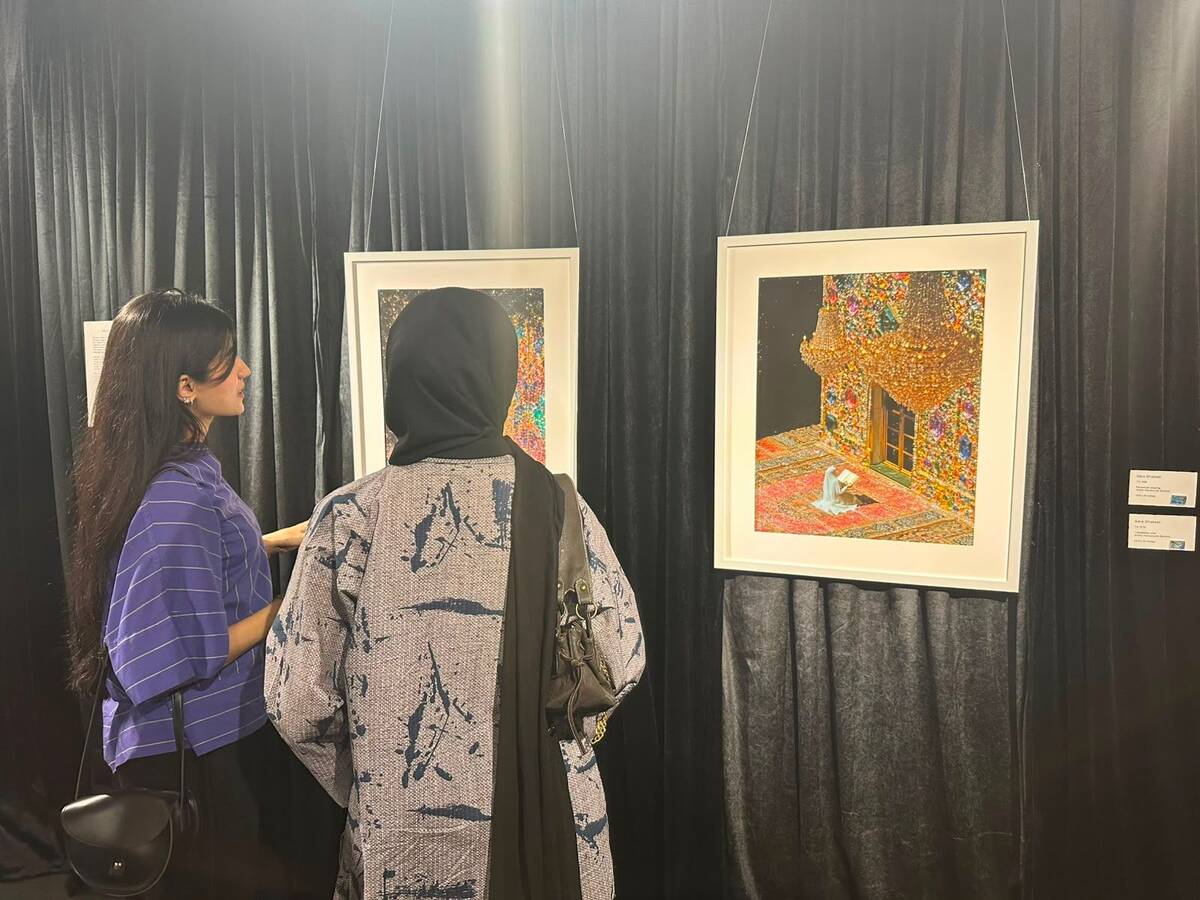
Visitors take a look at the art work displayed at an exhibition at Tanzara Gallery in Islamabad, Pakistan, on August 17, 2026. (AN)
Her collaboration with Chance the Rapper illustrated the crossover between the two. After seeing one of her digital images of a transparent, crystal-covered disc, the musician commissioned Shakeel to turn the concept into a physical object for “The Big Day.” She created a clear resin disc embellished with Swarovski crystals that was photographed for the 2019 album cover, before contributing artworks to “The Big Store,” an immersive Chicago exhibition built around moments from the musician’s life.
For a 521-square-meter space in Hong Kong during Art Basel Week, she created a solar system exploring how civilizations understood the planets before modern technology, researching mythology, folklore and symbols from different cultures.
“I designed all of this. I read every civilization and what they... the symbols they used for different planets,” she said.
The project also incorporated the work of Pakistani artisans, whose traditional skills Shakeel wanted to place within a contemporary international installation rather than simply reproduce in a familiar form.
“I just didn’t commission them to create something like a like a shadi ka jora,” she said, referring to an intricately embroidered wedding outfit.
“It was a very intimate process.”
Shakeel said the artisans were told about the larger project and their contribution to the Hong Kong exhibition.
“They really put their hearts into this,” she said. “Of course, it was a vision, but it was a vision brought by a lot of people coming together.”
Her international work also took her to Saudi Arabia, where an installation created with the Saudi Research and Media Group and Hia magazine for the Hia Hub fashion and lifestyle conference led to a larger commission for the Saudi Cup in 2023.
Despite the growing scale of the work, Shakeel said the idea underlying it remained remarkably simple.
“I am extremely in love with god and His creations, and whatever I see, whatever I put my eyes, you know, look into, I I see the beauty in it,” she said.
Her crystals, she said, were a way of making other people stop and look too.
“Crystals, no matter where you see them and no matter what you are in life, when something sparkles in front of you, it captivates you, you know.”
“So for me, I use that as an attention grabber, you know? Um, I grab their attention by adding crystals. Something that shouldn’t be there. You don’t expect crystals on a toilet paper.”
ALL ROADS LEAD HOME
Nearly a decade after Shakeel began posting her collages from Pakistan, works from the different stages of that journey have now arrived in Islamabad under a fitting title.
“All Roads Lead to Home,” at Tanzara Gallery, brings the artist back to a city where she lived and worked before her images found a global audience.
For some visitors, the exhibition also closes another circle: encountering in physical form work they had previously known through a phone screen.
“I am a huge fan of Sara’s work and used to saw her work on Instagram,” fashion designer Syeda Eisha Bukhari told Arab News. “And this is the first time I am attending her exhibition and I am loving her work. In person, it’s even more beautiful.”
For Shakeel, however, the journey from dentistry to Instagram and from digital collages to installations around the world is ultimately less about the scale of the work than what making it continues to give her.
“I never do anything that I don’t love,” she said.
She described creating as a place she retreats to when she wants to get away from “the cleverness of the world,” comparing the process to working alone like a “mad scientist.”
But she also sees the purpose of creative work as extending beyond herself.
“I think everyone’s job as a human being is to be in service to mankind in one form or another,” Shakeel said. “Let it be as a doctor, let it be as an artist, let it be as an emotional... you know, there are many forms of being in service for mankind.”
“Allah put this in front of me, and I started walking. If this finishes, I’ll find another way.”





