
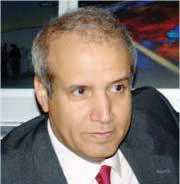

I know it’s difficult for an 88-year-old man to change his way of thinking; this is the case of Sadiq Al-Mahdi, the most prominent leader in Sudan and the head of the National Ummah Party.
He became a prominent Sudanese figure and presided over an elected government. Sadiq was overthrown in the 1989 coup. He then led the opposition against the duo of Bashir and Turabi for a quarter of a century. Despite Sadiq’s stature, you may be left shocked after reading his viewpoints. What he wrote last Friday in Al-Hayat newspaper reveals the secret behind the durability of a dictator’s governance like Omar Al-Bashir, and the reason behind the failure of the opposition led by Sadiq all these years.
He wrote about how an US-Zionist conspiracy brought a religious ruler, Hassan Al-Turabi of the Muslim Brotherhood, to power to prove that Islamic leadership would fail as a system of governance.
He believes the world is running according to the theory of Miles Copeland, author of “The Game of Nations,” a book that alleged that US intelligence is the decision maker and conspirator in global affairs. Sadiq cited one of the Sudanese security officers who told him: “This is not purely a Sudanese coup; it was plotted by the CIA.”
Thus, the leader of the Sudanese opposition believed the myth of “the Game of Nations” and is convinced that the fate of people’s worldwide is decided by the US intelligence service. A long list of concepts preoccupy the mind of a ruler who can neither deal with reality nor build for the future. In addition to these myths, Sadiq blamed everyone but himself and his own inadequacy in his memoirs. He even blamed former Egyptian President Hosni Mubarak saying that he worked against Sudan and pushed it to get involved in the Cold War. Historically, Sadiq’s party won the Sudanese elections with majority votes. However, his defeated MB rival Hassan Al-Turabi, took the presidency away from him by force with the cooperation of an overwhelmed sergeant.
Nevertheless, Sadiq does not provide a truthful and objective interpretation of his leadership and his party at that point in time; it is now history and yet, he does not admit his mistakes, such as the inability to deal with the chaos in the Sudanese political scene at the time. Instead of enhancing his nation’s ties with its most important neighbors, the Arab states were surprised that Sadiq Al-Mahdi was engaging in diplomacy that was counterproductive to Sudan’s interests. He made inroads with Iran and allowed his aides to usher in a new era of regional relations, implying hostility toward Egypt, the Gulf and Iraq, at the peak of their conflict with Iran. Sadiq also canceled the mutual defense agreement with Egypt; this was a serious message for Egypt, Sudan’s most important neighbor.
All of Sadiq’s actions suggested hostility toward Sudan’s Arab neighbors without any reasonable justification yet he still wonders why they were angry with him. I believe that it was easy for Iran to supersede Sadiq’s rule because the latter had brought them right into the heart of the Sudanese capital. At this point it is hard to dismiss their strong relationship with Turabi, whose party, the Muslim Brotherhood, considers Khomeini’s Iran as a role model.
The conspiratorial duo of Turabi, the religious and Bashir, the militarist, left the door even wider open for Iran after the coup. This reality is the antitheses of Sadiq’s theory, that the CIA is the one that brought them to power because it wanted to prove the failure of the Islamists’ rule. This analysis is illogical of course.
In any case, I believe that the failure of the Sudanese opposition for two and a half decades in brushing away the rebels is attributable to the mentality of its leaders, its belief in the myth of plots, its tendency to blame others without acknowledging its own mistakes, and its inability to do what is the best for the interest of the Sudanese people.


