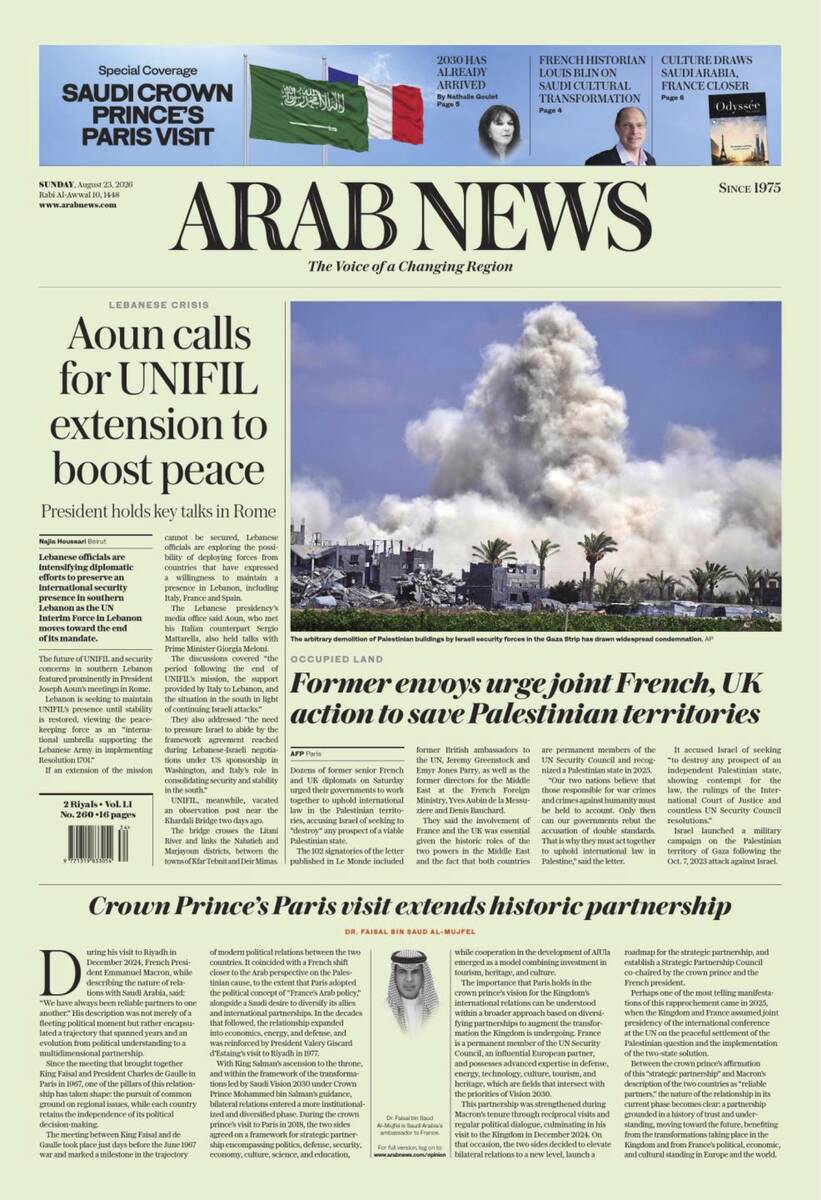

During his visit to Riyadh in December 2024, French President Emmanuel Macron, while describing the nature of relations with Saudi Arabia, said: “We have always been reliable partners to one another.” His description was not merely of a fleeting political moment but rather encapsulated a trajectory that spanned years and an evolution from political understanding to a multidimensional partnership.
Since the meeting that brought together King Faisal and President Charles de Gaulle in Paris in 1967, one of the pillars of this relationship has taken shape: the pursuit of common ground on regional issues, while each country retains the independence of its political decision-making.
The meeting between King Faisal and de Gaulle took place just days before the June 1967 war and marked a milestone in the trajectory of modern political relations between the two countries. It coincided with a French shift closer to the Arab perspective on the Palestinian cause, to the extent that Paris adopted the political concept of “France’s Arab policy,” alongside a Saudi desire to diversify its allies and international partnerships.
In the decades that followed, the relationship expanded into economics, energy, and defense, and was reinforced by President Valery Giscard d’Estaing’s visit to Riyadh in 1977, and later by the growth of security and military cooperation.
During the reigns of King Fahd and King Abdullah, Paris became a more prominent political and military partner. France’s participation in the Gulf War to liberate Kuwait reinforced mutual trust, while the relationship reached a remarkable level during Jacques Chirac’s presidency, built on political alignment with the Saudi leadership and shared ground on issues concerning Palestine, Lebanon, and Iraq. After the events of Sept. 11, 2001, Saudi-French dialogue gained added significance.
Saudi-French relations have entered a more institutionalized and diversified phase.
Dr. Faisal bin Saud Al-Mujfel
With King Salman’s ascension to the throne, and within the framework of the transformations led by Saudi Vision 2030 under Crown Prince Mohammed bin Salman’s guidance, bilateral relations entered a more institutionalized and diversified phase.
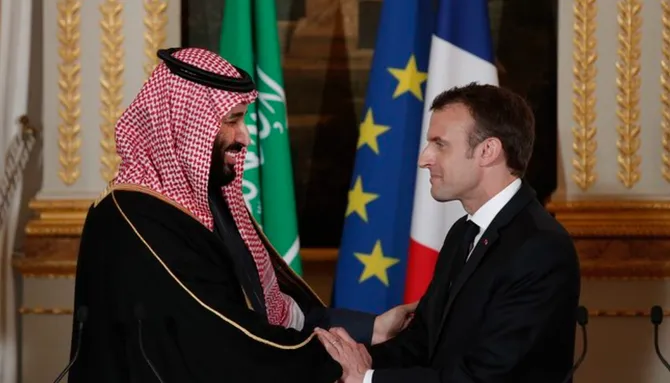
During the crown prince’s visit to Paris in 2018, the two sides agreed on a framework for strategic partnership encompassing politics, defense, security, economy, culture, science, and education, while cooperation in the development of AlUla emerged as a model combining investment in tourism, heritage, and culture.
The importance that Paris holds in the crown prince’s vision for the Kingdom’s international relations can be understood within a broader approach based on diversifying partnerships to augment the transformation the Kingdom is undergoing.
France is a permanent member of the UN Security Council, an influential European partner, and possesses advanced expertise in defense, energy, technology, culture, tourism, and heritage, which are fields that intersect with the priorities of Vision 2030. Moreover, France’s approach to strategic autonomy provides space for dialogue on both regional and international issues.
This partnership was strengthened during Macron’s tenure through reciprocal visits and regular political dialogue, culminating in his visit to the Kingdom in December 2024. On that occasion, the two sides decided to elevate bilateral relations to a new level, launch a roadmap for the strategic partnership, and establish a Strategic Partnership Council co-chaired by the crown prince and the French president.
Perhaps one of the most telling manifestations of this rapprochement came in 2025, when the Kingdom and France assumed joint presidency of the international conference at the UN on the peaceful settlement of the Palestinian question and the implementation of the two-state solution. This marked a transition from bilateral coordination to joint work on shaping international diplomatic initiatives.
This partnership takes on a contemporary dimension with the crown prince’s visit to Paris, which is expected to include talks with the French president on bilateral relations, and regional and international issues of shared interest. The visit comes as an extension of a path of regular consultation at the highest levels, reflecting the continuity of the partnership and the two countries’ commitment to developing it amid accelerating international transformations.
For his part, the crown prince encapsulated the spirit of this phase following his visit to France in 2022, when he affirmed that the talks demonstrated “our shared desire to strengthen the strategic partnership between our two friendly countries in all fields.”
Between the crown prince’s affirmation of this “strategic partnership” and Macron’s description of the two countries as “reliable partners,” the nature of the relationship in its current phase becomes clear: a partnership grounded in a history of trust and understanding, moving toward the future, benefiting from the transformations taking place in the Kingdom and from France’s political, economic, and cultural standing in Europe and the world.
• Dr. Faisal bin Saud Al-Mujfel is Saudi Arabia's ambassador to France.