
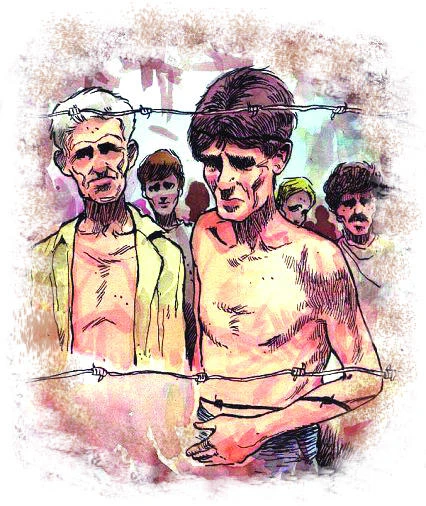

It was 20 years ago this month, on July 12, 1995, when units of the so-called Army Republika Srpska (VRS), also known as The Bosnian Serb Army, under the command of Gen. Ratko Mladic, aided by militias known as The Scorpions, entered an enclave in the besieged town of Srebrenica, in the Drina Valley of northeastern Bosnia, past a helpless 400-strong contingent of UN forces, and massacred well over 8,000 Bosnian Muslim men and boys, who had sought refuge in what was intended to be a “safe area under UN protection.”
The gruesome massacre shocked the world. The UN secretary general at the time described the mass murder as the worst crime on European soul since the World War II. How do we commemorate such a cold-blooded genocidal killing? Most of us do silently, with heads bowed. Columnists do so flagrantly, by writing about it.
Gen. Mladic, whom the media at the time too called the “Butcher of Srebrenica,” and who remained at large for an astonishing 16 years, was finally captured and, in May 2011, was extradited to the Hague to stand trial in front of the International Criminal Tribunal for the Former Yugoslavia for committing war crimes, crimes against humanity and genocide.
In court, witnesses testified to the tactics used by the VRS to starve and kill the besieged Muslim population, and how Mladic’s soldiers separated the men and boys from the women and children — the former for slaughter and the latter for rape. In court, Mladic, who bore a striking resemblance to Israel’s now deceased Ariel Sharon, another war criminal, growled at the judges and evinced no remorse.
The massacre did more than shock the world. It ended the war. Until then, the US and Nato had been deadlocked over the use of airstrikes against Bosnian Serbs. The horrors of Srebrenica broke the impasse and led to a bombing campaign that ended the conflict, which led to the Dayton accords — which in turn led the UN to adopt the doctrine of Responsibility to Protect, or R2P.
The question I want to raise here — the only question anyone can raise — is this: Why? What drives men to embark on such acts of wanton violence? Is there something in the archetype of the European people’s modern history that propels them to lunge with such unspeakable ferocity at each other? I submit there is.
Consider the World War I, the deadliest conflict in human history, with 17 million killed. Then consider the World War II, which surpassed its predecessor with 60 million killed. During that dreadful war, many millions of other people were imprisoned, enslaved and murdered for being who they were. They included Jews, Roma (known as Gypsies), those with perceived mental or physical disabilities, Jehovah’s Witnesses, political dissidents, Polish prisoners — and God knows who else.Thousands carried out the killing openly. Millions watched indifferently.
In Russia, for example, the Gulag, the government agency that administered the main Soviet forced labor camps during the Stalin era, worked to death between two and three million souls. The end result of all this? The value of human life in the minds of a whole generation was lowered. Once you consider “the other” a lower species of man — in Bosnia, a Muslim, in Germany, a Jew — you not only deny your victim his humanity, you reduce yours to a fragment. Anything will flow from there. You begin to behave in partial imitation of a beast.
When, as a case in point, armed Jewish terrorists entered the village of Deir Yassein on the night of April 8, 1948, intent on mayhem, and massacred 254 men, women and children, and threw their bodies in the village well, the victims were not people with whom the perpetrators shared their humanity. They were the hated other. What they committed was a massacre. A cold-blooded massacre. Massacre is a somber word. It refers to the wanton murder of innocent people by guilty ones, helpless civilians by armed men. Srebrenica will remain, for many years to come, full of rubble and arid shards in one’s mind. It will scar and bruise the landscape of how we see the world and how we view evil.


