
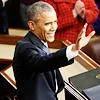

Is Barack Obama a transformational president? That was his ambition: To be more, as he put it, like Ronald Reagan than Bill Clinton, to launch a new era, not simply tack to the prevailing winds of the old.
What makes a president transformational? The first African-American president is inherently historic. Obama’s cheerleaders tick off his big accomplishments, as well: Healthcare reform; the 2009 fiscal stimulus that helped save the economy; more than 14 million jobs created in a record stretch of 70 months of growth; progressive tax reforms; progress on climate change; the nuclear deal with Iran; the move to normalize relations with Cuba, and more.
Skeptics note that his era may be called the “Long Depression” rather than the “Great Recession.” They say the Obama administration brought us worsening inequality; stagnant incomes; bigger banks; greater big-money corruption of US politics and governance; decaying public infrastructure; accelerating catastrophic climate change; and the US mired in endless wars, facing off against Russia and China and draining its coffers trying to police the world.
The presidents widely celebrated as transformational — William McKinley, Franklin D. Roosevelt, Reagan — all got big things done. But no president — even Roosevelt with his four terms — can be expected to realize a complete reform agenda. Real reforms are necessary but not sufficient to be a transformational president: He has to change the course of the nation.
That requires not only new policies but also framing and winning the ideological argument. It requires not only winning the presidency, but also helping to forge an enduring majority coalition that can sustain the era.
Obama is the first Democratic president to be elected and re-elected with a majority of the popular vote since Roosevelt. He both personifies and has helped to forge a new and growing majority coalition for progressive reform. Pollster Stan Greenberg has dubbed this coalition of millennials, people of color and single women the “rising American electorate.” Political analyst Bill Schneider calls it the “new America.” Yet the scope, durability and thrust of this coalition are still uncertain. Under Obama, the Democrats have lost control of the US Senate and the House of Representatives. Republicans have gained 913 state-legislative seats since 2010, control 30 state-legislative chambers and rule virtually unchallenged in states across the South, Great Plains and Rocky Mountains.
A transformational president has to infuse his majority coalition with a clear direction. By framing the ideological argument, he or she must help Americans understand how they got in the fix they are in and what must be done to get them out of it. The measure of ideological victory isn't simply that Democratic officeholders, activists and voters understand and enlist, but also that the opposing party finds it must adjust to the new arguments to survive.
Obama’s record in the ideological debate is mixed. On his watch, the “wedge issues” that once strongly favored Republicans began to favor Democrats.
On economic policy, Obama celebrators and detractors argue that he has extended the power of the state more than any president since Lyndon B. Johnson and his Great Society. Obama’s list is indeed impressive: An unprecedented economic stimulus; rescue of the auto industry; use of executive authority to address climate change; banking re-regulation, and 17 million more Americans with healthcare insurance because of the Affordable Care Act. He raised tax rates on the wealthy by largely letting the top-end George W. Bush tax cuts expire.
His economic stimulus, however, was weakened dramatically when he accepted Republican tax cuts in a vain effort to win bipartisan support. He undercut his argument for more public investment to get the US economy out of the crisis by arguing, only a few months after his stimulus bill passed, that government must “tighten its belt.”
His failure of vision is even more apparent in foreign policy. Obama won the 2008 Democratic nomination due, to a significant degree, to public dismay about the war in Iraq, which Hillary Clinton, his opponent, had voted for. He clearly hoped to extricate the US from the wars in the Middle East and Afghanistan and bring the inflated war on terror into perspective.
Yet he again chose not to litigate the past. He failed to offer a different vision and global strategy. His troop surge in Afghanistan turned out to be a trap. He reluctantly intervened in Libya and Syria. Though he withdrew troops in Iraq and Afghanistan, he expanded the use of drones. He allowed neoconservatives to drag him into raising tensions with Russia.
US Special Forces were active in more than 100 countries in 2015. If anything, Obama has expanded, rather than limited, the national-security claims of executive prerogative and extended surveillance and secrecy.
Obama’s successor will significantly affect history’s judgment of his presidency. If a Republican is elected president with a Republican-controlled Congress, Obama may well be seen as having lost the argument for reform. If a Democrat is elected, it will be left to him or her to interpret the moment for Americans, and to engage them in a bold reform agenda.
That Clinton has found it necessary to compete with Sanders by putting forth more activist and populist positions consolidates the thrust of the party. If a Democrat is elected president and successfully drives more reform, Obama will properly be judged as setting the stage for it. But if he or she is unsuccessful because of an obstructionist Congress, timid vision, economic woes or foreign calamities, Obama’s successor could end up discrediting progressive reform before it had the opportunity to fully take hold. Zhou Enlai was once asked what he thought about the French Revolution. He reportedly replied, “Too soon to tell.”
Will Obama be considered a transformational president? Far too soon to tell.
—
REUTERS


