
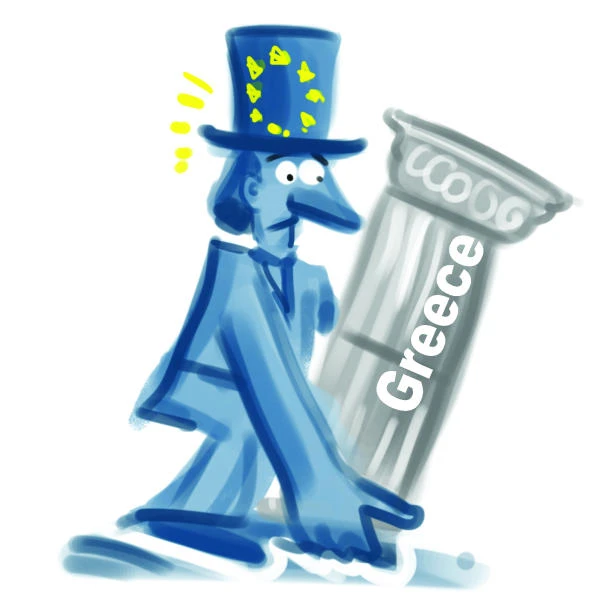

The threat that Greece may exit the euro zone, or that the country's economy may go under, was lifted recently after the Parliament in Athens reluctantly approved austerity measures required by the European Union — imperiously dictated by Germany — as a condition of a $96 billion bailout deal.
The measures, which many ordinary Greeks, along with not an insignificant number of legislators from the ruling party, see as both draconian and humiliating, are likely to unleash a lot more suffering on a population that has already suffered mightily from the worst downturn of any economy in any developed nation since the second half of the 20th century. Lest we forget, on June 30, Greece defaulted on a $1.7 billion in debt payment to the International Monetary Fund (IMF), the kind of default associated with failed states in the Third World. But for Greece and its people, the crisis appears to be over — for now.
What did this mess tell us about the European Union, or more accurately, about Germany, its mover and shaker, not to mention about Angela Merkel, the country's "autocratic" leader?
That the German government was relentless with, even dismissive and contemptuous of, Greeks in this crisis has been evident all along. Wolfgang Schauble, the finance minister, an even more aggressive hardliner than Merkel, suggested at one time that it may not be a bad idea if Athens were to exit the euro zone — though he later backtracked by saying he was only talking about a "temporary exit." All sweet talk on the outside, with a will of German steel on the inside, wouldn't you say?
All of which has raised serious questions in the public debate not only about Germany's intentions, but — hold on to your hat — Germany's "national character."
Last Friday, the Washington Post, published a front page article titled "Debt crisis revives the 'Cruel German'," with the telling subtitle, "Berlin's tough stance on Greece is erasing goodwill built up over the decades since WWII," from which I quote at length. The piece, by Anthony Faiola and Stephane Kirchner, datelined Berlin, began: "A divided Germany rose from the ashes of World War II, weathering the Cold War to transform into one of the good guys. Modern Germany quickly molded itself into the standard-bearer of global pacifism, a hotbed of youth culture and the tree-hugging Lorax of nations in the fight against climate change."
Then, the reporters added, something happened. "But, just like that, the image of the 'Cruel German' is back. Germany — more specifically, its chancellor, Angela Merkel — has faced years of derision for driving a hard bargain with financially broken Greece. But for both Germany and Merkel, the concessions extracted this week from Athens appear to have struck a global nerve. By insisting on years more of tough cuts and making other demands that critics have billed humiliating, Berlin is wiping out decades of hard-won goodwill."
What is it about Germany that has made it swing its big ego around? Is it something in its "national character," a loaded term considered both politically incorrect and, well, somewhat troubling? Yet the term has a long history in European anthropological literature, where we find discussions of it highlighting the differences between, say, Danes and Swedes, Belgians and Dutch, French and Italians, even between northern and southern Italians, northern and southern Belgians, and the rest of it. Problematic stereotypes one and all? Maybe.
Still, this columnist, true to his prissy political correctness, does not define Germany's identity, as many critics continue to do, through its revanchism in modern history (in Europe, revanchism was not unique to Germany) or through its spasm of militarism between 1933 and 1945 (there was a time when France and Britain were the militaristic bullies on the Continent), though the question remains unanswered as to how the country of Beethoven, Goethe, Hegel, Marx, Freud and Einstein could have begotten a venomous social ideology like Nazism, an ideology based on racial supremacy and the "Nordic virtues" of the "Aryan race."
Nor is this columnist naive enough to define Germany benignly as the nation that made a miraculously quick recovery after its defeat in World War II, which cast Germans as disciplined, efficient working stiffs, skilled at accumulating resources and capital faster than anyone else on the Continent, smart producers who, within a few decades, turned their country into an industrial juggernaut. National character? We'll call it that. It cannot be a mere accident that Germans are imbued with both traits of hero and villain.
In the conclusion to their Washington Post piece about the "Cruel German," Faiola and Kirchner quote a 51-year-old Berliner who works in public relations and who disapproved of his government's treatment of Greece, a fellow EU member. "I think it is a scandal," he said. "To humiliate a country like that is not acceptable. Even though the polls show that there is widespread support for Merkel and and Scauble, I think that many Germans would say that they don't want this kind of Europe. A Europe ruled by Germany in this way is not the democratic Europe that I would like to have."
But what do you do? Germany has opted to, well, stay in character.


