
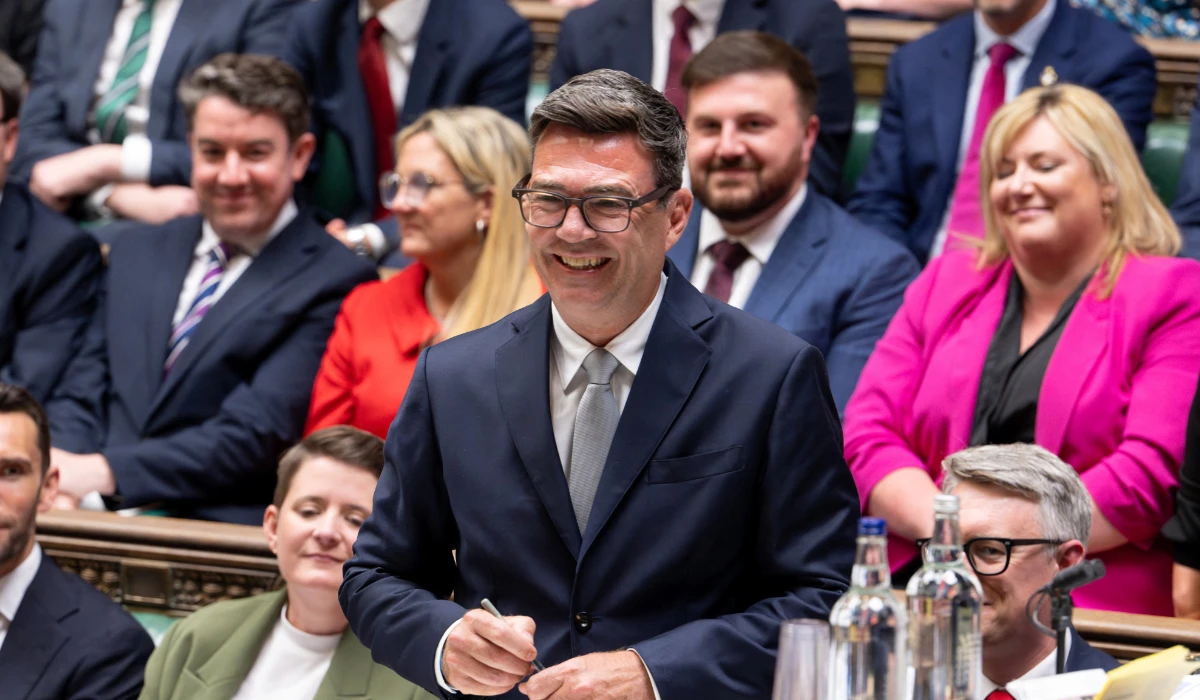

On his first morning as prime minister of the UK, Andy Burnham visited a charity for the homeless and pledged to end rough sleeping nationally by expanding the “Housing First” strategy he pursued as mayor of Greater Manchester. In doing so, he offered an early glimpse of his model of government: a state that provides resources from the center, then entrusts delivery — and the lessons that come with it — to local authorities.
The discourse surrounding Burnham’s devolution agenda often presents a false dichotomy between Manchester and Westminster, or localism versus centralism. But there is not necessarily a contradiction between handing power back to “the place where you live” and presiding over the machinery of a capable state at the national level. Consider Burnham’s pledge to “oversee the biggest council house-building program since the postwar period.” The clarity of vision and financing mechanisms come from the center, but implementation is expected to rest with councils and combined authorities on the ground. Each piece is equally critical to successful delivery, as is the connective tissue between them.
The choice was never between a strong center and strong councils, cities, and regions. The more important question is whether the two are built to work together, with the center creating leverage that other places can use, and with the lessons those places generate finding their way back to the center. Get this interplay right and the model will be self-reinforcing; get it wrong and you will perpetuate what Britain has had for the past two years: bold ambitions announced from the center, only to be quietly abandoned or compressed into short-term wins that fail to become enduring solutions.
Fortunately, cities are already engaged in learning by doing regardless of whether anyone at the center is watching. Manchester’s Bee Network brought buses under public control and taught the combined transit authority how to plan routes and fares as one network, rather than through a patchwork of private contracts. Camden’s pandemic response demonstrated what it actually takes to get people off the street and into shelters. The key question in such cases is whether specific lessons — which capabilities mattered, which relationships had to be built first, which approaches struggled — are captured and transmitted to where they are needed next.
What is learned in one place strengthens others.
Mariana Mazzucato
The Public Sector Capabilities Index, which my institute has been developing with Bloomberg Philanthropies across dozens of cities worldwide, was created to close the transmission gap. Rather than simply ranking governments, the index provides a common language and understanding of which capabilities — in-house negotiation, data use, and cross-departmental coordination — are driving results, and which are missing. Such insights are what turn a good local experiment into a transferable one, and scattered pilots into a coherent, self-improving system.
Burnham is not wrong to make devolution a key priority for the new government. Economic growth cannot show up only in aggregate figures from the Treasury. It must actually be felt in places like Rochdale and Sunderland. But devolved power still needs an engine. Local institutions can convert autonomy into meaningful outcomes only if they have the right capacities and capabilities.
To that end, they will need negotiators who can confidently shape deals in the public interest, instead of signing off on terms set by private-sector partners; procurement teams that understand how to maximize the public value of their purchasing power; and public-finance vehicles that function as investors of first resort, rather than merely derisking private capital. The Greater Manchester Good Growth Fund contains seeds of this approach, as does the Camden Community Wealth Fund, a £30 million ($40 million) place-based social investment fund that is designed to give residents a say in investment decisions.
At the same time, only the state can define national missions and catalyze activity across sectors through an outcomes-oriented industrial strategy, bringing various local strategies into a coherent framework that is larger than the sum of its parts. These should be built around shared, clearly articulated challenges, such as achieving net-zero emissions or creating good jobs and resilient supply chains, that give local institutions something worth aligning behind.
Equally important, a reformed fiscal framework can distinguish strategic, long-term investment from day-to-day spending, so that a local authority borrowing to build is not judged by the same headline number as one borrowing to cover a shortfall. The Office for Budget Responsibility estimates that a sustained increase in public investment of 1 percent of gross domestic product could boost output by 2.5 percent over 50 years. A Treasury that sees this potential and treats national missions as whole-of-government undertakings rather than as line items for one department can prevent ambitious objectives from being the first thing discarded under pressure.
None of this reform vision is in tension with devolution. On the contrary, it is what would give devolution staying power. The harder, less discussed challenge is to make the flow of local lessons back into the system routine rather than incidental. To facilitate this, the UK needs not only new fiscal rules that reward long-term investment, but also a civil service reequipped to negotiate rather than outsource, and mechanisms — like our capabilities index — that will let local experimentation feed back into the broader system instead of evaporating at the boundary of whichever council or combined authority ran it. This does not require choosing between the center and the periphery. It calls for creating connective tissue between them, so that what is learned in one place strengthens others.
“Place first, not party first” is the right instinct. But a mayor who becomes prime minister has a rarer opportunity than most of his predecessors. Burnham can build a state where the center’s job is not to control the periphery, but to scale the most promising solutions that the periphery generates. The test of the next 100 days lies not just in whether power moves from Whitehall to Manchester, but in how different authorities work together.
These implications extend beyond Westminster, and indeed beyond the UK itself. When Britain takes the G20 presidency in December 2026, it will have an opportunity to demonstrate how place-based policies and national industrial strategies can drive inclusive growth together. By bringing local lessons to the world stage, the UK can make a major contribution to the global conversation about good growth.
• Mariana Mazzucato, a professor at University College London, is Founding Director of the UCL Institute for Innovation and Public Purpose and the author of many books, including ‘The Big Con: How the Consulting Industry Weakens Our Businesses, Infantilizes Our Governments and Warps Our Economies’ (Penguin Press, 2023) and ‘The Common Good Economy: A New Compass’ (Allen Lane, 2026).
©Project Syndicate


