
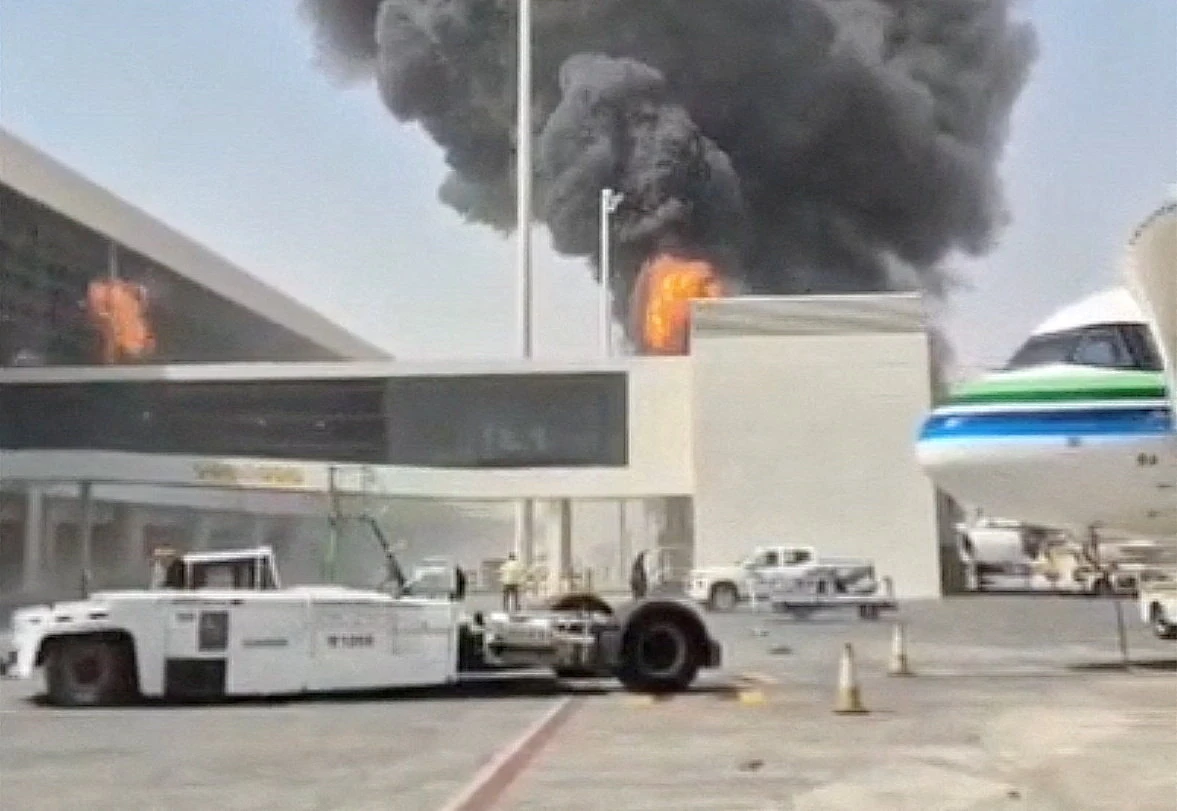

The escalatory nature of the Houthi attacks on Saudi Arabia cannot be ignored. Attacks on civilian airports, causing about 20 fatalities, are simply not something any state is able to ignore. That these are illegal and a violation of international law is not debatable.
Many states have condemned the attacks. These include Egypt, Pakistan, India, Japan, Canada and Australia. Most major European states, including France and Germany, have done likewise. UK Defense Secretary Wes Streeting called the attacks a “dangerous escalation” and “contemptible.”
Yet, as ever with such complex conflicts, the question of what to do next and how is far harder to answer. Condemning these attacks is the easy part. Some states have proscribed the Houthis as a terrorist group but, in reality, how much of a difference does that make on the ground? Identifying exactly what these leaderships are willing to do is another thing entirely.
The position of the Trump administration is vital. Typically, the smoke signals from Washington are bathed in uncertainty. President Donald Trump condemned the attacks and stated that the Houthis were “misbehaving very badly.” He has indicated the US might take action — but this fell well short of a cast-iron commitment. “We may. We’re going to look at it ... We move very quickly.”
One concern is that the US has yet to replenish its stocks of antimissile munitions, which are vital for intercepting Houthi weaponry and also in case of a further flare-up with Iran. In 2026, an estimated 2,000 Terminal High Altitude Area Defense and Patriot interceptors have been fired. The arsenal is depleted.
Another Trump concern is that, if he does engage US forces against the Houthis, this may not prove popular domestically. The Republicans are struggling in the polls prior to the midterms. He may defer US military action until after the Nov. 3 elections.
The Houthis cannot be allowed to relentlessly attack civilian targets without consequence.
Chris Doyle
Military strategists wonder if there is a military solution to the issue. Knocking out Houthi missile capabilities is no easy task and would have been done already if it was feasible. Wars on Yemen and in Yemen have not got a happy history. As the Houthis are aware, it is a war in which all sides can get embroiled but fail to exit.
The broader issue of the crisis with Iran is unresolved and could also escalate in a direct fashion after the US midterms. Given that the Houthis are arguably now the most powerful of Iran’s allies in the region, the implicit threat is that the Houthis can close the Bab Al-Mandab Strait. The impact of closing both this and the Strait of Hormuz to shipping would be devastating to the global economy.
In 2026, international actors have failed to act in a coherent, unified fashion. The US-Israel war on Iran was executed with little consultation with allies, including those in the region. The response can be summed up as: “You, the US and Israel, started this war and need to clear up the mess that you have created.”
Yet the crisis in Yemen and the Red Sea arena demands a more concerted effort. The Houthis cannot be allowed to relentlessly attack civilian targets without consequence.
Saudi Arabia expects support in a war it does not wish to see broaden. But it is also in the international interest that the Houthis cannot deploy these missiles.
If there is a unified international response, with states demonstrating a firm commitment, perhaps the Houthis will realize they must back off. This should include greater resources deployed to ensure freedom of shipping in Bab Al-Mandab. Those who have antimissile capabilities could also assist in defending Saudi Arabia, especially civilian sites such as airports and desalination plants.
None of this can be divorced from the issue of Iran. The latter has provided huge support to the Houthis. The Iranian leadership has a vested interest in the Houthis exacting a huge price from the Kingdom and its allies in this conflict.
Above all, aside from galvanizing a robust, unified response to the Houthis, the international community has to act to resolve the long-term crisis in Yemen. Leaving this conflict bubbling along has left the region vulnerable to a major flare-up, as has now happened. The military options are very limited. Action can create some degree of deterrence to push the Houthis back, but ultimately a long-term political solution in Yemen is required — and it must be buttressed by a fully-funded humanitarian response and development program.
Chris Doyle is director of the Council for Arab-British Understanding in London.
X: @Doylech


