
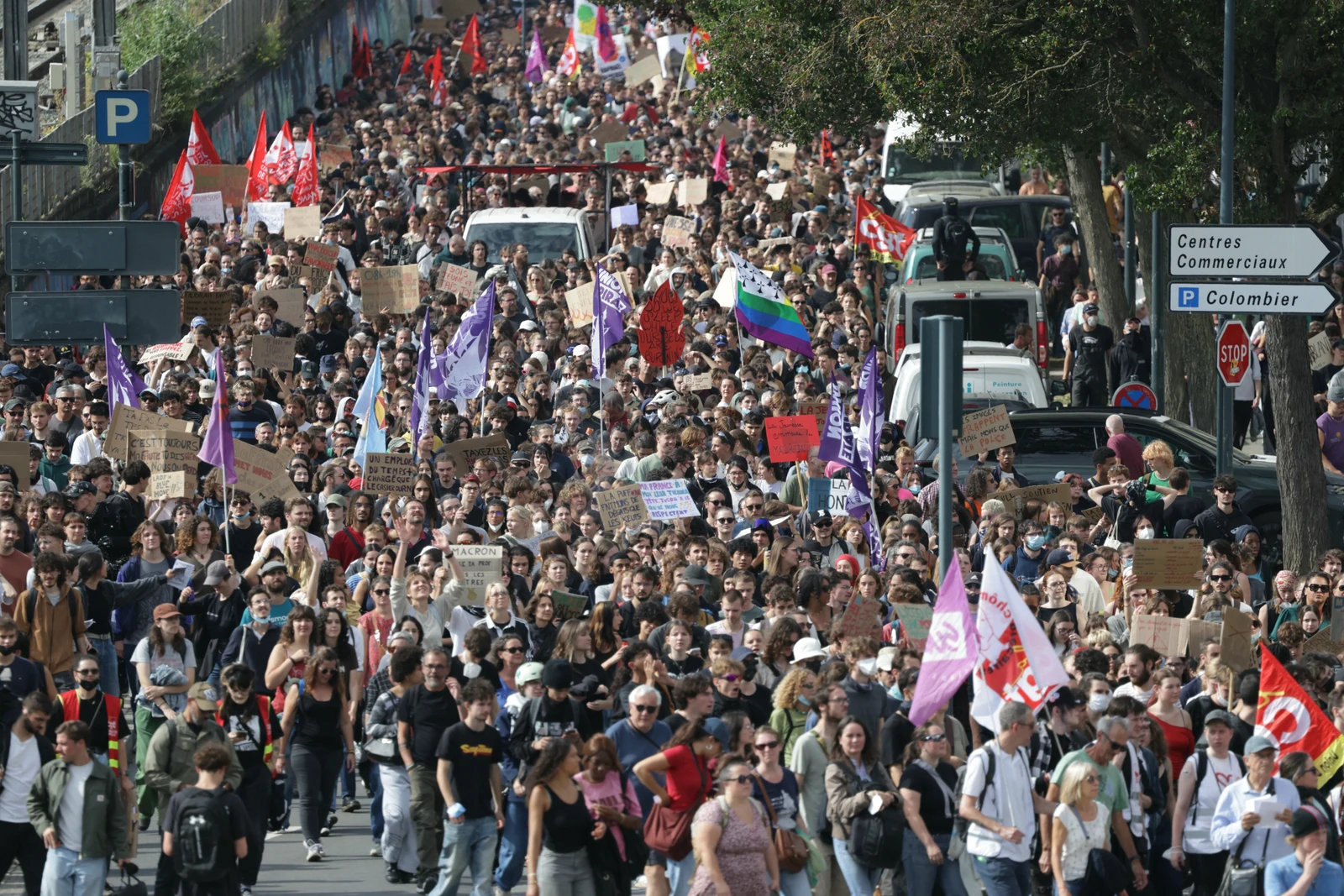

Demonstrations to express frustration and anger and draw the authorities’ attention to just demands is one thing. But demonstrations full of acts of violence, thuggery, public disorder and damage to property should be condemned and should not be something that French students tolerate.
Scenes of burning bins, damaged bus stops, torched cars and attacks on police are maybe not that strange in France. But for students to be the perpetrators of such acts while protesting diminishing educational staff, large class sizes and poor school building provisions — even if foreign elements and fifth-column actors bent on sowing chaos may have infiltrated peaceful demos — will not lead to the problem being fixed. Their acts of vandalism and destruction add more bills to an already overstretched and diminishing public spending budget.
From the outside, the police response could look heavy-handed. The heightened confrontations are maybe the result of unruly elements or a few criminals capitalizing on the chaos to cause damage and loot.
It is a no-brainer to remind the students that the plight of France is similar to that of many other countries. The issues include ballooning welfare costs, diminishing growth, heavy indebtedness and an economy stuttering all over due to geopolitical adversities resulting from avoidable and unavoidable wars. This has left successive governments unable to balance the books or reform public finances, as that would mean the public has to swallow the bitter medicine. That would come in the shape of one austerity budget after another in order to try and cut the deficit and satisfy increasingly restive bond markets.
It is a no-brainer to remind the students that the plight of France is similar to that of many other countries
Mohamed Chebaro
Ahead of a crucial presidential election next year, what is happening could test the political resilience of the French Republic. Prime Minister Sebastien Lecornu has declared his willingness to address the core demands of the students. But how to do that when his government has pledged to make budget cuts worth €54 billion ($60 billion), including real cuts to school and education funding.
To answer the students’ demands, France needs to spend more, not less. It needs more buildings, not vandalization and fires. An autumn of discontent awaits France and maybe a winter too, until the presidential election is held in the spring.
Many believe that behind the troubles is the hand of the radical-left France Unbowed party. Its activists are said to be fomenting the violence and egging on students to demonstrate in the hope of reaping the benefits through leader Jean-Luc Melenchon winning the Elysee next year.
Polls have shown that Melenchon has massive support among the youth. Some 40 percent of 18 to 24 year olds back him — and this is concentrated in the populous, high-immigration city suburbs where his talk of a “new France” is highly appreciated. But the youth in France often shun elections.
In addition to the toxic social media posts that are leveraged by the radical left, other actors lurk in the shadows, such as revolutionary Trotskyist and even Islamist groups.
What the young people are failing to see is that the age of political activism and great ideas might now be over
Mohamed Chebaro
The spectacle of burned-out schools, riot police, tear gas and running battles with protesters on the streets across France offers an opportunity for Marine Le Pen, the front-runner to be the next president, to breach the walls that have, until now, denied the far right access to power. It is easy for her National Rally party to call out France Unbowed for fomenting the school protests and to highlight the need to toughen up law and order legislation.
But that alone is unlikely to satisfy the students or bring them better schooling and a less anxious future.
During my years as a reporter, I saw France erupting in flames multiple times. There were the 2005 suburban riots, the 2006 youth demonstrations against employment contracts and the 2023 “Yellow Vest” protests. Since the country’s famous revolution of 1789, France has never left its cycle of uprisings. Some even look back on the 1968 student protests with great romance, especially some of the parents and grandparents who are today trying to restrain the youth.
In the age of social media, when the genie is out of the bottle, it is difficult to get it back in. You can overthrow governments and regimes if you like, such as the social media-driven Generation Z protests that have rocked Nepal, Bangladesh, Kenya, Indonesia, Serbia and Madagascar in recent years. But one wonders if any have actually overturned the status quo. And I am not talking about politicians from the left, right or center. But whether any such protests resulted in finding the recipe for prosperity, growth and meeting welfare demands.
France’s protesting students and workers must ask themselves if any of the contenders for the presidency have what it takes to change the country’s fate without any real sacrifices. What the young people are failing to see is that the age of political activism and great ideas, along the lines of the spirit of 1968, might now be over.
We live in a different age, with state and society now at the mercy of algorithms and Big Tech. It is an age of a splintering world order. An age in which multilateralism is dying and superpower assertiveness is on the rise. An age in which individualism reigns supreme and the budgets of corporations and individual wealth surpass those of the state.
Many surely see that the future of any nation’s rise or fall is in the hands of the youth. Yes, demonstrations may be a conduit for a public debate about what future they want, whether or not they can shape it and, most importantly, how it can be paid for. But a painful conversation is needed in France. This is what the students should be focused on.
The students marching in France ought to be careful what to wish for. Before breaking the current order, the youth on the left and the right should know that building a new order or fixing the current one cannot be achieved through a single march or the shouting of slogans. Instead, it requires a painful, slow and grinding effort that takes its toll on everyone and could mean sacrifices, resilience, more austerity, larger classrooms, fewer tutors and studying in the heat amid dilapidated classrooms. Are they ready for the challenge?
Mohamed Chebaro is a British-Lebanese journalist with more than 25 years of experience covering war, terrorism, defense, current affairs, and diplomacy.


