

The current war in Yemen could lead to a historic transformation, much like what happened in Syria with the fall of another Iran-aligned regime.
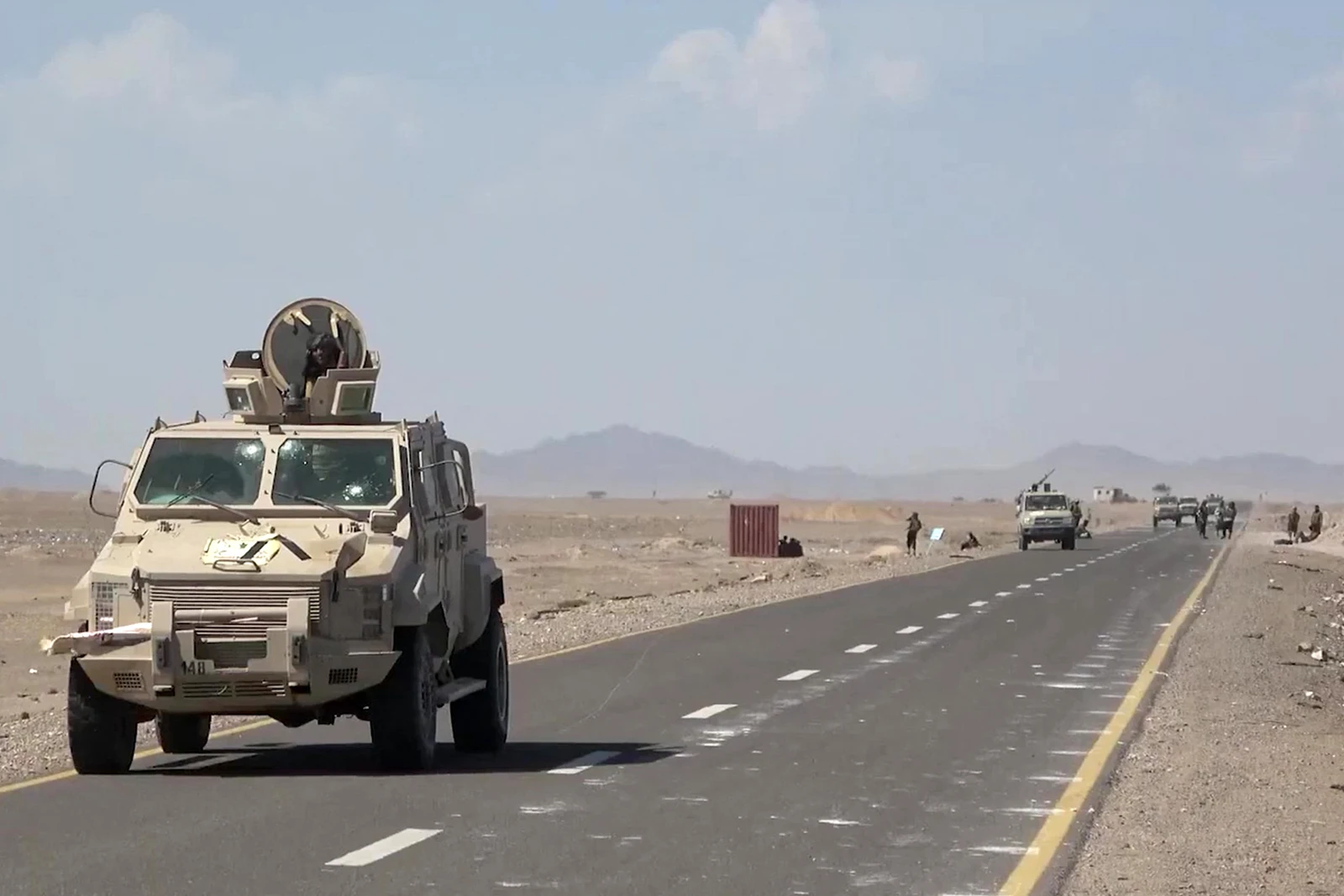
Yemen’s internationally recognized government now extends its influence over more than two-thirds of the country and is fighting to reclaim what remains. Yet that remaining third is no easy task due to geographic and military considerations. This is a war against Iran’s Islamic Revolutionary Guard Corps and Lebanon’s Hezbollah, both of which operate within the Houthi leadership and ranks.
The conflict may not be decided quickly, despite the gains achieved in the north and southwest of the country.
This war differs from Yemen’s previous conflict in 2015 in several respects. For years, the Houthi militia has operated under the supervision of the IRGC, contrary to portrayals that depict its fighters as barefoot tribesmen dwelling in caves.
Its members have been trained in Lebanon and Iraq, and prepared for this confrontation over many years, making it another regional conflict involving Tehran. Credible reports indicate that Abdulreza Shahlai, a commander in Iran’s Quds Force, directed the Houthis’ recent offensive in the Tihama Plain.
The conflict may not be decided quickly
Abdulrahman Al-Rashed
Several new factors distinguish today’s war in Yemen from the previous conflict. The international community, once divided, has become almost unified against the Houthis. It is increasingly convinced that this is a just war on behalf of the Yemeni people. The conflict has also become a matter of regional security and international trade.
There is also a desire to end Houthi control as part of broader efforts to reduce Iranian influence in the region, a trend that was underscored by the fall of the Assad regime nearly two years ago.
During the previous Yemen war, Britain and the US pushed to prevent an advance toward Hodeidah and Sanaa, believing that a political solution through the Stockholm negotiations could achieve the desired outcome.
After nearly a decade of Houthi rule, it has become clear that the group is not significantly different from organizations such as Daesh and Hezbollah. It is a branch of the Iranian regime’s network, despite some secondary differences.
This year, the Houthis have become a greater international concern as the strategic importance of the Bab Al-Mandab Strait has grown. With the Strait of Hormuz effectively constrained by the war with Iran, the Red Sea has become an alternative route for energy exports.
In coordination with Iran, the Houthis declared their intention to close the strait. In line with Iran’s targeting of oil transit routes, the Houthis announced a maritime blockade against Saudi Arabia and began targeting its tankers. To further that objective, they seized Perim Island and the Mokha area last month, though the latter has since been recaptured.
Previously, the international community paid little attention to fixing the situation in this devastated country. That changed when the crisis evolved from a humanitarian tragedy affecting Yemenis and neighboring countries into a threat to international shipping. The EU, Britain, and the US administration quickly condemned the Houthis and offered logistical support for any operation against the group.
If the current war achieves its objectives, it will end Houthi domination over the Yemeni people and help bring an end to the suffering of millions. It could save roughly 22 million Yemenis living under Houthi control from the threat of famine and disease. According to World Health Organization data, cholera cases tripled in just three weeks. Millions of children could also return to school after years without education.
Battles in the coming weeks may prove decisive
Abdulrahman Al-Rashed
The extremist religious movement has turned Yemen into a transit corridor for people fleeing wars and famines in East Africa, a route for drug smugglers, and a haven for both Al-Qaeda and Daesh, which remain active there and engage with the Houthis. The group also maintains weapons-smuggling links with Somalia’s Al-Shabab movement.
Twelve years have passed since the Houthis forcibly seized control of Sanaa, in a manner reminiscent of Hezbollah’s dominance in Lebanon. Adopting the name “Ansar Allah,” they have promoted their leaders’ images.
This war is different from previous conflicts and clashes. It is the first war fought by Yemen’s legitimate government as a unified force, bringing together various Yemeni factions under one banner. Earlier confrontations were primarily led by the Arab coalition and government forces whose influence locally was more limited.
The battles of the coming weeks and months may prove decisive. Yemen’s Presidential Leadership Council has identified the liberation of Sanaa as its central objective. If Yemenis succeed in defeating Iran’s allied movement, it would represent a major regional victory, much as Ahmed Al-Sharaa’s forces advanced from Idlib Province and ultimately liberated the Syrian capital from Assad’s regime.
Abdulrahman Al-Rashed is a Saudi journalist and intellectual. He is the former general manager of Al Arabiya news channel and former editor-in-chief of Asharq Al-Awsat, where this article was originally published. X: @aalrashed


