
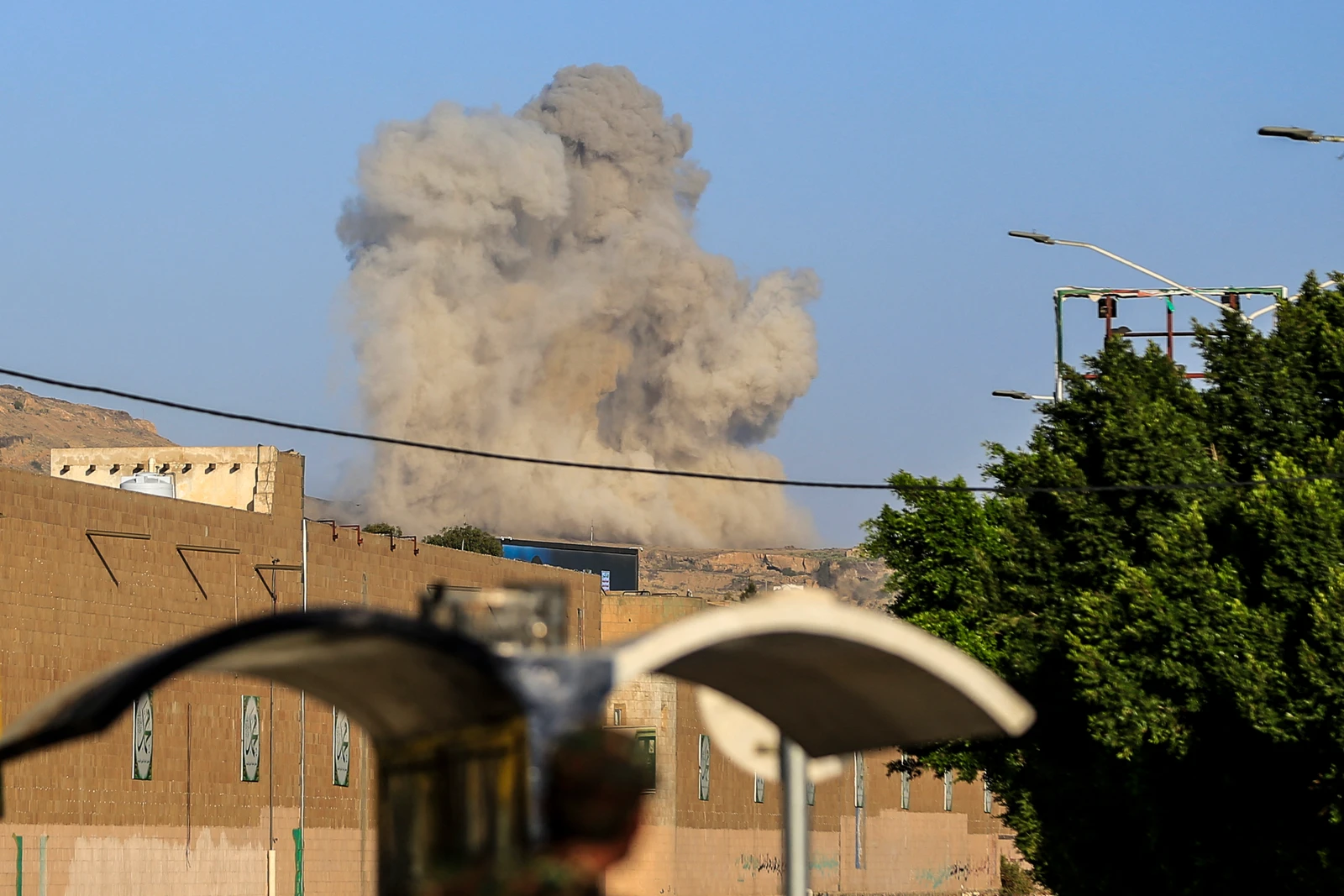

Twelve people were killed and 309 others injured, some critically, in the attack carried out by the Houthi militia against a passenger terminal at King Khalid International Airport in the Saudi capital, Riyadh, on Saturday.
Four of those killed were Saudis, while the others were of various nationalities, including a US citizen. The attack sparked an outpouring of anger toward the Houthis — and that anger was not confined to Saudis alone. Arab and international condemnations came swiftly and unequivocally, particularly since the attack struck a civilian airport rather than a military target.
Spokesman for the Coalition to Restore Legitimacy in Yemen, Maj. Gen. Turki Al-Maliki, described the attack as a “full-fledged war crime” and said in a statement that the coalition would respond “firmly,” in accordance with international humanitarian law.
On the same day, coalition forces announced that a projectile had fallen in the vicinity of King Fahd International Airport in Dammam, following other attacks on Saudi airports in recent days. This is an indication of the extent of the Houthis’ expanding hostilities, through which they seek to raise the political, economic and security costs for the Kingdom, destabilize domestic peace and undermine the confidence of citizens and residents in the Ministry of Defense’s ability to counter missiles and drones coming from Yemen.
They also seek to portray Saudi Arabia as a state incapable of confronting an armed faction and, consequently, believe they can alter Riyadh’s regional standing and thereby secure financial and political gains in future negotiations, in which the Houthis would receive a greater share. This is a naive perception that is detached from reality. It does not read Saudi policy as it is but instead constructs a wishful vision through which the Houthis believe they are capable of exerting influence. They fail to recognize that Riyadh cannot accept political blackmail through terrorism and that its patience stems from its determination to decide the form, timing and mechanism of its response, rather than becoming hostage to Houthi actions.
Saudi Arabia’s response to the ongoing developments is based on a military strategy formulated according to intelligence and to political and field realities. The scale of the airstrikes and the number of targets destroyed are part of the operations aimed at reducing the frequency of Houthi launches, diminishing their accuracy, increasing the time required to prepare them and forcing the Houthis to consume their stockpiles at a faster rate than they are able to replenish them.
Why all this? Because this is a military battle fought across complex terrain, more so than a conventional battle. It involves targeting underground storage facilities, supply convoys and command and control centers, in addition to technical components and land and maritime smuggling routes.
The Houthis fail to recognize that Saudi Arabia cannot accept political blackmail through terrorism.
Hassan Al-Mustafa
An analysis of satellite imagery by the International Institute for Strategic Studies showed that, since the 2022 truce, the Houthis have expanded their fortified underground military facilities around Sanaa and Saada, allowing them to protect heavy equipment and military components from airstrikes. This explains why the coalition needs a sustained series of airstrikes based on precise coordinates, using lethal smart bombs that strike their targets directly, thereby disrupting logistical support and technical capabilities, destroying weapons depots and missile launchers and, most importantly, weakening infrastructure related to Houthi military communications and command centers.
In parallel, the Saudi Ministry of Defense is working to protect airports, energy facilities and sensitive civilian sites through a multilayered ballistic missile interception system. It begins with early warning, followed by short- and medium-range defenses and then electronic interception and jamming systems to counter drones. This is preceded by deploying sensors, radars and reconnaissance aircraft, along with sufficient interceptor stockpiles for a prolonged campaign aimed at thwarting Houthi military operations as they launch or before they can be carried out.
There is also a domestic Yemeni dimension that complements the protection of Saudi territory, through Riyadh and the coalition’s backing of the internationally recognized Yemeni government, whose various battalions are directly fighting the Houthis in several governorates.
The field priority of “Operation Dawn of Yemen” should remain focused on the fronts that weaken Houthi capabilities, while simultaneously having a direct impact on security and navigation in Bab Al-Mandab, the western coast, Taiz and Marib. This is because expanding toward major geographical targets before consolidating these fronts would weaken the forces’ ability to maintain control on the ground and give the Houthis an opportunity to draw their opponents into multiple fronts.
Turning back to the Houthi attack on King Khalid International Airport in Riyadh, Al-Maliki’s description of it as a “war crime” adds a legal dimension to the military response. This would involve documenting the attacks, the types of munitions used and the civilian sites damaged. A case can then be submitted to international legal bodies and human rights institutions, thereby helping to build a broader coalition opposed to the Houthis.
Saudi Arabia will most likely work to make Houthi attempts to attack the Kingdom more difficult and more costly. It will do so by intensifying its airstrikes against military and security targets inside Yemen, supporting the legitimate Yemeni forces with additional equipment and intelligence, and urging the international community to shoulder its responsibilities in addressing the threat posed by the Houthis, not only to Riyadh but also to the security of the Middle East, Bab Al-Mandab and the Red Sea.
This is particularly the case given that this is a terrorist group that maintains cross-border ties with Iran’s Islamic Revolutionary Guard Corps, Somalia’s Al-Shabab and the Iraqi militias, all of which are extremist entities seeking to tighten their grip on the Middle East’s vital waterways.
Hassan Al-Mustafa is a Saudi writer and researcher interested in Islamic movements, the development of religious discourse, and the relationship between Gulf Cooperation Council states and Iran.
X: @Halmustafa


