
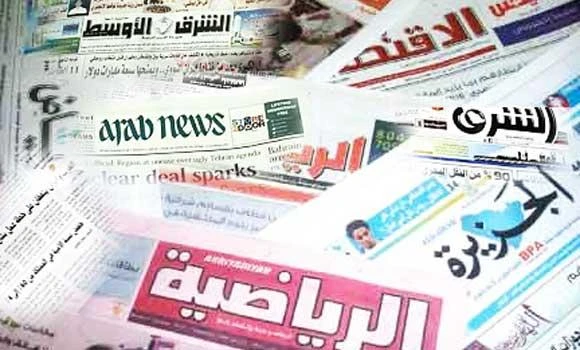
Islamic alliance to fight terror
The Islamic alliance, which was launched from our country and gained global support, is a proof that our country is always seeking to maintain peace and is eager to confront terrorism and all challenges that the mankind may face anywhere.
This alliance, which has so far included 35 countries, is united to form a formidable front against deviant terrorist forces. The alliance, being launched from the land of peace, will spread security, stability and peace, complete liberation of lands where terrorism has nestled and contributed to displacement of people.
The alliance, among other objectives, will deal with an iron fist all outlawed and deviant groups working against Islamic values and principles, which are playing on sectarian symphony and unfortunately, carrying out an agenda known to all.
Deputy Crown Prince Mohammad bin Salman admired the whole world with his wisdom upon announcing the birth of the Islamic alliance and, same time, to prove that the young leadership is capable of taking action and laboriously working to implement the country’s wise policies and that its leaders are still stronger than conspiracies and waves of terrorism.
Since Custodian of the Two Holy Mosques King Salman assumed power, the wise leadership has worked to enhance peace, security and stability in Arab countries, which are suffering, from terrorism, notably Syria and Yemen.
Whatever blame we put on terrorism and miseries it causes day after day, the world blames those who do not fortify themselves from dangers, mobilize potentials to defend themselves and protect their interests.
Therefore, as we live the joy of the birth of the Islamic alliance, we have to determine responsibilities and rally our Islamic ranks to realize the objectives of the alliance.
After all, the dream has become real and the Islamic alliance was born to send a blow to terrorism and to prove that Saudi Arabia and other Muslim countries are united in the face of terror and all challenges that may face Islam and Muslims.
— By Ahmed Al-Maghlouth
The royal address
The royal address made by Custodian of the Two Holy Mosques King Salman before the Shoura Council contained topics concerning the whole nation and reflected feelings of its wise leaderships toward people.
This year’s royal address has highlighted an unprecedented strong Saudi presence represented by 11 months of historic initiatives including, among others, the “decisive storm” and “Islamic military alliance.”
This strong presence has forced the whole world to listen solemnly to what is being issued by our leader on the fact that his leadership has become an Islamic work approach that does not depend on reactions nor misled by maneuvers of the opponents.
— By Mohammed Marouf Al-Shaibani
Development of Saudi women
The royal address of Custodian of the Two Holy Mosques King Salman before the Shoura Council highlighted a variety of issues that have close relevance to citizens including health, education and housing.
The address also dealt with Kingdom’s internal and external policies, Saudi citizens as the prime concern of development, national unity and equality of citizens in rights and duties.
The king also gave special attention to the position of Saudi women and their role in the development of the country on an equal footing with their counterparts in other parts of the world.
In the era of late King Abdullah, the Saudi women enjoyed a golden time for their active participation in key sectors such the Shoura Council and, later, to run, as voters and candidates, municipal elections in the era of Custodian of the Two Holy Mosques King Salman.
After the royal address, we, as women, look forward to seeing performance of service ministries more eager to deal with concerns of citizens, including oppressed and marginalized women who are suffering from poverty although they are caring for families, patients, sons of prisoners, drug addicts, and psychiatric patients but they need help and support.
The ministries are also urged to look into Saudi women’s legitimate, financial and legal claims pending in courts for several years.
Moreover, the king’s address is a “national document,” which has royal, historic and humanitarian importance that needs implementation at the local level, the role, which is to be undertaken by the controlling bodies.
— By Mudhi Al-Zahrani
Rationalized spending
The state budget is expected to be announced tomorrow (Monday) through the Cabinet meeting.
The new budget is poised to gain momentum because it comes in conditions apparently different from previous situations due to the drop of oil prices, which represent nearly 89 percent of the state revenues.
This will lead to drop in public spending, in a manner that needs revision of mechanisms to control spending to cope with the requirements of the current stage.
The government opted for expanded spending during the last ten years without any ceiling to spending items estimated in the budget.
Therefore, the increase in actual spending in the last six state budgets ranged between 12.8 percent and 39 percent of the projected budgets.
The increase in (real) spending was dictated by certain developments such as expansion of the Two Holy Mosques and expropriation of properties to this end, developmental projects, international aids program, increase of capitals of government funds, and the government desire to enhance economic growth.
Needless to say, financial conditions of the Kingdom at the time were favorable due to higher oil prices capable enough to cover increased spending. Additionally, the budget surpluses helped to cut public debts with the exception of last year (2014) when the budget registered a deficit of SR54bn.
However, financial conditions have changed with the drastic drop in oil prices and, therefore, spending without looking at estimated allocations will create more pressures on public finance that could possibly lead to withdrawal from reserves or issuance of bonds, both of which are temporary.
Accordingly, there is a need for a serious thinking to run the budget properly through the linkage of actual spending with revenues in the next years until we draw a clear vision about the future of oil prices.
The link between the actual spending and realized revenues is an ideal model in all conditions, notably in cases of financial crises where we, at least, make sure that spending and revenues are equalized (balanced) and no deficit is registered by the end of the year.
— By Mohammed Al-Oufi
Hike in airport fee
According to a statement quoted by local media, the General Authority of Civil Aviation (GACA) said that the new fees announced early last week was meant to meet airport facilities, which have been in force for several years at SR50 for each passenger but raised to SR87, an increase of only SR37!
Ironically, this increase was preceded by another announcement on the cancellation of the reduction on ticket fares for students on domestic flights. The reduction was ordered by a royal decree before nearly 40 years.
With due respect to the GACA, the new increase is not logical on the ground that services at our airports have not yet lived up to the required level, especially it coincided with the decline in oil prices, which were supposed to cut costs of flights and ticket fares and not the exact opposite.
However, if the citizens are accustomed to pay the new or additional fees without knowing reasons behind the increase, the foreign passengers, who are concerned with that increase (SR37), will think over it and complain at a time when we are marketing for our local tourism.
The GACA has justified the increase by saying, “It comes in accordance with what is known in neighboring regional and international airports,” which is an old pretext.
Some officials of service companies used to describe their services as the best and cheapest where lots of customers come to believe that but, however, does not fit with the era of information and communications, which brought nearer what is the farthest and revealed the facts.
— By Abdullah M. Al-Jamili
Safety standards at stake
Perhaps we might have waited for the results of investigation into the Jazan hospital fire incident to know who was responsible for this catastrophic accident.
But no need to wait because such catastrophe could not have happened unless there was a failure in automatic fire extinguishing system or rapid evacuation plans.
Here we are facing two calamities: Either the hospital does not have an automatic fire extinguishing system or it did not work properly as required.
In both cases, we are facing a big question mark over whether our public facilities, notably health and educational institutions, are applying evacuation plans in emergency cases and in the occurrence of incidents, and to what extent the civil defense is making sure those facilities are implementing (safety) standards.
It does not matter how many officials will be sacked or punished, because resignation or punishment of the whole staff of the Ministry of Health or Civil Defense will not bring back any victim of the disaster to life, relieve pains of their relatives or cure burns of the injured.
What is important now is how and why this incident happened and what guarantee we have that such incident will not be repeated in the future in any other health facility?
— By Khalid Al-Sulaiman


