
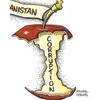

What is the reaction of an ordinary Afghan man called Nurallah, from Kandahar, who was assaulted by police for refusing to pay a bribe and who then had his phone smashed when he impudently reported the incident? He gets furious and tells you this: If I see someone planting an IED on a road and then see a police truck coming, I will turn away and not warn them.
What happens when the elders of Hijran Karez, a village over the rocky ridge to the east of Kandahar, doubly furious, tell you the story of how then President Hamid Karzai’s younger half-brother, Ahmad Wali, had claimed dozens of acres in the watershed of their precious spring as eminent domain — and then proceeded to subdivide it and sell it off like his own property, after bulldozers, protected by police brandishing AK 47s and driving US-supplied Ford Rangers, had caved up the land? You become, willy-nilly, a Taleban supporter.
And how do you respond when you, in this case an idealist NPR correspondent and a senior associate at the Carnegie Endowment, armed with a $25,000 grant that you use to set up a cooperative in the Afghan countryside providing soap products to the locals, go to the bank to make a simple deposit and the bank-teller demands a bribe for the privilege of depositing your money into your own account? You write a book about the adverse effects of corruption on the body politic, on long-term economic growth and on human development in the country.
And that is precisely what Sarah Chays did — she wrote a book detailing her experiences in Afghanistan and elsewhere in impoverished countries where corruption has not only impacted the lives of ordinary people but also posed a threat to political stability. The book, “Thieves of State,” released recently, has an even more intriguing subtitle, “Why Corruption Threatens Global Security.”
Corruption, of course, is not unique to Afghanistan. It is prevalent in Syria, Iraq, India and China, in Palestine and Uzbekistan, and in North African countries and countries south of the Sahara. If there’s a difference here, the difference is in degree not in kind. Take Thieves of State to the beach with you this summer not only because it is an edifying read but because it is a compelling read as well.
We all need a wake-up call about how corruption is a pervasive and pernicious social problem that is a root-cause of low levels of human development as well as of revolutionary uprisings, uprisings that in recent history stretch, as Chays reminds us, all the way from the Protestant Reformation to the so-called Arab Spring. No one, the author stresses over and over again, should underestimate the corrosive impact that kleptocrats leave behind them, whether their theft is petty, or grand and systemic, in other words, operating on the street level or on the highest levels of government.
Corruption, in short, represents a significant subversion of the economic, political and legal structures of any state, where these structures clearly are a major, indeed the major, building block of equitable governance, social stability and a solid institutional environment. Structural theft, on the other hand, whether it is graft, embezzlement, bribery, fraud, and the rest of it, conversely, is a stumbling block to high levels of human development. It infringes on no less than the human rights of citizens to live decent, ordered lives.
Freedom from corruption is indeed a human right, though few appear to regard it as such. They should. That right finds ample support in the foundational “rights theories” in the Euro-American world, as evidenced by the work of John Locke, one of the most influential of Enlightenment thinkers, and in the Muslim world, as equally evidenced in Islamic jurisprudence elucidated not only by theologians but by the likes of the Muslim political philosopher Ibn Khaldun, who regarded freedom from corruption, or fasad, as a first principle of governance.
In the modern world, however, subverting that freedom has not yet acquired the appropriate stigma as an act encroaching on one’s human rights. After all, the argument goes, it is a “white collar crime” where no one gets “hurt.” Wrong!
“The global community now widely recognizes corruption involving public officials as a principal cause of human suffering, but not as a violation of a human right,” wrote Andrew Spalding, professor at the University of Richmond School of Law, Virginia, in a paper he recently published for Brookings Institute. “For example the United Nations Convention Against Corruption does not frame official corruption as a rights violation.” Well, that international body should do so.
Consider this: The United States has already spent a mind-numbing one trillion dollars in Afghanistan, of which $123 billion was devoted to the country’s reconstruction. Even when adjusted for inflation, that price tag exceeds the US contribution to the Marshall Plan to rebuild Europe after the World War II. Europe, you may have noticed, has long since been rebuilt. Afghanistan, you may have equally noticed, remains a basket case 14 years after “reconstruction” began.
What went wrong? Read Sarah Chay’s book, then weep — and scratch your head at the brazenness of the tale she tells. The people of Afghanistan deserve better, certainly better than finding solace in the arms of the Taleban, who advance themselves as corruption-free and thus as a seductive alternative to the status quo.


