
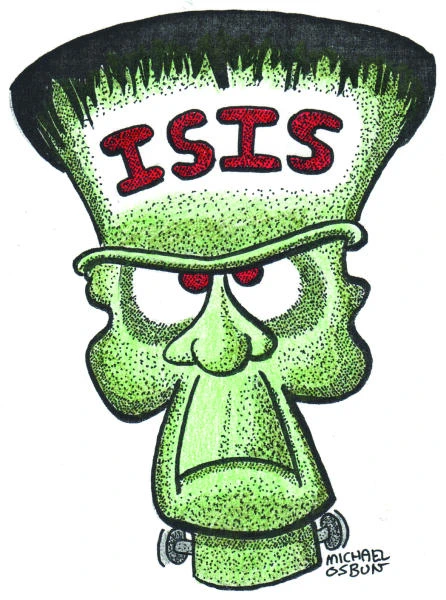

What is the likelihood that former President George W. Bush and his younger brother Jeb Bush, who aspires to be the next American president, will admit, now in the cold light of hindsight, that the 2003 invasion of Iraq was a blunder, one of whose consequences was the emergence of IS? Practically zero.
Not quite four weeks ago, the former Florida governor was asked in an interview with Fox News whether, had he been president then, he would have authorized the war that year. His response suggested that he would have done so even if he had known of the intelligence failures that preceded it. It’s difficult to say if that was his true judgment or that he was prompted by sibling loyalty. Probably both. A few days later, he began backtracking. “Knowing what we know now,” he said at a talk in Tempe, Arizona, “I would not have engaged.”
Oops! Too late, Jeb. An original statement, uttered with concision, is like a bullet — once fired, it cannot be recalled.
But the clincher came in Reno, Nevada, last week at a Town Hall meeting where Bush was confronted — and stymied — by a 19-year-old student a the University of Nevada named Ivy Ziedrich, who told the flustered presidential aspirant simply: “Your brother created IS.” This was a retort by Ziedrich to Bush’s speech, in which he put the blame for the rise of the radical group on President Obama, for “removing the troops from Iraq” in 2011.
Ziedrich, who is majoring in Middle Eastern Studies and who knows a thing or two about the region, was convinced that indeed the emergence of IS should be attributed to the former president’s bungled intervention. She later told a reporter: “A Bush was trying to blame IS on Obama’s foreign policy — it was hilarious. It was like somebody crashing their car and blaming the passenger.” Was Ziedrich on to something here? Something hiding in plain view? Something so transparent that it has passed largely unnoticed?
To be sure, those who assert that an American president somehow “created” IS do not imply that the US literally founded, funded and trained the terrorist group. That would be an absurd claim that not even the most demented conspiracy theorist would advance. Rather the implication here is that, in the dialectic of events triggered by the invasion of that ancient land, diverse forces were unlocked — a Pandora’s box, as it were, of social, political, sectarian and class contradictions — that left a vacuum in the country, that in turn was filled by militants from Al- Qaeda in Iraq, who later morphed into IS.
Nor was the 19-year-old Ziedrich, of course, the first political activist, analyst or political commentator in the US to raise that question. The question had been raised by people as diverse as Wesley Clark, former Supreme Commander of NATO and Graham Fuller, a retired senior CIA officer, not to mention liberal social critics like Noam Chomsky.
From the time Paul Brenner, America’s civil administrator in Iraq, took on the task soon after the invasion of “restructuring” Iraqi society, when his brash de-Baathification policies wreaked havoc on the lives of hundreds of thousands of Iraqis, policies whose end result was the loss of political influence by the Sunni community (whose leaders had ruled Iraq since the 7th century), the stage was set for the Sunni Arab minority to go into rebellious mold.
Take one case in point: In December 2012, the arrest of the bodyguards of the moderate Sunni minister Rafi Al-Issawi by the Shiite-led government, led to widespread protests in the Sunni provinces. Protesters demanded an end to political, civil and economic discrimination against their community. Then Shiite Prime Minister Nuri Al-Maliki, whose government was promoted by the US, and who was notorious for his brazen sectarianism, offered only cosmetic changes — or no changes at all.
After all the invasions launched by the US in Muslim countries, after all the occupations, after all the drone campaigns, after all the putative wars on terror, after all the uprooting of millions — well, all that proved a bonanza for the rise of a nascent IS.
"Though the militants of IS would undoubtedly be horrified to think so, they are the spawn of Washington,” wrote Tom Englehardt, author of The End of Victory Culture: Cold War America and the Disillusionment of a Generation (1998). “Thirteen years of regional war, occupation and intervention played a major role in clearing the ground for them. They may be our worst nightmare, but they are also our legacy.... In fact, just about everything done in the name of the war on terror has facilitated their rise.”
A new generation of Americans, to which the astute Ziedrich belongs, appears to be as fully versed in those wars' drastic consequences just as ours was in anticipating them. As Noam Chomsky put it: “The Iraq war was the first conflict in western history in which an imperialist war was massively protested against before it had been launched.”
And, yes, what was Jeb Bush’s response to the retort by the 19-year-old major in Middle Eastern Studies at the University of Nevada? Search me. Mumbling incoherent answers runs in the Bush family.


