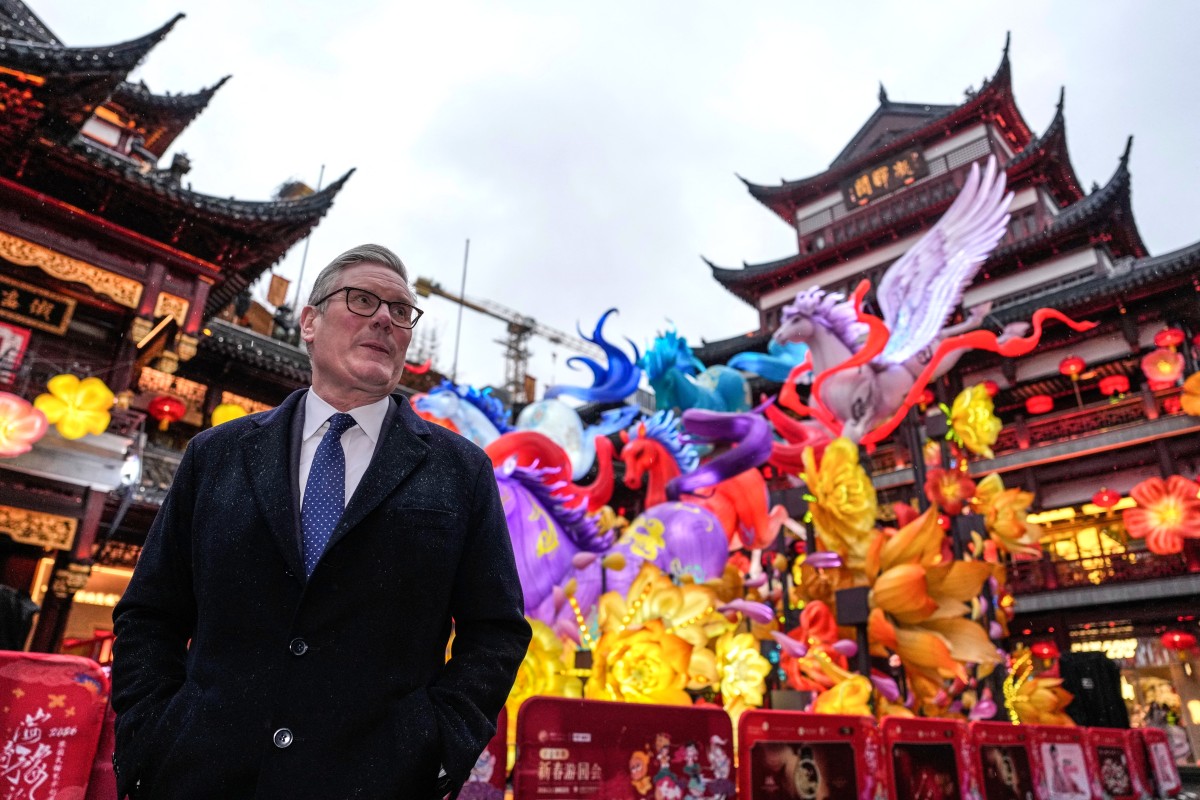

Keir Starmer faces mounting domestic policy challenges at home, so it was no surprise the UK prime minister welcomed the opportunity of a visit to Tokyo and Beijing — a road trip that allowed him to focus on foreign policy.
Starmer’s first trip as UK premier to Japan and China was as important as it was timely. In Japan, he met with Prime Minister Sanae Takaichi whose Liberal Democratic Party is poised to make striking gains in an important snap election on Sunday that could be a gamechanger for the country’s politics.
In Tokyo, Starmer was told that bilateral relations are the “strongest in decades.” The two leaders agreed to strengthen collective security across the Atlantic and Asia-Pacific region, while boosting growth and economic resilience, including launching a new cybersecurity strategic partnership.
The two powers also agreed to build more diversified supply chains in critical minerals, and boost global trade by expanding the 12-nation Comprehensive and Progressive Agreement for Trans-Pacific Partnership, which includes not only the UK and Japan, but also Australia, Brunei, Malaysia, New Zealand, Singapore, and Vietnam.
Yet, the mainstay of Starmer’s trip was the several days he spent in Beijing, where he became the first UK prime minister to visit China in about eight years. Starmer has called for a “more sophisticated” bilateral relationship that would bring greater stability after the diplomatic rollercoaster of the last decade and a half.
That latter period saw the so-called “golden age” in ties between London and Beijing during the governments of David Cameron to 2016. However, there has been a cooling in relations in the post-Brexit period, and especially since the pandemic, under later Prime Ministers Boris Johnson, Liz Truss, and Rishi Sunak.
Chinese President Xi Jinping also voiced the need for greater equilibrium in ties. Xi said last week he had “long been clear that the UK and China need a long-term, consistent, and comprehensive strategic partnership” beyond the “twists and turns” of recent times.
Yet, despite this apparent meeting of minds between the two leaders, the trip has been widely criticized domestically in the UK, and also by Donald Trump. The US president last month described Starmer’s visit as “dangerous” for London, despite the fact that he is also planning to visit China in April.
Starmer broadly continues a policy trajectory of recent UK governments of all political stripes.
Andrew Hammond
Within the UK, Starmer has also been slammed by much of the political right and left. On the right, Trump ally and Reform UK leader Nigel Farage declared himself “very nervous” about the UK moving toward closer relations with Beijing. Meanwhile, Conservative leader Kemi Badenoch slammed Starmer for moving ahead with a trip that she said was “not in the national interest.”
Across the political spectrum, Daisy Cooper, deputy leader of the Liberal Democrats — now the third-largest party in the UK Parliament — said Starmer was going “cap in hand” to China. She said the visit would not have a “single consequence” for Beijing over its “campaign of espionage.”
While Farage, Badenoch, and Cooper come at this topic with different viewpoints, they all purported to disagree with the government’s decision last month to grant China planning permission to build a so-called “super-embassy” in London. They also believe Starmer won too little from Beijing during his trip.
Perhaps the key prize from last month’s visit is a feasibility study for a possible trade in services agreement. This is welcome for London as the UK had a £10 billion surplus in services with China in the year to last June, with potential for much further growth.
Broader deals include visa-free travel for UK citizens, which brings the UK in line with more than 50 other countries, including France and Germany; and enhanced cooperation on organized crime.
For all the criticism that Starmer has endured over his policy on China, it largely represents a continuation of that of previous UK governments, both Conservative and Labour, which have overseen a significant UK reorientation to the Asia-Pacific region, especially since Brexit.
Starmer has also visited both Samoa and India, with New Delhi signing the UK’s biggest trade deal since the CPTPP was accepted by the last Conservative government.
Taken together, while the UK leader received much criticism about his China visit, domestically and from Trump, it broadly continues a policy trajectory of recent UK governments of all political stripes. Under this and future UK administrations, the country is only likely to deepen and broaden its focus on the vast Asia-Pacific region, including key powers such as Japan and India.
- Andrew Hammond is an associate at LSE IDEAS at the London School of Economics.