
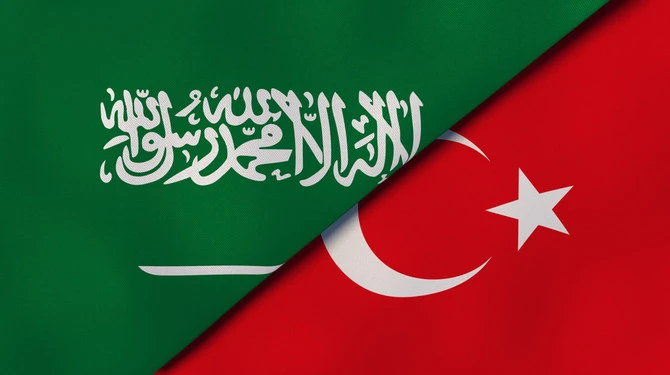

Escalating tensions in the Middle East are pushing the region’s countries not only toward closer political alignment to mitigate the tensions, but also deeper cooperation to secure their economic interests. The closure of the Strait of Hormuz is seen as a structural shift — one that is accelerating efforts to develop alternative economic corridors that are less vulnerable to such disruptions.
Following this month’s agreement between Turkiye, Jordan and Syria to develop an economic corridor via a railway system, Saudi Arabia announced plans to link this system to its national railway network. Saudi Transport Minister Saleh Al-Jasser stated last week that studies on a railway that would connect the Kingdom to Turkiye via Jordan and Syria are expected to conclude by the end of this year. He underlined that there has been close coordination among the states involved in the project.
In his words, the railway would “enhance regional integration, support trade and develop a sustainable land transport system between countries of the region.” The Saudi minister’s comments followed remarks by his Turkish counterpart that Ankara is planning to establish a broader transport corridor stretching from Southern Europe to the Gulf as part of efforts to revive the historic Hijaz Railway.
Saudi Arabia’s national rail network currently extends to the Jordanian border at the Al-Haditha crossing, making it a strategic focal point for regional connectivity. Ankara aims to complete the first phase by upgrading the Turkiye-Syria-Jordan line, making this the backbone of the proposed project. The second phase would involve a southward extension, eventually linking with Saudi Arabia’s rail network and reaching Riyadh.
This project is more than just an economic corridor, it is a strategic alignment among four states
Dr. Sinem Cengiz
This project is more than just an economic corridor, it is a strategic alignment among four states, navigating alternative trade routes amid disruptions to traditional maritime and overland networks. The timing is, therefore, significant, as it comes amid the developments in the Strait of Hormuz. Although the idea for this project was long overdue, the US-Israeli war with Iran and its impact on the region have accelerated progress. The fall of the Assad regime in Syria was the original push to revive plans to connect the Gulf to Europe via Syrian and Turkish ports.
These four states aim to position themselves as central transit hubs, capitalizing on global instability to redirect commerce through their territory. Syria plays a pivotal role in this plan, serving as the geographic link between Turkiye and Jordan.
First and foremost, the railway project aims to strengthen regional connectivity. However, it also reflects a broader foreign policy alignment, serving as a soft power tool that would connect the people of the countries involved.
Besides the situation in the Strait of Hormuz, another reason behind the north-south corridor efforts is that Iraq’s Development Road project — backed by Turkiye, Qatar and the UAE — does not appear to offer an immediate route capable of mitigating disruptions caused by the war. Uncertainties about governance in Iraq, the presence of Iran-aligned groups that pose a structural constraint, and Iraq’s political stability raise questions about this project’s viability. As a result, regional states are pursuing a dual-corridor strategy, diversifying their options to connect the Gulf to Europe.
Establishing a north-south corridor is a holistic strategy aimed at reducing political and security risks
Dr. Sinem Cengiz
Overall, establishing an economic corridor is a holistic strategy aimed at reducing political and security risks along the route. The success of the north-south economic corridor depends on regional stability, but also on long-term political alignment. Israel is the elephant in the room here. While the interests of Turkiye, Saudi Arabia, Jordan and Syria increasingly intersect, Israel has its own vision of routes involving roads and pipelines linking the Gulf to Haifa. This makes Israel a potential disruptor to the corridor.
Secondly, such a project would require deeper cooperation between the states that are involved. They would need to establish a joint cooperation committee for the long-term development of the corridor, with dedicated units in each country. To ensure that the project drives inclusive economic growth, policymakers from these states also need expanded free trade agreements.
Thirdly, this project will require investment in reconstruction and infrastructure in Syria, because stability there is the essential element for the corridor. Syria is not only considered as a hub for railway and road transport, but also for pipelines linking the Gulf to Europe. Washington reportedly has a plan to turn Syria into a key energy corridor.
However, Syria is still in the early stages of its recovery from civil war and has issues with infrastructure and stability. Like in Iraq, security and governance conditions are essential to sustain projects such as this economic corridor. Therefore, as middle powers, Turkiye and Saudi Arabia need to support Damascus, as well as Jordan. While Riyadh appears to be the strategic partner for Jordan, Ankara can assume a similar role for Syria.
The proposed north-south economic corridor is not just about transport, trade or connectivity. It represents a political alignment, an instrument of geopolitical influence and of regional integration. Reaching a shared understanding on a regional project is not easy and sustaining the effort required to realize it is even more challenging. The current circumstances created by the Iran war leave little alternative but to pursue the Turkiye-Gulf economic corridor.
- Dr. Sinem Cengiz is a Turkish political analyst who specializes in Turkiye’s relations with the Middle East. X: @SinemCngz


