
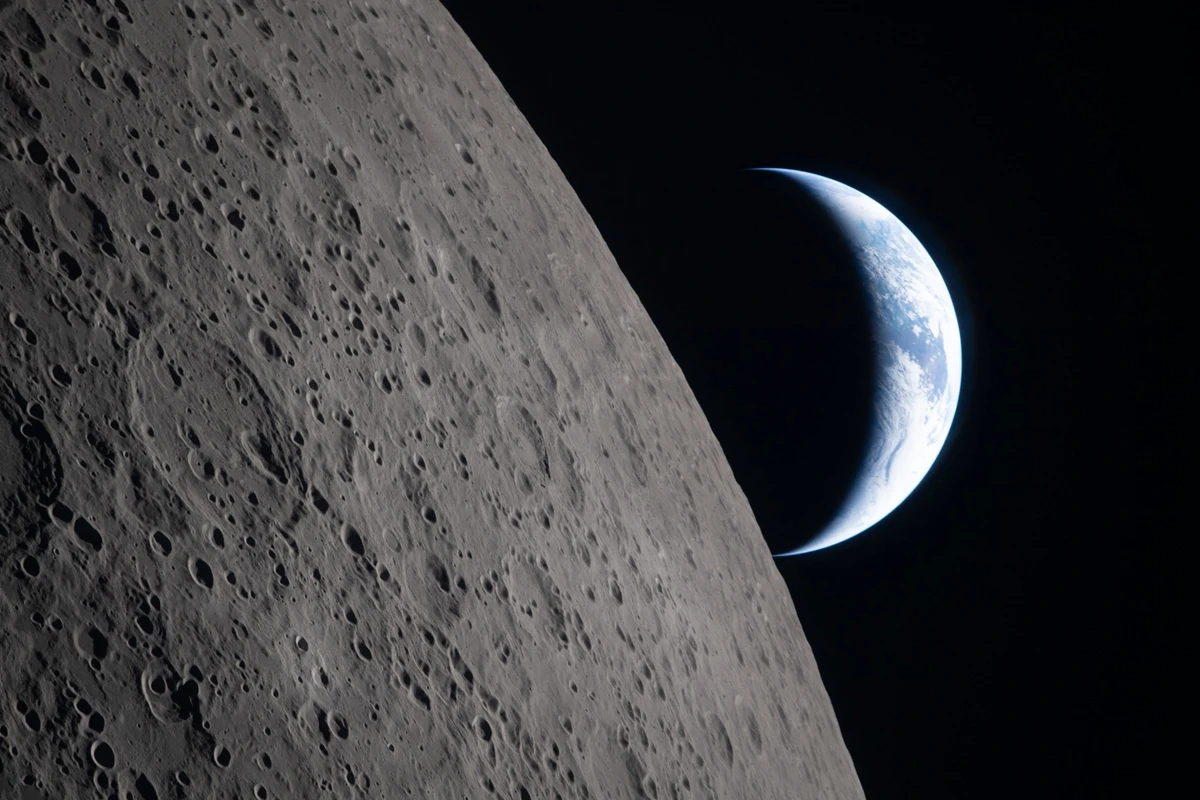

Following last month’s successful Artemis II mission, which carried four astronauts around the moon and back, NASA has now shifted its full focus to Artemis III. This is the final planned test mission before humans return to the moon. The last time a human set foot on the moon was in 1972 with the US’ Apollo 17 mission. At that time, the US was facing the Soviet Union in the Cold War. Tensions between China and the Soviets had escalated and Beijing’s rapprochement with the US, led by President Richard Nixon, had begun. The Middle East was in turmoil.
Against this backdrop, space missions were guided by a race between the US and the Soviet Union. They wanted to show their technological superiority for many reasons, including, obviously, dual-use capabilities. Although the latest phase of achievements in space — since the success of Elon Musk’s SpaceX — have been guided primarily by a commercial approach rather than great power competition, the latter has become more prominent recently. We are in a period that rhymes with the 1970s, but this time China has replaced the Soviet Union in the great power competition.
There is no doubt that this competition extends to space. Yet, while the past was also about dual-use technologies, it was also an extension of the Cold War and the two rivals proving their technological and, indirectly, moral superiority with each new breakthrough. Ultimately, the proposal known as the “Star Wars” program, announced by President Ronald Reagan, was intended as a shield against any nuclear or ballistic missile attack. It discouraged the Soviet Union in its global fight against the US. That program is now being revived as the “Golden Dome.”
The space race clearly has a real objective and target in sight: the moon. Both China and the US see the potential for settlements there to gain a clear strategic advantage.
Both China and the US see the potential for settlements on the moon to gain a clear strategic advantage
Khaled Abou Zahr
This new moon race is pushing NASA to rapidly prepare the Artemis III mission. It is planned as a crewed Earth-orbit test flight, rather than a direct moon landing. According to recent statements, the mission will focus on testing rendezvous and docking operations between NASA’s Orion spacecraft and commercial lunar landers developed by Blue Origin and SpaceX. Astronauts are expected to attempt a lunar surface mission during Artemis IV.
Artemis III is seen as a critical step to reduce technical and operational risks before returning humans to the moon’s south pole and eventually building a long-term lunar base. As with all similar missions, the agency is still refining the details, including crew assignments, mission duration, science activities and testing. This is undoubtedly a highly complex rehearsal mission that will prepare NASA and its partners for the sustained human exploration of the moon and future missions to Mars.
China is not staying on the sidelines. Expected to launch in about 2029, the current mission in preparation is Chang’e-8, which is due to investigate the presence of ice and other volatile materials at the moon’s south pole.
An interesting move, led by the Hong Kong University of Science and Technology and approved by the China National Space Administration, is the development of a robotic support vehicle for this mission. This is part of the country’s long-term strategy to build a scientific base in this region of the moon. The 100kg robot is designed to support autonomous surface operations in harsh lunar conditions, including extreme temperatures, dust, uneven terrain and limited communication.
China is increasingly focused on infrastructure development rather than mere scientific observation. This is clear as Chang’e-8 will also test technologies for using lunar resources directly on the moon, such as 3D printing, with the goal of reducing dependency on materials transported from Earth. While the US is focusing on crewed missions, China has chosen, for now, a robotic approach.
The moon’s south pole is a major target of all powers because scientists believe craters there may contain water ice
Khaled Abou Zahr
The moon’s south pole is a major target of all powers because scientists believe craters there may contain water ice, which could eventually provide drinking water, oxygen and, just as important, rocket fuel for future missions. This race is also taking place as the main conduit of global space cooperation is reaching the end of its life. The International Space Station, which has been an important focus of collaboration between all nations, will be decommissioned in 2030. This indirectly means that, for now, the mindset behind the moon missions is purely national in essence and with a competitive aspect.
China’s approach is quite similar to the one it has for the Arctic. There, it is expanding its presence through scientific research stations, satellite infrastructure and frequent icebreaker expeditions under its “Polar Silk Road” strategy. Its key bases include the Yellow River Station in Svalbard, Norway, and the China-Iceland Arctic Science Observatory, while additional influence comes from satellite ground stations, logistics investments and dual-use infrastructure in places like Greenland, combining scientific research with long-term commercial and strategic ambitions. Ultimately, it is marking its territory and establishing a long-term presence that will be difficult, if not impossible, to remove.
The US has established a framework for cooperation through the Artemis Accords, which outline the principles for peaceful and sustainable space exploration. Grounded in the 1967 Outer Space Treaty, they govern lunar and planetary activities and currently have 67 signatory nations. China has not joined this alliance and is collaborating with Russia to build the International Lunar Research Station, a joint permanent research base located at the moon’s south pole. Plans for a joint nuclear plant are even being considered, according to Chinese officials.
UN treaties indicate that no single nation can claim territories on the moon. Yet, once a country has a settlement there, even if unmanned, it does not need to claim it. It is de facto its own territory. So, is there a risk of direct confrontation between China and the US for the prime spots? And what happens a decade down the line, when there are successful settlements and ongoing activities, both commercial and military, on the moon?
If the two sides’ current plans succeed, and this is by no means guaranteed, they could both have a presence on the moon by the end of the 2030s or early 2040s. The risks are the same as on Earth and the same dynamics and rules of engagement will apply. For now, the risk is greater in the Arctic than on the moon. But what happens in one will no doubt extend to the other.
- Khaled Abou Zahr is the founder of SpaceQuest Ventures, a space-focused investment platform. He is CEO of EurabiaMedia and editor of Al-Watan Al-Arabi.


