
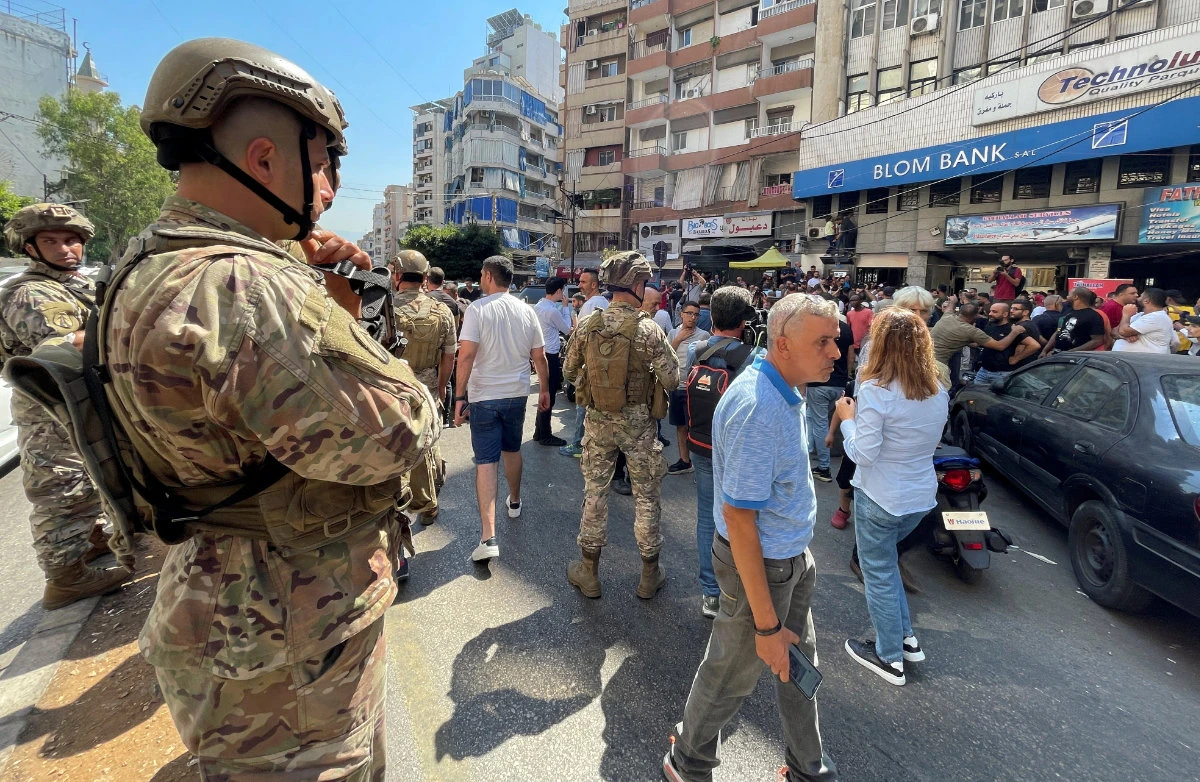

It is scarcely conceivable that ordinary citizens should be forced to conclude that their only practicable course of action is to hold up a bank, and a damning indictment of the miserable state of Lebanon that most people support them.
Sali Hafez brandished a toy pistol to extract $13,000 of her own money to save the life of a sister dying of cancer. “I previously begged the branch manager for my money, and I told him my sister was dying and didn’t have much time left,” she said. “I reached the point where I had nothing else to lose.”
After a nationwide outbreak of such incidents, including five banks held up in one day, bank staff threatened a countrywide strike and their employers decided to shut altogether for three days from Monday.
Large gatherings of protesters demanded the release of those arrested for demanding access to their own money, whereupon state prosecutor Ghassan Oueidat instructed the police to vigorously pursue everyone involved. As one journalist observed, Oueidat was “fast to act when it comes to depositors, while regarding the crimes committed by the banks as a trivial issue not deserving his attention.”
Nadim Cherfan, the choreographer who founded Mayyas, the inspirational Lebanese dance troupe that last week won America’s Got Talent, demanded: “People should break all the banks, shake up the country and turn the table over politicians' heads.”
Bank controls that prevent people from withdrawing their own savings have been in place since 2019, and rampant inflation has slashed those savings to a fraction of their previous value. Such constraints did not apply to a kleptocratic ruling class whose wholesale looting of the banking system triggered this crisis in the first place.
Domestic and societal violence, including acts of abuse against children, has hit explosive levels because of these intolerable tensions and worsening mental health. Many people survive from day to day on antidepressants. Thanks to Hezbollah’s monopoly over the narcotics trade, murderous products such as Captagon and methamphetamine are among the few goods that are cheap and readily available.
The real Lebanese resistance today is the resistance against social injustice and political dysfunction, coupled with popular and patriotic rejection of Iran’s destructive hegemonic project for the region.
Baria Alamuddin
There are thousands of excess deaths in Lebanon attributable to shortages, untreated illnesses, suicides, and drowning at sea. Just last week five children were among those drowned, after an unseaworthy vessel sank off Turkey. The politicians who have gratuitously mired Lebanon in such desperate straits should not be charged merely with negligence, or even obscene levels of theft — but rather mass murder.
This once flourishing and beautiful nation is afflicted with rampant power cuts, fuel shortages, and implosion of the medical and educational systems. The slashing of subsidies this month sent fuel prices rocketing further, prompting the quip that in today’s Lebanon only the rich can drive cars — the rest use donkeys.
According to a new UN survey, 84 percent percent of households lack the funds to cover basic essentials. Many risk getting into unsustainable debt just trying to feed themselves. The fabric of society is in shreds as an entire generation of professionals — doctors, lawyers, academics, technicians — have departed. Amid this brain drain there are also concerns about Lebanese depopulation, at a time when most families cannot afford to have more children.
The only way matters could be worse is if war were to erupt. Hezbollah is doing its upmost to bring this about. Its leader Hassan Nasrallah last week threatened military confrontation if Israel went ahead with gas extraction in disputed waters. Tensions on the Lebanon-Israel border have increased markedly. In response to reports of large volumes of Hezbollah munitions being moved around the country, the group made the unlikely assertion that these were for use in a religious festival.
Political tensions will also escalate in Lebanon as brinkmanship commences for the selection of a new president. The most hated man in Lebanon — Gebran Bassil, backed for the position by the incumbent, his father-in-law Michel Aoun — behaves ever more erratically as his support evaporates, even within his own party. Even his Hezbollah allies are hesitatant.
There are commendable efforts by the parliamentary majority to arrive at a consensus candidate, but Hezbollah would readily burn down the country to prevent a non-aligned candidate winning a two-thirds majority. As Hezbollah cracks open its favourite political gambits of bullying, bribing and blocking, it’s a sobering thought that the previous selection of a president took nearly two and a half years. In Lebanon’s politics of obscenity and farce, efforts to form a government also look like dragging on for ever.
Amid the ham-fisted state responses to the banking crisis, the anger of law-abiding citizens is palpable. Revolution is in the air — we can smell it and taste it. Hunger and desperation have removed the scales from people’s eyes. They view developments with a clarity they lacked before.
The real Lebanese resistance today is the resistance against social injustice and political dysfunction, coupled with popular and patriotic rejection of Iran’s destructive hegemonic project for the region.
The day is coming when Lebanese citizens will rid themselves of these corrupt elites once and for all —better sooner than later. This may be one of the worst crises in this troubled nation’s history, but the Lebanon we love and believe in — this endlessly creative, fecund and industrious nation — will ultimately rise phoenix-like from the ashes.
If, like Sali Hafez, out of the depths of our desperation and misery we collectively muster the courage and unity of purpose to act decisively for revolutionary change — motivated by our sincere desire to save our motherland and the people we love — that Lebanese greatness and genius can once again be ours.
• Baria Alamuddin is an award-winning journalist and broadcaster in the Middle East and the UK. She is editor of the Media Services Syndicate and has interviewed numerous heads of state.


