
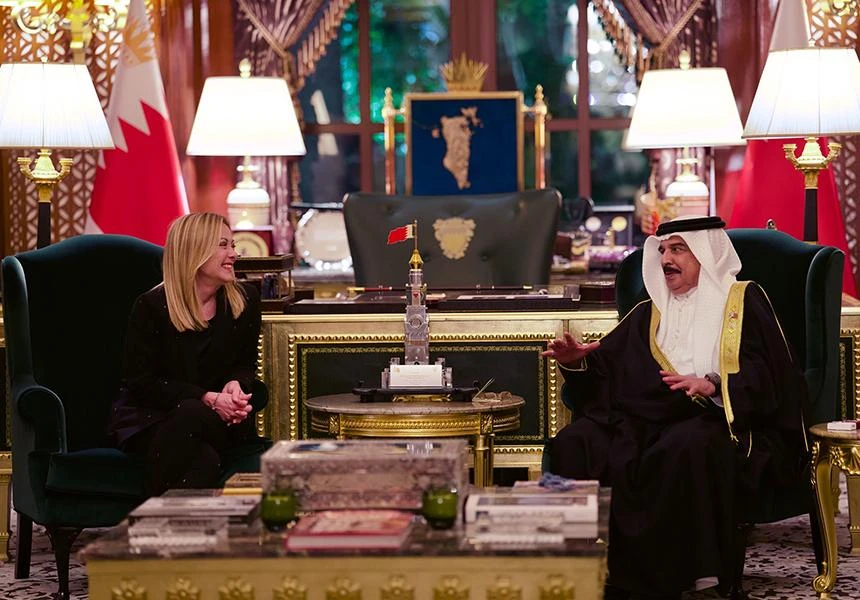

Italian Prime Minister Giorgia Meloni last week took part in the annual Gulf Cooperation Council summit in Bahrain. She said the GCC was offering a “historic opportunity” to Italy, a “nation with an ancient heart and forward-looking attitude” that is able to interact and integrate with other cultures, “yet never losing itself” — i.e., similar to GCC countries themselves.
Suggesting a new emphasis on links with the region, Meloni said that “geography and history have shaped our relationships and are destined to chart our common future.” She added that Italy “could never conceive of itself without the Mediterranean,” which “occupies only 1 percent of the world’s waters, yet it is crossed by 20 percent of the world’s maritime traffic thanks to the Suez Canal.”
She recalled ancient and extensive Roman-Arabian contacts, noting that “the Limes Arabicus (the border between the Roman Empire and the Arabian Peninsula) was not a rigid separation but a space for transit, communication and trade.” The Mediterranean and the Gulf are not “regional seas,” Meloni added, but rather can be “protagonists of major intercontinental interconnections.” Enclosing four key international passageways (the Strait of Hormuz, the Bab Al-Mandab Strait, the Suez Canal and the Strait of Gibraltar), they play an unparalleled role in international trade and security.
Meloni is seeking a “natural” GCC-Italy partnership that unites Europe and Asia. She proposed hosting a “GCC-Med” summit to create this ambitious partnership between Gulf and Mediterranean nations. She said this partnership “knows how to work on complementarities, synergies and mutual strengths,” so that it is cooperative, not adversarial. The GCC-Med forum Meloni proposes would enhance cooperation between not only Italy and the GCC, but also extend to the rest of Europe, the Middle East and North Africa.
This partnership is based on seven pillars that were discussed during the summit. The first is the India-Middle East-Europe Corridor, a US proposal endorsed by the G20 in New Delhi in 2023 to increase maritime and land connectivity, including via railroads, between the three regions. Meloni suggested Trieste, Italy’s historic northernmost port, to be the European terminus of the project, which was supported by Saudi Arabia and other countries but has been put on the back burner because of Israel’s war on Gaza. After initial hesitation, several European countries are now competing to serve as the European destination of the corridor.
Second, and equally strategic, is digital connectivity via, for example, the construction of the Blue-Raman cable system, the maritime backbone to connect India and Europe through the Arabian Peninsula and the Mediterranean.
Third is a new energy diplomacy that includes transitional energy supplies and is “more pragmatic and less ideological,” according to Meloni. Italy has recently signed energy agreements with Saudi Arabia and the UAE, in addition to its more general investment agreements with all GCC countries. The GCC has long called for measured and differentiated energy policies that are consistent with the national priorities and interests of developing countries.
Fourth is energized GCC-Italy trade and investment. At present, two-way trade is worth $35 billion annually, which is not compatible with their combined market of nearly $4.8 trillion. Investment is limited but growing with the new emphasis on energy. What can grow this pillar, Meloni said, is Italy’s policy of providing its partners with “financial instruments, know-how, industrial skills and technological capabilities in the most advanced sectors.”
Fifth involves making joint efforts on Gaza and the West Bank. Both sides support US President Donald Trump’s plan and the Sharm El-Sheikh summit, which Meloni attended and where she was warmly embraced by Trump. Considering her close relationship with Trump and Israel, Meloni is in a good position to press both on the need to move quickly to the second phase of the plan, which has been stuck in recent weeks.
Meloni is in a good position to press Israel and the US to move quickly to the second phase of the Gaza plan.
Dr. Abdel Aziz Aluwaisheg
Italy is doing its part by training Palestinian security forces and providing aid toward reconstruction, but more immediate help is needed in providing personnel for the International Stabilization Force and getting the plan unstuck.
Sixth is the relationship with Iran, with both sides supporting a diplomatic approach including the full involvement of the International Atomic Energy Agency. Italy hosted two negotiating rounds between Iran and the US and is ready to do more.
Seventh is interfaith dialogue. Meloni was quite candid discussing the tense relations between some European countries and their Muslim minorities and immigrants. She talked about an increasing “phenomenon of Islamic separatism,” which “triggers tensions that risk undermining social cohesion and fueling hostility toward Muslim minorities across Europe.”
It was somewhat unusual to speak in this manner during a summit with countries that do not send immigrants to Europe and have for decades done more than their share of fostering interfaith dialogue. Perhaps she was addressing those comments to her constituencies back home. It would be useful to have such cultural dialogue, which would be more fruitful before a wider audience, beyond GCC borders.
To translate these proposals into reality, the two sides have been working on a draft joint action plan for the next four years, which is expected to be finalized soon. It includes political and security dialogue, economic cooperation and people-to-people engagement.
The seven countries are eager to get started on their partnership to make up for lost time. The previous Italian government expressed interest in strengthening relations with the Global South, including with the Gulf, but there was little concrete progress.
Italians now recognize that being a member of the EU should not mean turning their back on thousands of years of history of engagement with their old friends and partners in the Middle East and North Africa. Meloni mentioned the Limes Arabicus but, according to historians, Roman-Arabian relations go back much further. Evidence discovered in Southern Italy showed the remnants of a Nabataean community that thrived there before the Common Era. Several Roman emperors were Arabs, a little-known fact. In Arabia, the Romans engaged with the Nabataeans extensively and built garrisons to protect trade routes on land and on islands in the Red Sea. The contacts were not always peaceful, but they had a mix of trade, war and culture.
That shared history between Italy and Arabia should make it easier to embark on this second phase of a mutually beneficial partnership.
- Dr. Abdel Aziz Aluwaisheg is the GCC assistant secretary-general for political affairs and negotiation. The views expressed here are personal and do not necessarily represent those of the GCC. X: @abuhamad1


